Pros
Cons
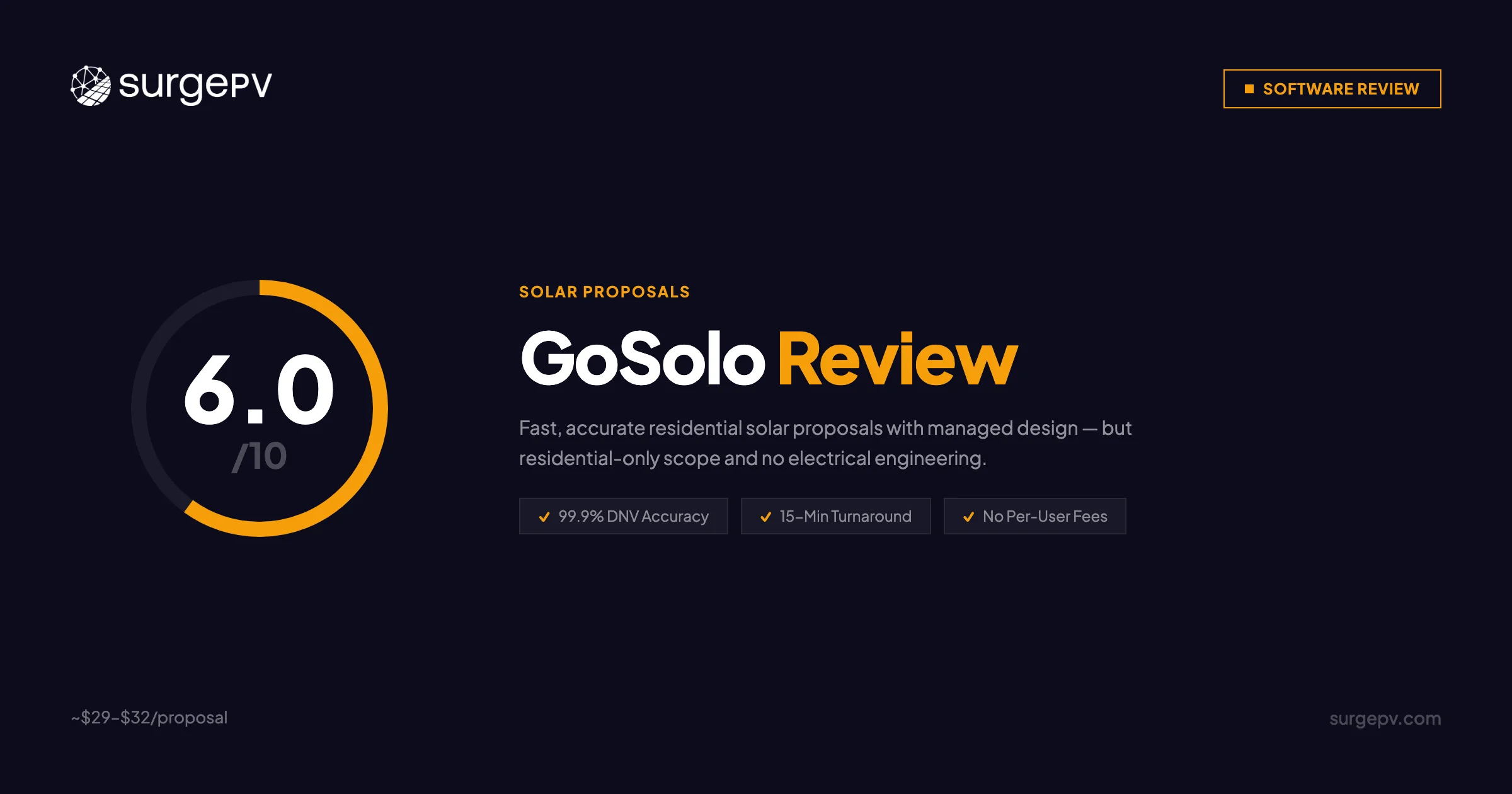
TL;DR: GoSolo is a residential solar proposal platform that generates accurate proposals in 15 minutes through a managed design service. At $29–$32 per proposal, costs reach $1,600–$8,000+/month at typical volumes. Based on internal survey data, 98% of customers report satisfaction, with praise for speed and financing integration — but the residential-only scope, absence of electrical engineering, and steep per-proposal pricing create real limits for growing teams. For residential-only sales organizations prioritizing proposal speed, GoSolo delivers. For commercial EPCs, permit-required projects, or teams that need cloud solar design software with full electrical capabilities, SurgePV offers a complete alternative at a fraction of the per-project cost.
Author: Keyur Rakholiya Title: Contributing Writer, SurgePV | MD & CEO, Heaven Green Energy Limited Expertise: 1+ GW solar projects delivered, 20+ design software platforms tested, 10+ years EPC operations Published: 2026-03-08 Last Updated: 2026-03-08 Review Methodology: Official GoSolo documentation, internal customer survey data (98% satisfaction, n=undisclosed), independent production validation study (1,899 systems), comparison of published product information
Who This Review Is For
This GoSolo review is for:
- Residential solar installers evaluating proposal software options
- Sales managers comparing per-proposal vs per-seat pricing models
- Solar companies considering managed design services vs in-house design teams
- Teams researching GoSolo alternatives for commercial expansion
- Installers in the Phoenix (PHX) market where GoSolo has local adoption
Who should skip this review:
- Pure commercial EPCs (GoSolo doesn’t serve this market)
- Teams that need permit-ready electrical documentation
- Utility-scale developers (GoSolo is residential-focused)
What Is GoSolo?
GoSolo (also marketed as “Solo”) is a sales conversion platform for residential solar installers. It combines a managed design service — where GoSolo’s own team of 25+ designers builds proposals — with DirectDesign technology that lets sales reps make real-time layout adjustments in the field.
GoSolo raised $30M in a Series B from Bregal Sagemount in September 2022, a signal of serious institutional backing in the residential proposal space. In September 2023, GoSolo acquired SolarNexus, adding CRM capabilities to the platform.
Company Background
| Detail | Info |
|---|---|
| Founded | 2018 |
| Headquarters | Lehi, Utah |
| Funding | $30M Series B (Bregal Sagemount, September 2022) |
| Employees | 299–302 |
| Revenue | $42M annually (reported) |
| Key Acquisition | SolarNexus (September 2023) — adds CRM |
| Leadership | CEO Thomas O’Keefe; founders Daniel Larkin and Jeremy Smith |
| Market claims | 10,000+ contractors, 6M+ proposals generated |
Core Value Proposition
GoSolo’s positioning is direct: get a professional, accurate solar proposal in front of a homeowner within 15 minutes of arriving at the site — without needing your own design team. The managed service model means you pay per proposal rather than maintaining headcount.
“Solo gets reps out there selling and not stuck in designing.” — GoSolo customer survey
Target Market
GoSolo serves small-to-medium residential installers with 5–50 employees who want proposal speed without maintaining an in-house design team. The Phoenix (PHX) metro area is a strong adoption market. GoSolo operates primarily in the US market.
GoSolo Pricing & License Cost
GoSolo does not use per-seat licensing. It charges per proposal, with volume discounts that kick in as monthly usage increases. This model benefits high-volume teams and penalizes lower-volume or seasonal operations.
Solo Solar Software Pricing Tiers
| Monthly Volume | Per Proposal | Est. Monthly Cost |
|---|---|---|
| 50–250 | $29–$32 | $1,450–$8,000 |
| 250–499 | $26 | $6,500–$13,000 |
| 500–999 | $23 | $11,500–$23,000 |
| 1,000–2,499 | $20 | $20,000–$50,000 |
| 2,500–4,999 | $17 | $42,500–$85,000 |
| 5,000+ | Custom | Custom |
Additional fees (not included above):
- One-time onboarding fee (amount undisclosed)
- Shade reports: contact for pricing
- DXF downloads: contact for pricing
- KBA identity verification: contact for pricing
Pricing Transparency Note
GoSolo does not publish exact per-proposal amounts publicly. The ranges above are based on reported figures from the existing review and company documentation. Request a formal quote from GoSolo’s sales team to confirm current rates for your volume tier.
Total Cost of Ownership
At 100 proposals per month — a mid-range volume for a growing residential installer — the annual cost comparison looks like this:
| Workflow | Annual Cost |
|---|---|
| GoSolo (100 proposals/month at $29–$32/proposal) | $34,800–$38,400/year |
| GoSolo + AutoCAD for permits | $36,800–$40,400/year |
| SurgePV (3 users, all-inclusive) | $4,497/year |
| Aurora Solar (standard) | ~$6,000–$8,400/year |
At 100 proposals per month, GoSolo costs roughly 8x more annually than SurgePV for a 3-person team. That gap narrows for very high-volume operations where GoSolo’s managed design service genuinely replaces headcount.
Pro Tip
Before committing to GoSolo’s per-proposal model, calculate your actual monthly proposal volume over the past 12 months including seasonal variance. A team generating 40 proposals in slow months and 120 in peak months will face unpredictable monthly costs that a flat subscription avoids entirely.
Hidden Costs
GoSolo’s pricing has several undisclosed elements:
- Onboarding fee: required, amount not disclosed
- Shade reports, DXF exports, KBA verification: all priced separately on request
- No self-service trial means you cannot evaluate before committing to onboarding
Is GoSolo Free? Free Trial Options
GoSolo does not offer a free tier or self-service trial. Getting started requires a sales demo and onboarding call, plus a one-time onboarding fee. This is different from OpenSolar (free tier available) or SurgePV (demo available with no upfront commitment).
If cost is a concern, OpenSolar offers a free tier for basic residential proposals. For teams that need speed and accuracy comparable to GoSolo at a predictable flat rate, SurgePV’s subscription model at $1,499/user/year includes proposal generation as part of the full platform.
Core Features & Capabilities
Managed Design Service
GoSolo’s core differentiator is its 25+ in-house designer team. Submit a project address and system specs, and GoSolo returns a complete proposal — typically within 15 minutes. This eliminates the need to hire, train, and manage your own design team.
GoSolo cites $50,000–$80,000 savings per designer not hired as the value case. For a 5-person sales team without design expertise, this math can work out in GoSolo’s favor compared to hiring.
The trade-off: you give up design control. If a homeowner wants to see multiple layout options or a custom configuration, the revision cycle goes through GoSolo’s team rather than being made instantly by your own staff.
DirectDesign Technology
DirectDesign lets sales reps adjust panel layouts in real time — adding or removing panels, changing configurations — without submitting a revision request to the design team. This is a meaningful capability for in-home sales calls where a homeowner pushes back on system size or wants to see a smaller configuration on the spot.
GoSolo positions this as “rep empowerment.” In practice, it gives frontline salespeople a degree of design flexibility without requiring engineering knowledge.
Production Accuracy
GoSolo claims DNV-certified 99.9% production accuracy. An independent study covering 1,899 installed systems confirmed 97% accuracy compared to actual measured output. SolarInsure backs this with a 95% first-year production guarantee for eligible systems.
For residential sales purposes, this accuracy level is solid. For bankable commercial projects requiring P75 or P90 production estimates, GoSolo only provides P50 metrics — which is inadequate for project financing and not a use case GoSolo targets.
Solar Proposal Features
GoSolo proposals include:
- Interactive visuals with media and energy offset graphs
- Lifestyle-oriented content designed for homeowner engagement
- Integrated financing: instant credit qualification, lender documents, e-signing, real-time rate information
- Custom adders including NEM 3.0-compatible battery solutions
- Mobile-responsive delivery for tablet and phone presentation
Financing lenders integrated: GoodLeap, LightReach, Sungage, Dividend, Sunlight Financial, Mosaic, Sunnova.
CRM Capabilities
Following the SolarNexus acquisition in 2023, GoSolo now includes:
- Lead management with milestone tracking
- Kanban-style pipeline view
- Customer engagement tools
- Project installation tracking
- Proposal design within the CRM workflow
This makes GoSolo more competitive with platforms like Arka360 that have built-in CRM. Previously, GoSolo required external CRM integrations.
Integrations
GoSolo connects with 70+ tools via open API, webhooks, and native integrations:
| Category | Partners |
|---|---|
| Financing | GoodLeap, LightReach, Sungage, Dividend, Sunlight Financial |
| CRM | Salesforce, HubSpot, Zoho, SolarNexus, JobNimbus |
| Field Sales | SalesRabbit, SPOTIO |
| Document Signing | DocuSign, SoloSign |
| Automation | Zapier, Open API, WebHooks |
| Imagery | Nearmap |
The open API and webhook support are well-designed for teams with custom tech stacks. Trigger events for milestone-based automation allow GoSolo to fit into existing workflows without requiring a full platform replacement.
Need More Than Proposals? See the Full Platform.
SurgePV handles design, electrical engineering, proposals, and permit documentation in one tool — starting at $1,499/user/year.
Book a DemoNo commitment required · 20 minutes · Live project walkthrough
GoSolo Solar Proposal Software: What It Can and Cannot Do
GoSolo is purpose-built for the residential sales proposal workflow. Understanding its exact scope prevents mismatched expectations.
Electrical Engineering Capabilities
| Capability | GoSolo | SurgePV |
|---|---|---|
| SLD Generation | No | Yes (automated, 5–10 min) |
| Wire Sizing | No | Yes (automatic) |
| Conduit Sizing | No | Yes (automatic) |
| Voltage Drop Analysis | No | Yes (NEC compliant) |
| Permit-Ready Output | No | Yes |
GoSolo does not generate any electrical documentation. It cannot produce Single Line Diagrams, wire sizing calculations, or permit packages. Installers that operate in jurisdictions requiring permits must use a separate tool — which adds cost and workflow complexity to the GoSolo model.
Commercial Capabilities
| Capability | GoSolo | SurgePV |
|---|---|---|
| Residential | Yes | Yes |
| Commercial (100 kW+) | No | Yes |
| Carport Solar | No | Yes |
| Solar Trackers | No | Yes (single/dual-axis) |
| East-West Racking | No | Yes |
| Ground Mount | Limited | Yes |
GoSolo is residential-only. A team that handles both residential and any commercial work cannot use GoSolo as its primary solar design tools. That forces either a second platform subscription or a switch to a full-service tool.
User Reviews & Feedback
GoSolo has limited third-party review coverage. The platform does not have substantial G2 or Capterra profiles with verifiable scores. The primary satisfaction data comes from GoSolo’s own internal survey, which reports a 98% positive opinion rating.
Top Praised Features
| Rank | Feature | Source |
|---|---|---|
| 1 | Proposal speed (15 minutes) | Customer survey, testimonials |
| 2 | DNV-certified production accuracy | Independent validation study |
| 3 | No per-user fees | Competitive comparison mentions |
| 4 | Financing integration depth | Customer testimonials |
| 5 | DirectDesign real-time adjustments | Product documentation |
Top Criticisms
| Rank | Issue | Source | Severity |
|---|---|---|---|
| 1 | Software quality issues (bugs, “Buggy Click Art, Zero Value”) | Third-party reviews | ⚠️ HIGH |
| 2 | Residential-only limitation creating growth ceiling | User feedback | ⚠️ HIGH |
| 3 | Per-proposal pricing scales steeply | Cost analysis | ⚠️ HIGH |
| 4 | No design control (managed service dependency) | User feedback | Medium |
| 5 | No self-service trial access | Sales process | Medium |
One third-party reviewer described the experience as “Buggy Click Art, Zero Value” and cited “Zero contract process or design process.” This level of criticism from actual users, combined with the absence of verifiable G2 reviews, makes independent validation of GoSolo’s claims difficult.
“Solo gets reps out there selling and not stuck in designing.” — GoSolo customer survey
The 98% satisfaction figure is notable but comes from GoSolo’s own survey with an undisclosed sample size and methodology. Third-party review platforms would provide stronger validation.
Pros & Cons
Pros
1. DNV-Certified 99.9% Production Accuracy
The accuracy claim is independently validated. An external study across 1,899 systems confirmed 97% actual vs estimated production. SolarInsure backs it with a 95% first-year guarantee. For residential homeowner presentations, this accuracy level builds confidence and reduces post-installation disputes.
2. 15-Minute Managed Proposal Turnaround
GoSolo’s 25+ in-house designers deliver proposals fast. For door-to-door or in-home sales teams that need a professional proposal on the spot, this speed is the core value proposition. Teams without design staff can close same-day without a design bottleneck.
3. No Per-User Fees — Unlimited Team Members
The per-proposal pricing model means adding a new sales rep costs nothing in software licensing. A team growing from 5 to 25 reps pays only for the proposals generated, not the headcount. This scales naturally with a fast-growing sales organization.
4. Integrated Financing with 7+ Lenders
GoodLeap, LightReach, Sungage, Dividend, and Sunlight Financial are all built in. Instant credit qualification, lender documents, and e-signing happen within the proposal flow — not as a separate step. For residential sales, this removes friction at the close.
5. DirectDesign Real-Time Adjustments
Sales reps can modify panel layouts in the field without waiting for a revision from the design team. This is a genuine workflow improvement for in-home presentations where the system size needs to change mid-conversation.
6. 70+ Integrations with Open API
The integration network is wide. JobNimbus, SalesRabbit, SPOTIO, Zapier, and DocuSign are all connected. The open API and webhooks make GoSolo composable within a larger tech stack without requiring a full platform replacement.
Cons
1. Residential-Only — Zero Commercial Capability ⚠️ CRITICAL
GoSolo does not support commercial solar of any kind. No projects above residential scale, no carports, no trackers, no East-West racking. A team that wants to expand beyond residential has no path forward with GoSolo — they have to switch platforms entirely.
2. No Electrical Engineering — Not Permit-Ready ⚠️ CRITICAL
GoSolo generates zero electrical documentation. No SLDs, no wire sizing, no conduit fill, no voltage drop. In jurisdictions that require permit packages (most US markets above 10 kW), GoSolo users need a second tool. This adds $1,500–$2,000/year in software costs plus manual time per project.
3. Per-Proposal Pricing Scales Steeply
At 100 proposals per month, GoSolo costs $34,800–$38,400 per year. At 200 proposals per month, that’s $60,000–$70,000. A 3-user SurgePV subscription handles the same volume for $4,497/year. The gap is hard to justify unless GoSolo’s managed service is genuinely replacing headcount.
4. Managed Service Creates Design Dependency
Control of the design process sits with GoSolo’s team. For clients with specific layout requirements, complex roof geometries, or mid-call revision needs, this creates delay. DirectDesign partially addresses this, but complex changes still go through the GoSolo team.
5. No Self-Service Trial ⚠️ HIGH (operational risk)
Evaluating GoSolo requires a sales demo and onboarding commitment with an undisclosed fee. You cannot test the platform before paying. This is an unusual barrier compared to most solar software alternatives.
6. Limited Independent Review Coverage
GoSolo’s 98% satisfaction figure is self-reported. Third-party review platforms show sparse coverage. The absence of verifiable G2 scores with specific feature breakdowns makes it harder to benchmark GoSolo against competitors using independent data.
GoSolo vs SurgePV
Both GoSolo and SurgePV serve solar installers, but they operate in different segments. GoSolo is a residential proposal tool. SurgePV is a full-platform PV design software covering design, simulation, electrical engineering, proposals, and permit documentation.
Feature Comparison
| Feature | GoSolo | SurgePV | Winner |
|---|---|---|---|
| Residential proposals | Yes (managed, 15 min) | Yes (self-service, 30–45 min) | GoSolo (speed) |
| Commercial design | No | Yes (100 kW–10 MW) | SurgePV |
| Carport solar | No | Yes (only platform) | SurgePV |
| Solar trackers | No | Yes (single/dual-axis) | SurgePV |
| SLD generation | No | Yes (automated, 5–10 min) | SurgePV |
| Wire sizing | No | Yes (automatic) | SurgePV |
| Permit-ready output | No | Yes | SurgePV |
| Production accuracy | 99.9% DNV-certified | ±3% vs PVSyst (documented) | Tie |
| Financing integration | 7+ lenders built in | Integrates with lenders | GoSolo |
| Per-user fees | None (per-proposal) | Per-user subscription | GoSolo (for large teams) |
| India market | No (US-only) | Yes (India + US) | SurgePV |
| Pricing at 100 proposals/month | $34,800–$38,400/year | $4,497/year (3 users) | SurgePV |
| CRM | Yes (via SolarNexus) | Integrates with existing CRM | GoSolo |
Workflow Time Comparison (100 kW Commercial Project)
| Step | GoSolo | SurgePV |
|---|---|---|
| Roof design | Not supported | Included |
| Shading simulation | Not supported | Included |
| SLD generation | Not supported | 5–10 min (automated) |
| Proposal | 15 min (managed) | 30–45 min (self-service) |
| Permit package | Requires separate tool | Included |
| Total | Cannot complete | 45–60 min |
Annual Cost Comparison (100 Proposals/Month)
| Option | Annual Cost |
|---|---|
| GoSolo (100 proposals/month at ~$29–$32) | $34,800–$38,400 |
| GoSolo + AutoCAD for permits | $36,800–$40,400 |
| SurgePV (3 users) | $4,497 |
| Annual savings with SurgePV | $30,303–$33,903 |
Where GoSolo Wins
GoSolo has a genuine speed advantage for residential proposals through managed service. Sales teams without design expertise get professional proposals in 15 minutes without maintaining design headcount. If GoSolo’s managed service is genuinely replacing two or three designer salaries, the per-proposal cost can make economic sense at high volumes.
Financing integration is deeper than most competitors. Having GoodLeap, LightReach, and Sungage credit qualification and document signing inside the proposal flow removes the friction of switching between tools at close.
Where SurgePV Wins
SurgePV covers everything GoSolo cannot: commercial design, electrical engineering, permit-ready documentation, carport and tracker support, and international markets. The per-project cost at scale is a fraction of GoSolo’s per-proposal model. For any team that does commercial work — even occasionally — or that needs permit packages, SurgePV is the complete solution.
See our solar proposals feature overview for a detailed look at what a full-platform approach delivers.
GoSolo Alternatives
SurgePV
The strongest GoSolo alternative for teams that need more than residential proposals. SurgePV handles design, solar shading analysis, electrical engineering, and solar proposals in one platform. Pricing starts at $1,499/user/year — substantially lower than GoSolo at typical proposal volumes. Best for: commercial EPCs, teams needing permit-ready electrical documentation, and installers expanding beyond residential.
Aurora Solar
Aurora is the established residential and commercial solar design platform. It offers self-service design tools, production simulation, and proposal generation at per-seat pricing. Aurora has stronger commercial capabilities than GoSolo and deeper independent review coverage. Best for: residential teams that want self-service design control rather than managed service.
OpenSolar
OpenSolar offers a free tier for basic residential design and proposals, making it the entry point for cost-sensitive installers. It lacks GoSolo’s managed service speed but removes the per-proposal cost model entirely. Best for: early-stage installers or solo operators not yet at volume to justify GoSolo’s pricing.
Arka360
Arka360 combines design, proposals, and built-in CRM with competitive pricing starting at $199/month. It is India-focused but supports US markets. Best for: residential installers who want an all-in-one platform with native CRM at a flat subscription rate.
HelioScope
HelioScope is an engineering-grade simulation and design platform — the opposite direction from GoSolo. Where GoSolo optimizes for sales speed, HelioScope optimizes for technical accuracy in production modeling. Best for: commercial engineers and EPCs who need bankable simulation output.
Solargraf
Solargraf (by Enphase) offers proposal generation with direct integration into Enphase system design. Best for: Enphase-aligned installers who want tight hardware-software integration in the proposal workflow.
Who Should Use GoSolo?
GoSolo Is Right For:
1. Residential-only sales organizations Teams that do exclusively residential work and have no plans to enter commercial. GoSolo’s scope matches this use case exactly. Adding a commercial project would require a platform switch.
2. Door-to-door and in-home sales teams Sales teams that present and close at the homeowner’s kitchen table need a proposal fast. GoSolo’s 15-minute turnaround and DirectDesign for real-time adjustments match this workflow directly.
3. High-volume residential installers without an in-house design team Teams generating 200+ proposals per month without a design department. At that volume, GoSolo’s managed service can replace 1–3 designer salaries. The per-proposal math becomes more defensible as volume increases.
4. Phoenix (PHX) market installers GoSolo has established adoption in the Phoenix metro market and regional network effects are real. Local references and familiar integration partners are in place.
5. Teams prioritizing financing integration If getting GoodLeap or Sungage financing approved at close — inside the proposal — is the top priority, GoSolo’s financing depth is hard to beat among residential proposal tools.
GoSolo Is Wrong For:
1. Any commercial work If even 10% of your pipeline is commercial — schools, warehouses, municipalities — GoSolo cannot serve that work. You’ll need a second platform.
2. Permit-required markets Most US markets above 10 kW residential require permit packages. GoSolo generates none of the required documentation. You need a second tool, which adds cost and workflow steps.
3. Budget-conscious growing teams At 50–100 proposals per month, GoSolo costs $18,000–$38,400 per year. SurgePV at $4,497 for 3 users handles the same volume and adds commercial design, electrical engineering, and permit documentation.
4. International operations GoSolo is US-market-only. Teams serving India, Europe, or other markets need a platform with broader geographic coverage.
Frequently Asked Questions
What is GoSolo solar software?
GoSolo is a residential solar sales proposal platform headquartered in Lehi, Utah. Founded in 2018 and backed by $30M from Bregal Sagemount, it serves 10,000+ solar contractors and has generated over 6 million proposals. GoSolo combines a managed design service — 25+ in-house designers producing proposals in under 15 minutes — with DNV-certified 99.9% production accuracy and integrated financing from 7+ lenders. GoSolo is residential-only and does not support commercial design or electrical engineering.
How much does GoSolo cost? (Solo solar software pricing)
GoSolo charges per proposal rather than per seat. The rates are approximately $29–$32 per proposal at 50–250 proposals per month (roughly $1,450–$8,000/month), dropping to $23 at 500–999 proposals per month and $20 at 1,000–2,499 proposals per month. A one-time onboarding fee applies at sign-up, though the amount is not publicly disclosed. There is no free trial; getting started requires a sales demo.
Can GoSolo handle commercial solar projects?
No. GoSolo is designed exclusively for residential solar. It does not support commercial design above residential scale, carport solar, trackers, East-West racking, or any electrical engineering output. Teams with commercial work need a different platform — SurgePV, Aurora Solar, or HelioScope are the main alternatives.
Does GoSolo generate permit-ready documentation?
No. GoSolo does not generate Single Line Diagrams, wire sizing calculations, conduit fill calculations, or voltage drop analysis. It is a sales proposal tool, not an electrical engineering platform. In jurisdictions that require permit packages, GoSolo users must use a separate tool to generate permit documentation.
Is GoSolo accurate for production estimation?
GoSolo holds DNV-certified 99.9% production accuracy. An independent validation study across 1,899 systems confirmed 97% accuracy versus actual measured production. SolarInsure backs this with a 95% first-year production guarantee. GoSolo provides P50 estimates only — not P75 or P90 — which limits its use for bankable or project-financed commercial work.
Does GoSolo offer a free trial?
No. GoSolo requires a sales demo and charges a one-time onboarding fee to get started. There is no self-service trial. OpenSolar offers a free tier as an alternative for installers who want to evaluate a tool before committing to any cost.
What are the best GoSolo alternatives?
The top alternatives to GoSolo are:
- SurgePV — full platform with design, electrical engineering, and proposals at $1,499/user/year
- Aurora Solar — established residential and commercial design with self-service tools
- OpenSolar — free tier for small residential installers
- Arka360 — India and US market platform with built-in CRM at $199/month
- HelioScope — engineering-grade simulation for commercial EPCs
Final Verdict
GoSolo Executive Summary
Strengths:
- 99.9% DNV-certified production accuracy (independently validated)
- 15-minute managed proposal turnaround through 25+ in-house designers
- No per-user fees — scales with proposal volume, not headcount
- Financing integration with 7+ lenders inside the proposal workflow
- DirectDesign for real-time rep adjustments in the field
- 70+ integrations with open API
Limitations:
- Residential-only — zero commercial capability
- No electrical engineering — not permit-ready in any jurisdiction
- Per-proposal pricing reaches $34,800–$38,400/year at 100 proposals/month
- Managed service removes design control from your team
- No self-service trial before committing
- Limited third-party review data for independent validation
The Decision Framework
Choose GoSolo when:
- 100% residential-only portfolio with no commercial plans
- High monthly proposal volume where managed service replaces design headcount
- Door-to-door or in-home sales team prioritizing speed at close
- Financing integration at the point of sale is the top priority
- You are operating in US market only and have budget for premium per-proposal pricing
Choose SurgePV when:
- Any commercial work is in your pipeline (now or planned)
- Permit-ready electrical documentation is required
- You need PV design software with full engineering capabilities
- Cost efficiency at scale matters — SurgePV is 8x cheaper at 100 proposals/month
- India + US market operations or international expansion is planned
- Design control and customization are required
Value Analysis
GoSolo’s per-proposal model makes economic sense in one specific scenario: a high-volume residential sales organization where GoSolo’s managed design service is genuinely replacing in-house design staff. If GoSolo eliminates two designer positions at $50,000–$80,000 each, the math works even at $35,000/year in proposal fees.
Outside that scenario, the numbers are hard to defend. At 100 proposals per month, GoSolo costs roughly $35,000–$38,000 per year. SurgePV at $4,497 for three users handles the same volume, adds commercial design, electrical engineering, permit documentation, and leaves $30,000+ on the table.
For residential-only teams that are growing fast and prioritize sales speed over engineering depth, GoSolo delivers what it promises. For teams that need a complete solar PV design software platform — including permit documentation, commercial capabilities, and predictable annual pricing — SurgePV is the better investment at virtually every volume level.
| Scenario | Best Choice |
|---|---|
| Residential-only, high volume, no design team | GoSolo |
| Residential with occasional commercial | SurgePV |
| Commercial EPCs (100 kW+) | SurgePV |
| Permit-required markets | SurgePV |
| Budget-conscious growing teams | SurgePV |
| Phoenix market, door-to-door sales | GoSolo worth evaluating |
Take the Next Step
See how SurgePV compares on the features GoSolo cannot cover:
- Book a demo — See SurgePV’s electrical engineering and proposal tools in one walkthrough
- View pricing — Flat per-user pricing vs GoSolo’s per-proposal model
- Solar proposal generation — How full-platform proposals differ from managed design
- Shadow analysis software — Production accuracy without a managed service dependency
- Generation and financial tool — ROI modeling for residential and commercial projects
Related Resources
Platform Comparisons:
- Arka360 Review — All-in-one platform with built-in CRM at lower per-proposal cost
- Best Solar Software — Complete platform comparison guide
Feature Deep Dives:
- Solar Proposals — Full-platform proposal generation vs managed service
- Shadow Analysis — Shading accuracy for residential and commercial
- Generation and Financial Tool — ROI and payback modeling
This GoSolo review was written by Keyur Rakholiya, Contributing Writer at SurgePV and MD & CEO of Heaven Green Energy Limited, using the cited public sources. All claims about SurgePV are verified against official product documentation. GoSolo information is sourced from official GoSolo documentation (gosolo.io), an independent production validation study (1,899 systems), and GoSolo’s published customer survey data. We disclose that SurgePV publishes this review and disclose our company affiliation transparently.
Review published: 2026-03-08 | Next review: June 2026
About the Contributors

Co-Founder · SurgePV
Nirav Dhanani is identified by SurgePV as a company co-founder. His SurgePV author page lists only role information that can be tied to the public profile below; credentials, project totals, conversion results, and market-expansion claims are not asserted without retained evidence.

Editorial contributor · SurgePV
Rainer Neumann is credited as an editorial contributor on SurgePV content. This profile does not assert engineering credentials, project totals, software-testing experience, education, speaking engagements, or media citations because independent verification evidence is not retained in the publication record.
