Solar panel efficiency has improved from 6% in Bell Labs' first commercial cells in 1954 to 24%+ in today's best TOPCon modules. That progress didn't happen in a straight line - it came through distinct technology generations, each replacing or complementing the last. We're now at another inflection point. Perovskite tandem cells have broken the single-junction silicon efficiency barrier in the lab. Whether they can do it commercially - reliably, at scale, with 25-year warranties - is the question that will define solar technology in the second half of this decade. For background, see our blog post on perovskite solar cells.
What you'll learn in this chapter
- The Shockley-Queisser limit and why it constrains single-junction silicon panels
- The full silicon technology roadmap from BSF through TOPCon, HJT, and IBC
- What perovskite is, why its bandgap is tunable, and why that matters for tandems
- The three main challenges preventing commercial perovskite modules in 2026
- How tandem cells physically break the single-junction efficiency ceiling
- Other next-generation technologies: quantum dots, OPV, CPV
- What to specify today - and why waiting for perovskite is the wrong call
Why Solar Technology Keeps Improving
The photovoltaic effect converts photons into electricity, but no solar cell captures all available photon energy. Single-junction silicon cells are bounded by what physicists William Shockley and Hans-Joachim Queisser calculated in 1961: a maximum theoretical efficiency of 33.7% for silicon's bandgap of 1.1 eV. This is the Shockley-Queisser limit.
The limit exists because of two unavoidable losses. Photons with energy below the bandgap pass straight through the cell without being absorbed. Photons with energy above the bandgap are absorbed, but the excess energy is lost as heat rather than converted to electricity. Silicon's bandgap of 1.1 eV is well-matched to the solar spectrum, which is why silicon became the dominant material - but it still leaves a substantial fraction of available solar energy on the table.
Today's best commercial silicon panels sit at 22–24% efficiency. That's close to but not at the Shockley-Queisser limit. The remaining gap between 24% and 33.7% is the engineering challenge that drives continued silicon cell development. Beyond that ceiling, tandem configurations using multiple junctions with different bandgaps can capture more of the spectrum and theoretically exceed 40% efficiency.
The economic incentive is direct. Each 1% absolute efficiency improvement means more power from the same roof area. For a typical residential roof with space for 20 panels, moving from 22% to 23% efficiency adds roughly 70–80 Wp of capacity without additional hardware. Across millions of installations, those gains compound into significant cost reductions in balance-of-system components - fewer panels, less racking, fewer connections, less cable - for the same energy output.
Key Takeaway
The Shockley-Queisser limit of 33.7% is not a physical barrier to all solar cells - only to single-junction silicon cells. Tandem configurations using two or more absorber layers with different bandgaps can exceed this limit by capturing more of the solar spectrum. Perovskite's tunable bandgap is what makes it the leading candidate for the top cell in silicon tandem systems.
The Silicon Technology Roadmap
Solar panel technology has progressed through distinct generations, each building on the last. Understanding where each technology sits helps you make sense of the commercial landscape and where perovskite fits into it.
PERC dominated the market from roughly 2015 to 2022 by adding a passivation layer on the rear of the cell to reduce recombination losses - a relatively simple manufacturing addition that squeezed 1–2% absolute efficiency gain from existing silicon cell lines. TOPCon took that further by replacing the aluminum back-surface field with a tunnel oxide and polysilicon passivating contact, delivering another 2–3% over PERC. TOPCon is now the dominant technology shipped by major manufacturers including Trina, Longi, and JA Solar.
HJT (Heterojunction Technology) takes a different approach: a thin-film amorphous silicon layer deposited on a crystalline silicon wafer creates an exceptionally well-passivated junction. HJT panels have among the lowest temperature coefficients commercially available - an important advantage in hot climates - and slightly higher efficiency than TOPCon, but at higher manufacturing cost. They are the premium choice for space-constrained applications.
Back-contact IBC cells (used by SunPower/Maxeon) move all contacts to the rear of the cell, eliminating shading from front-side busbars and allowing maximum light absorption. They achieve the highest efficiencies available in commercial silicon modules at up to 24.5%, though at the highest price point.
What Is Perovskite?
Perovskite is a crystal structure - not a single material, but a family of materials sharing the same ABX₃ arrangement. In photovoltaic applications, A is typically an organic cation (methylammonium or formamidinium), B is lead, and X is a halide (iodide, bromide, or chloride). The specific combination determines the material's optical and electronic properties.
What makes perovskite valuable for solar is the tunable bandgap. By adjusting the chemical composition - substituting different halides or cations - the material's bandgap can be shifted across a wide range of the solar spectrum, from roughly 1.2 eV to 2.3 eV. Silicon's bandgap is fixed at 1.1 eV. This tunability is what enables the most promising application of perovskite in solar energy: the tandem cell.
A perovskite cell formulated with a bandgap of approximately 1.7 eV absorbs high-energy (short-wavelength) photons effectively, passing lower-energy photons through to a silicon cell below. The silicon cell absorbs those lower-energy photons. Together, the two absorber layers capture a substantially wider range of the solar spectrum than silicon alone - and therefore convert more of the available sunlight into electricity.
The manufacturing cost potential is the other driver of interest. Lead halide perovskite can be deposited from solution at relatively low temperatures, using processes that could potentially be far cheaper than the high-temperature vacuum processes required for crystalline silicon. Whether this cost advantage survives the sealing and encapsulation requirements needed for durability remains an open question, but it is why hundreds of research groups and multiple major manufacturers have been pursuing the technology intensively since 2012.
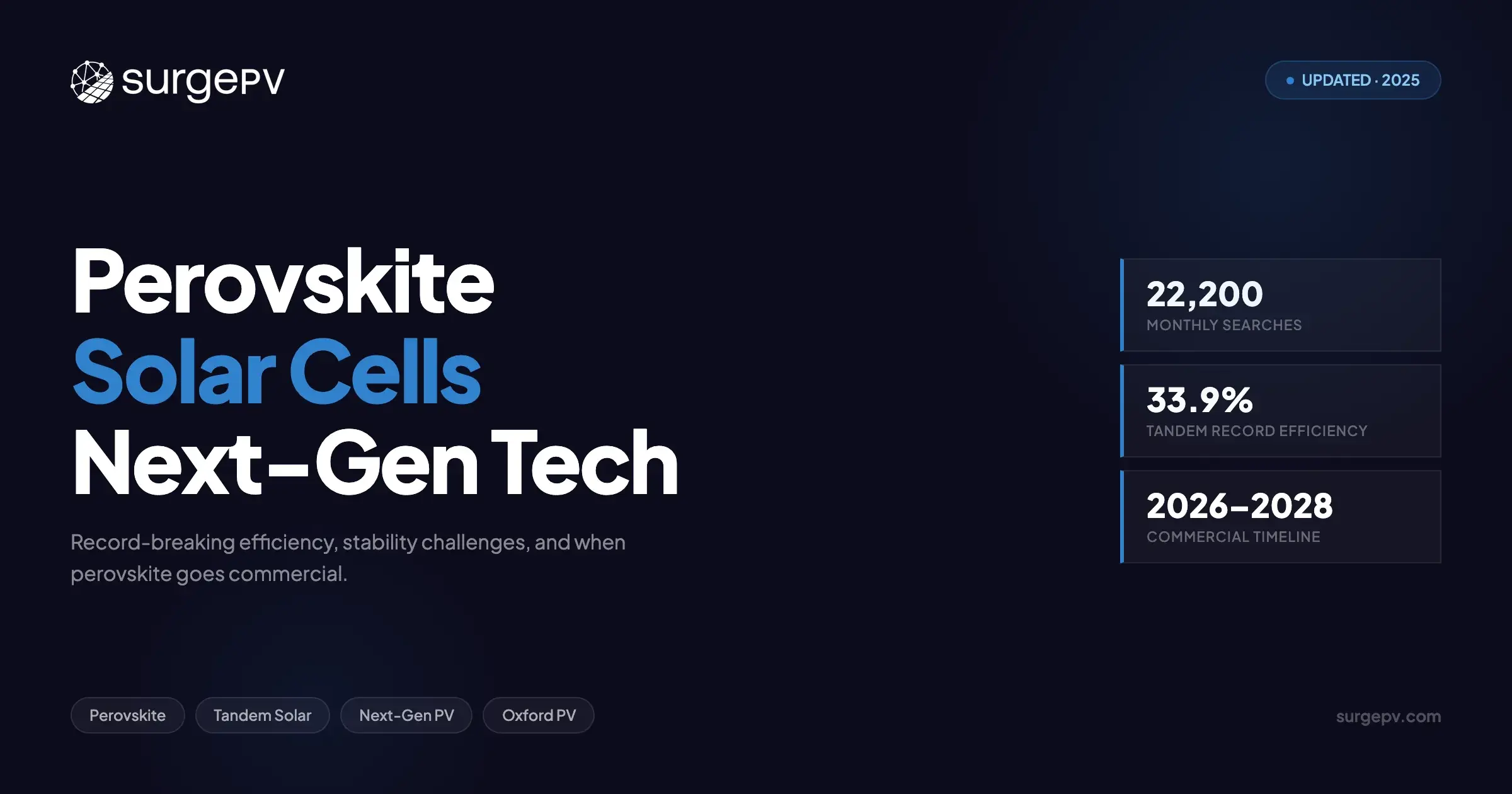
In 2024, Oxford PV achieved a perovskite-silicon tandem cell efficiency of 33.9% - a world record that exceeded the theoretical single-junction silicon limit of 33.7%. This confirmed what the physics had predicted: tandem configurations can break the single-junction ceiling.
Perovskite efficiency milestones vs silicon
| Technology | Best Lab Efficiency | Best Commercial Efficiency | First Reported | Status (2026) |
|---|---|---|---|---|
| Silicon (PERC mono) | 24.5% | 22.3% | 1954 (Bell Labs) | Mass market |
| Silicon (TOPCon) | 26.0% | 23.8% | 2013 (Fraunhofer) | Mass market (2022+) |
| Silicon (HJT) | 26.7% | 24.5% | 1992 (Sanyo/Panasonic) | Premium market |
| Single-junction perovskite | 26.1% | N/A | 2012 (Park et al.) | Research / pilot |
| Perovskite-silicon tandem | 33.9% (Oxford PV, 2024) | N/A | 2015 (Bailie et al.) | Pre-commercial (target 2026–2028) |
| III-V triple junction | 47.6% (concentrated) | ~40% (concentrated) | 1994 (NREL) | Space / CPV only |
The Challenges Stopping Commercial Perovskite Now
Despite the impressive lab records, no major manufacturer offers commercial perovskite solar modules in 2026. Three interconnected challenges explain why.
Stability under real-world conditions
Silicon solar cells are extraordinarily durable. Deployed modules routinely demonstrate less than 0.5% annual power degradation under combined heat, humidity, and UV exposure over decades. Perovskite cells degrade substantially faster in the same conditions. Heat causes decomposition of the organic cation. Moisture penetrates the lattice and degrades cell performance. UV light triggers photochemical degradation. Laboratory cells are tested in controlled conditions; the combination of these stresses in outdoor deployment is significantly harsher.
Progress has been rapid. In 2012, perovskite cells lasted hours in ambient conditions. By 2026, advanced encapsulation strategies and more stable inorganic-organic hybrid formulations have extended lab lifetimes to thousands of hours under accelerated testing. But "thousands of hours under IEC accelerated aging" is not the same as "25 years of guaranteed outdoor performance" - and the gap between those two standards is what the commercial market requires.
Lead content and regulation
The most efficient perovskite formulations use lead as the B-site cation. Lead is a regulated substance under the EU's RoHS directive, which restricts hazardous substances in electrical and electronic equipment. While solar panels currently have an exemption, future regulatory changes and the general direction of EU environmental policy create commercial risk. Lead-free perovskite alternatives - using tin or bismuth as the B-site - have been demonstrated, but with efficiency penalties. Research on stabilizing lead-free perovskite without sacrificing performance is ongoing but unresolved.
Scaling from lab cell to commercial module
The world-record efficiency of 33.9% was achieved on a cell area of approximately 1 cm². A commercial solar module uses cells covering 1.6–2 m² in total area. As perovskite cell area increases, maintaining uniformity in the deposited film becomes harder, and efficiency drops. This area-scaling problem affects every thin-film solar technology and is a known engineering challenge, but it requires manufacturing process development that takes years to resolve at commercial scale.
The sealing requirement compounds the scaling challenge. Perovskite cells require more sophisticated encapsulation than silicon to prevent moisture ingress - the material is more sensitive to water than silicon, which has been deposited and sealed at commercial scale for decades. Developing encapsulation that adds acceptable cost and weight while providing genuine 25-year moisture barriers at module scale remains an active area of industrial R&D.
Current Commercial Status (2026)
No major commercial perovskite solar modules are available for sale in 2026. Oxford PV, LONGi, and Hanwha Q CELLS are among the companies that have publicly targeted 2026–2028 for initial commercial perovskite-silicon tandem product launches. Initial commercial products will likely be premium, relatively expensive, and in limited quantities before broader market availability follows. TOPCon and HJT remain the commercially proven premium choices.
Tandem Cells: The 40%+ Future
The physics of tandem solar cells is the same as splitting white light into its spectrum. Silicon absorbs a broad range of photon energies well but loses the high-energy portion to thermalization. A second absorber layer with a higher bandgap - placed above the silicon, facing the sun - absorbs the high-energy photons before they reach the silicon layer. The silicon then absorbs the remaining lower-energy photons. Both layers produce electricity from their respective portions of the spectrum.
Four-terminal vs two-terminal tandems
In a two-terminal (monolithic) tandem, both absorber layers are electrically connected in series within a single device. The current through the cell is limited by whichever junction produces less current - so the two junctions must be carefully current-matched. This is more efficient but more complex to manufacture. In a four-terminal tandem, the top and bottom cells are independent devices, each with their own contacts. This eliminates the current-matching constraint but requires two separate modules with optical coupling between them, adding cost and complexity. Most commercial development targets two-terminal monolithic tandems despite the manufacturing complexity.
The 40% pathway
For a two-junction perovskite-silicon tandem with an ideal bandgap split, theoretical efficiency exceeds 45%. Real-world optical and electrical losses bring that down, but 35–38% efficiency remains achievable with optimized two-junction designs. Going further requires triple-junction cells - adding a third absorber layer with a third bandgap, covering a third portion of the spectrum.
Triple-junction cells with III-V semiconductor materials (gallium arsenide, indium gallium phosphide) already achieve over 40% efficiency under concentrated light. These are used in space applications - satellites and concentrated photovoltaic systems - where the extraordinary manufacturing cost is justified by the power-per-kilogram requirements. Bringing triple-junction efficiency to terrestrial solar at commercial cost is a longer-term research objective.
Who is closest to commercial
Oxford PV, headquartered in the UK with manufacturing in Germany, has been developing perovskite-silicon tandem at commercial scale longer than most competitors. Their 33.9% world record is the leading indicator. LONGi (China's largest silicon cell manufacturer) has invested heavily in tandem R&D and has the manufacturing scale to ramp production quickly once the technology is ready. Hanwha Q CELLS has partnership programs with research institutions and has published commercial targeting timelines of 2026–2028. The commercial launch of these products will be consequential: they will either accelerate the pace of energy transition or demonstrate that the challenges are harder than current projections suggest.
Design With Today's Best Technology
SurgePV supports all current panel technologies in your simulation workflow - TOPCon, HJT, bifacial, and standard mono - so you can design with the most accurate performance data available.
Book a DemoNo commitment required · 20 minutes · Live project walkthrough
Other Next-Generation Technologies
Perovskite-silicon tandems get most of the attention, but other next-generation solar technologies are worth understanding - both for context and because some have found niche commercial applications.
Quantum dot solar cells
Quantum dots are semiconductor nanocrystals whose bandgap depends on their physical size rather than their chemical composition. Smaller dots have wider bandgaps; larger dots have narrower bandgaps. This size-tunable bandgap, analogous to perovskite's composition-tunable bandgap, is theoretically attractive for multi-junction designs. Current laboratory efficiency for quantum dot cells sits below 15%, well behind the leading technologies. They remain a research interest without near-term commercial prospects for photovoltaic applications.
Organic photovoltaics (OPV)
Organic solar cells use carbon-based molecular semiconductors rather than inorganic materials. They can be deposited on flexible substrates at low temperatures and low cost, making them attractive for applications where conventional rigid silicon panels are impractical - curved surfaces, integrated into flexible materials, or wearable electronics. Commercial OPV products exist in niche applications, but conversion efficiency remains in the 15–18% range for the best laboratory cells, with shorter operational lifespans than silicon. For standard solar energy applications, OPV is not competitive with silicon.
Concentrator photovoltaics (CPV)
CPV uses lenses or mirrors to concentrate sunlight - sometimes by factors of 500x or more - onto tiny, highly efficient multi-junction III-V semiconductor cells. Under concentrated light, these cells exceed 40% efficiency. The catch is that CPV requires direct (beam) irradiance, which means it only works well in locations with high direct normal irradiance: desert climates with clear skies. In Europe's often diffuse-irradiance conditions, CPV performs poorly. CPV has found commercial deployment in parts of Spain, the Middle East, and North Africa, but it represents a small fraction of global installed solar capacity and is not growing as a commercial segment.
Space-based solar
Various organizations have proposed placing solar panels in geostationary orbit, where they would receive sunlight 24 hours per day unobstructed by atmosphere or weather, then transmitting the power to Earth via microwave or laser. The physics is sound. The engineering, logistics, and cost are extraordinary challenges. The European Space Agency has funded feasibility studies; JAXA in Japan has demonstrated small-scale wireless power transmission. This technology is decades from any practical implementation at energy-relevant scale and is not a factor in commercial solar planning today.
What Should You Specify Today?
The practical question for anyone designing or buying a solar system in 2026 is simple: what should I actually install? The answer is also simple, and it doesn't involve perovskite.
Don't wait for perovskite
Perovskite-silicon tandem modules are 3–5 years from reliable commercial availability. Every year spent waiting for them is a year of paying grid electricity prices, missing out on feed-in tariff income, and forgoing carbon reduction. The financial case for installing now with proven technology is almost always stronger than waiting for technology that doesn't yet exist at commercial scale.
A 10 kWp TOPCon system installed today at a cost of €18,000–€22,000 will generate significant annual savings for its entire 25-year life. The first year's savings begin immediately. A perovskite tandem system in 2028 - even at higher efficiency - would need to overcome 3 years of missed income to break even against the decision to install now.
Current best choices by application
| Application | Recommended Technology | Why |
|---|---|---|
| Most residential and commercial | TOPCon | Best price-performance ratio; proven 25-year track record in advanced form; widely available from major manufacturers |
| Space-constrained roofs | HJT or IBC | Higher efficiency per m² justifies premium when roof area is the binding constraint |
| Hot climates | HJT | Lower temperature coefficient (-0.26%/°C vs -0.35%/°C for PERC) means less output loss at high temperatures |
| Ground-mount utility | TOPCon bifacial | Bifacial gain on top of TOPCon efficiency; best LCOE at scale |
| Budget-sensitive projects | PERC mono | Still widely available; lower upfront cost when space is not constrained |
How to future-proof the non-panel components
Panel technology will continue advancing. The inverters, mounting systems, monitoring equipment, and electrical infrastructure installed today will all still be in service when better panels are available - or when panels are eventually replaced. Specifying quality inverters with good remote monitoring and software update capability, and racking systems rated for the panel dimensions of likely future replacements, extends the useful life of the balance-of-system components even as panel technology evolves.
What perovskite's arrival will do to panel prices
When commercial perovskite-silicon tandem modules arrive, they will likely command a premium price initially. The response from incumbent silicon manufacturers will be to accelerate TOPCon and HJT production and reduce prices to defend market share. This means that customers who install TOPCon or HJT systems today at current prices may actually be buying at close to the historical low for those technologies - further improving the economics of installing now versus waiting.
Use solar design software that supports accurate energy simulation for today's panel technologies. The generation and financial modeling tool in SurgePV allows you to model the actual performance of TOPCon and HJT panels against site-specific irradiance data, giving customers accurate payback projections with current technology rather than speculative future efficiency numbers.
Model TOPCon and HJT Performance for Your Site
SurgePV's generation and financial tool lets you compare panel technologies with your actual irradiance data - so customers see real payback numbers, not marketing estimates.
Book a DemoNo commitment required · 20 minutes · Live project walkthrough
Frequently Asked Questions
Are perovskite solar panels available to buy?
Not as commercial products in 2026. Several companies are targeting commercial production in 2026–2028, including Oxford PV, LONGi, and Hanwha Q CELLS. Current perovskite solar cells remain in the research and pilot production stage. The cells achieve impressive lab efficiencies (33.9% for tandem in 2024) but haven't yet solved the durability and scaling challenges required for 25-year commercial products. TOPCon and HJT are the commercially available premium technologies in 2026.
What efficiency will perovskite solar cells achieve?
Single-junction perovskite cells have achieved 26.1% in lab conditions - comparable to the best silicon cells. The real breakthrough comes in tandem configurations: perovskite-silicon tandems have reached 33.9% (Oxford PV, 2024), exceeding the theoretical limit for single-junction silicon. Commercial tandems are expected to launch at 28–30% efficiency initially, rising toward 33%+ as manufacturing matures. Triple-junction cells could theoretically reach 40%+ efficiency.
Why isn't perovskite solar commercially available yet?
Three main obstacles remain: stability (perovskite cells degrade faster than silicon under real-world conditions of heat, humidity, and UV), lead content (European RoHS regulations restrict lead use, and lead-free alternatives currently underperform), and scalability (lab cells are tiny; producing full-size modules at high efficiency while sealing against moisture is genuinely difficult). Companies are making progress on all three, but achieving the 25-year warranties required by the commercial market hasn't yet been demonstrated at scale.
What is the Shockley-Queisser limit?
The Shockley-Queisser limit (33.7% for silicon) is the theoretical maximum efficiency for a single-junction solar cell with silicon's bandgap of 1.1 eV. It arises because photons with energy below the bandgap aren't absorbed, while photons with excess energy lose that excess as heat. Current best commercial silicon panels at 24% are close to but not at this limit. Tandem cells circumvent this limit by stacking multiple junctions with different bandgaps, capturing a wider range of the solar spectrum.
Should I wait for perovskite solar panels?
No. The cost of waiting 3–5 years for perovskite commercial availability, while paying grid electricity prices or missing out on feed-in tariffs, outweighs any efficiency advantage. The best TOPCon and HJT panels available today offer 22–24% efficiency with proven 25-year durability. When perovskite does arrive commercially, it will likely compress TOPCon/HJT prices - making current systems installed at today's prices look like good value. Install now with proven technology; technology advances will continue throughout the system's life anyway.
About the Contributors

Editorial contributor · SurgePV
Rainer Neumann is credited as an editorial contributor on SurgePV content. This profile does not assert engineering credentials, project totals, software-testing experience, education, speaking engagements, or media citations because independent verification evidence is not retained in the publication record.
