A £12,000 solar system can feel like a reckless splurge or a no-brainer investment. The panels haven’t changed. The inverter hasn’t changed. The only thing that changes is the sequence, context, and framing of the numbers you show the customer first.
Behavioral economics gives solar sales teams a playbook for exactly this. Tversky and Kahneman’s work on anchoring bias tells us the brain locks onto the first number it sees. Thaler’s mental accounting explains why £50 per month feels different from £12,000 upfront. The decoy effect shows how a third option nudges buyers toward the tier you actually want to sell. These are levers you can pull in every proposal, not abstract theories.
This article maps seven proven pricing psychology techniques directly to solar sales touchpoints. You’ll get specific numbers, proposal sequencing, and UK and US market examples you can use today. No generic retail analogies. No SaaS subscription metaphors. Just solar.
TL;DR — Solar Pricing Psychology
Showing a customer’s 25-year projected utility bill total before the system cost anchors the brain to a large reference point, making the solar price feel smaller by comparison. Research by Ariely, Loewenstein, and Prelec shows that arbitrary anchors can increase stated willingness to pay by 57–107% (Ariely, Loewenstein & Prelec, 2003). The rest is sequence: savings first, cost second, financing third.
In this guide:
- Why solar buyers experience sticker shock (and how to prevent it)
- Price anchoring: show the big number first
- Framing: reframe cost as daily savings
- The decoy effect: three package options
- Loss aversion: the rising bill frame
- Social proof framing: “Most customers choose…”
- Scarcity and urgency without manipulation
- Putting it all together: the pricing sequence
Why Solar Buyers Experience Sticker Shock (And How to Prevent It)
Solar buyers experience sticker shock because the human brain processes large upfront costs using fast, intuitive thinking before slower, analytical thinking can contextualise lifetime savings. Showing the 25-year utility total first gives the brain a larger reference point, making the system cost feel smaller by comparison.
Solar buyers experience sticker shock because their brains process a large upfront cost using fast, intuitive thinking before slower, analytical thinking can contextualise it. When a customer sees £12,000 or $24,000, their System 1 thinking reacts with immediate resistance. The number feels abstract and absolute. System 2 thinking — the rational analysis of lifetime savings — never gets a chance to catch up if the large number lands first.
Kahneman’s research on System 1 and System 2 thinking shows that first impressions of numbers are sticky. The brain compares every subsequent number to the first one it encounters. This is why leading with system cost is a mistake. The customer anchors to £12,000. Everything else — savings, incentives, payback — gets filtered through that lens.
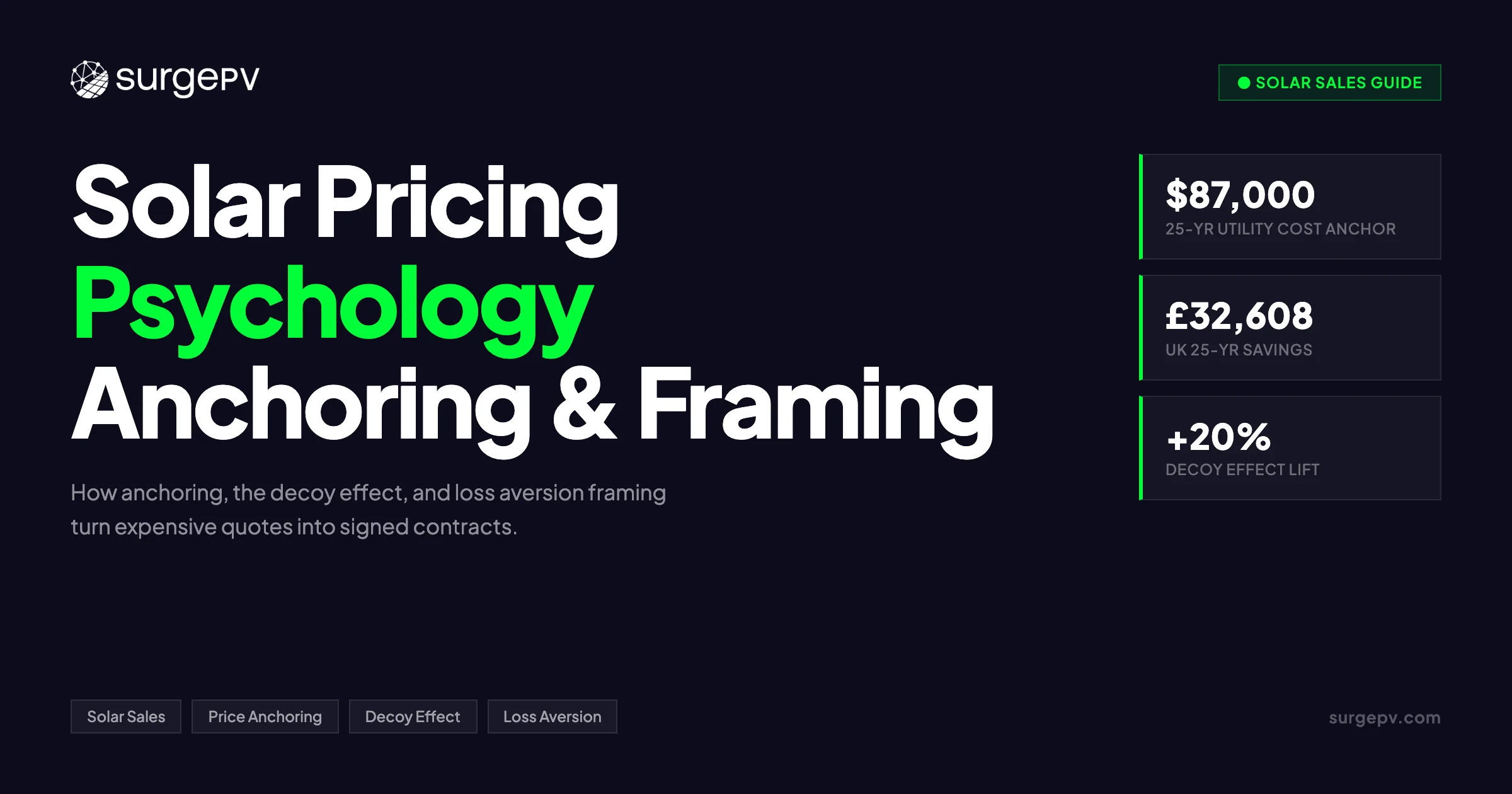
The fix is simple in theory. Show the customer what they will spend anyway. A UK homeowner with a £160 monthly electricity bill will pay roughly £48,000 over 25 years at current rates. In the US, a $210 monthly bill becomes $87,000 over 25 years. These are arithmetic, not projections. When the solar system cost appears after these totals, the brain has already accepted a much larger anchor. The system now feels like a discount.
Preventing sticker shock in practice:
- Never open with the system price. Open with the 25-year utility total, the lifetime cost of inaction, or the projected rate escalation.
- Use the customer’s actual bill. Generic estimates feel like marketing. A number pulled from their actual usage feels like truth.
- Show the math. Break down how you arrived at the 25-year total. Transparency builds trust and prevents the anchor from feeling manipulative.
- Pause after the anchor. Give the customer a moment to absorb the large number before moving to the system cost. Rushing the sequence weakens the effect.
This principle is built into modern solar proposal software. The best tools structure the proposal so the savings page appears before the pricing page. The customer scrolls through their projected utility spend, their bill offset, and their payback period before they ever see a system total. By the time the price appears, the anchor is set.
Price Anchoring: Show the Big Number First
Price anchoring in solar sales means showing the customer’s 25-year projected utility bill total before revealing the system cost. When the brain anchors to £48,000 in electricity spend, a £12,000 solar system feels like a discount rather than an expense. Tversky and Kahneman first documented this cognitive bias in the 1970s.
Anchoring is a cognitive bias where people rely too heavily on the first piece of information offered. Tversky and Kahneman first demonstrated this in the 1970s. In solar sales, the anchor should never be the system cost. It should be the cost of doing nothing.
The mechanism is straightforward. When a customer sees “£48,000 in electricity over 25 years” first, their brain stores that as the reference point. When “£12,000 for the solar system” appears second, the brain codes it as a £36,000 saving — not as a £12,000 expense. The same system, same panels, same price. Different mental account entirely.
Real-world solar anchoring looks like this:
- UK residential: “Your current usage pattern means you’ll spend roughly £32,608 on electricity over the next 25 years. A 4kW system, fully installed, costs between £6,600 and £8,100.” (Source: GreenMatch, October 2025)
- US residential: “At current utility rates, your home will consume roughly $87,000 in electricity over the next 25 years. This 10kW system is priced at $24,997 after incentives.”
- Commercial: “Your facility’s annual energy spend is $48,000. Over 10 years, that’s $480,000 — and rates have risen 3–5% annually in your utility district. This 250kW system is $485,000 installed.”
The commercial example is especially powerful. The anchor and the system cost are nearly identical. But the system produces power for 25–30 years, while the anchor only covers 10. The long-term mental math works in your favour.
Pro Tip
Charm pricing — ending in 997 instead of 000 — adds a secondary anchor. A £12,997 system feels closer to £12,000 than £13,000 because the leftmost digit anchors lower. Research by Schindler and Kibarian found that .99 price endings increased sales by nearly 8% compared to round prices (Schindler & Kibarian, 1996). Use it on your target tier, not every tier.
Anchoring also works with competitor pricing. If your prospect has a quote from another installer, you can anchor against it. “Their 8kW system is quoted at £14,500. Our 10kW system with higher-efficiency panels is £13,997.” The competitor’s price becomes the anchor. Your price becomes the saving. This only works if the comparison is genuine and defensible. False comparisons destroy trust faster than no anchor at all.
In a solar design tool like SurgePV, anchoring happens automatically if you sequence the proposal correctly. The software generates the 25-year projection from the customer’s actual usage data, satellite imagery, and local irradiance. The anchor is personalised and precise — not a generic estimate from a sales script.
Framing: Reframe Cost as Daily Savings
Framing presents the same solar cost in different words to trigger different mental accounts. Describing a £12,000 system as £1.60 per day moves the purchase from savings capital to petty cash. Daily, monthly, bill-offset, and investment frames each change how the customer feels about the same number.
Framing is the same information presented in different words. Kahneman and Tversky’s prospect theory proved that people make different decisions depending on how identical outcomes are described. In solar sales, this means the difference between “£12,000” and “£1.60 per day.”
The brain files these into different mental accounts. £12,000 comes from savings, debt, or investment capital. £1.60 per day comes from petty cash — less than a coffee. The total hasn’t changed. The feeling has.
Effective solar framing techniques:
Daily equivalent: “This system costs £1.60 per day over 20 years. Your current electricity spend is £5.30 per day.” The daily frame makes the saving feel immediate and habitual.
Monthly bill offset: “Replace your £160 monthly utility bill with a £110 solar loan payment. You keep £50 in your pocket from month one.” This frames solar as a bill swap, not a new expense. The customer already pays a bill. You’re just redirecting it.
Investment frame: “This system pays for itself in 6–7 years, then generates free electricity for 18–19 more. That’s a 14–16% annual return — better than most ISAs or index funds.” (Source: GreenMatch UK break-even data) The investment frame attracts analytically minded buyers who need to justify the spend to a spouse or finance director.
Per-kWh production frame: “Your system will generate electricity at an effective cost of 6p per kWh over its lifetime. Your utility currently charges 34p per kWh.” This reframes the purchase as a long-term energy hedge.
An industrial maintenance services case study found that reframing a $120,000 annual contract as $329 per day increased attach rates from 28% to 49% and reduced quote-to-close time by 15% (Umbrex Pricing Framework, 2026). Only the frame had changed.
For UK installers, the 0% VAT frame is currently available. “The government saves you £2,850 in VAT on this 4kW system plus battery.” That is a real policy benefit, not a discount from you. But it only works if you frame it before the customer sees the total. Show the VAT-inclusive price first, then the 0% VAT price. The drop feels like a win.
SurgePV’s generation and financial tool calculates all these frames automatically from the system design. It outputs daily, monthly, lifetime, and per-kWh equivalents alongside standard ROI and payback metrics. The salesperson doesn’t need to do the math. They just need to choose the right frame for the customer in front of them.
The Decoy Effect: Three Package Options
The decoy effect uses a third expensive option to make your target tier look like the sensible middle ground. In solar proposals, a Good-Better-Best structure with an oversized battery package as the decoy can increase selection of the target middle tier by shifting the customer’s comparison point.
The decoy effect — also called asymmetrical dominance — occurs when a third option makes one of two other options look clearly superior. Huber, Payne, and Puto first documented it in 1982. In solar proposals, you use it to make your target tier feel like the sensible middle ground.
Here is how it works in practice:
| Package | System Size | Price | Key Features |
|---|---|---|---|
| Good | 8kW | £18,997 | Standard panels, string inverter, no battery |
| Better | 10kW | £22,997 | Premium panels, hybrid inverter, 10-year warranty ← TARGET |
| Best | 12kW + 10kWh battery | £31,997 | Top-tier panels, full backup, 15-year warranty, monitoring app |
The Best package exists primarily to make Better look like a bargain. Without the Best tier, the customer debates whether they need 10kW or can get away with 8kW. With the Best tier, the debate shifts to whether they need a battery. The 10kW system becomes the obvious, balanced choice.
Huber, Payne, and Puto’s original experiments found that adding a decoy increased demand for the target option by up to 20% in some product categories (Huber, Payne & Puto, 1982). The effect is strongest when:
- The decoy is clearly superior to the low tier but only marginally inferior to the target tier
- The price gap between target and decoy is large enough to feel significant
- The target tier carries a visual badge like “Most Popular” or “Recommended”
Practical rules for solar decoy structures:
- Make the target tier 70–80% of your decoy price. A £22,997 target against a £31,997 decoy works. A £22,997 target against a £25,997 decoy does not — the gap is too small to trigger the effect.
- Add one premium feature to the decoy that only 10–20% of buyers actually need. Whole-home battery backup during grid outages is perfect. Most homeowners want solar for savings. The minority who need backup will self-select into the Best tier. Everyone else will feel smart for choosing the middle.
- Never make the bottom tier unattractive. It should be a genuine, viable system. Some customers genuinely have budget constraints. A bad-faith bottom tier destroys trust and triggers reactance.
Proposal platforms like Solargraf and Solo have built Good-Better-Best tiers into their core workflow. SurgePV’s solar proposal software lets you configure these tiers with custom badges, colour coding, and feature callouts. The decoy structure becomes a template, not a manual design task.
Loss Aversion: The Rising Bill Frame
Loss aversion means losses feel roughly twice as painful as equivalent gains feel good. In solar sales, framing the choice as “you will pay the utility £28,000 and own nothing” motivates more strongly than “you will save £28,000” because the loss triggers more urgent action than the gain.
Loss aversion is the principle that losses feel roughly twice as painful as equivalent gains feel good. Kahneman and Tversky demonstrated this repeatedly. In solar sales, this means “You will lose £28,000 to the utility” motivates more strongly than “You will save £28,000 with solar.”
The frame is simple. Instead of leading with what solar gives, lead with what not going solar takes away.
- “Utility rates in your state rose 4.2% annually over the past decade. At that pace, your £160 monthly bill becomes £240 in 10 years. You will pay the utility an extra £28,000 — and you will own nothing.”
- “The average UK electricity tariff is 34p per kWh and rising. With solar, you lock in 6p per kWh for 25 years. Without it, you lock in whatever the market decides.”
- “If you wait one year, you lose 12 months of generation. At £783 annual savings, that’s £783 gone forever — plus another year of rate increases.”
These are verified trends, not scare tactics. UK electricity prices have risen faster than inflation for most of the past 15 years. EIA data shows US residential electricity rates increased an average of 2.85% per year from 1999 to 2024 (EIA, 2025). The loss is real. You are simply making it visible.
Loss aversion combined with anticipated future regret is a documented barrier to big-ticket purchases. When purchases are framed as loss prevention — “buy now to avoid paying more later” — that barrier drops. The customer is pre-paying to avoid a larger future spend, not spending.
The cost of inaction table is a powerful proposal tool:
| Year | Cumulative Utility Spend | Cumulative Solar Spend | Difference |
|---|---|---|---|
| 5 | £10,400 | £12,000 | -£1,600 |
| 10 | £22,800 | £12,000 | +£10,800 |
| 15 | £37,600 | £12,000 | +£25,600 |
| 20 | £55,200 | £12,000 | +£43,200 |
| 25 | £76,000 | £12,000 | +£64,000 |
At year 5, the customer is still slightly behind. At year 10, they are £10,800 ahead. The crossover point is concrete and motivating. It also sets realistic expectations — solar is not an instant win. It is a mid-term wealth builder.
For UK installers, the SEG frame adds another loss-aversion layer. “Without solar, you pay 34p per kWh for every unit you use. With solar, you generate your own and export the excess at up to 30.31p per kWh. Every sunny afternoon you wait is a missed export payment.” (Source: GreenMatch SEG tariff data)
Build Proposals That Apply Pricing Psychology Automatically
SurgePV’s proposal tool structures your pricing in the sequence that closes — savings first, cost second.
Book a DemoNo commitment required · 20 minutes · Live project walkthrough
Social Proof Framing: “Most Customers Choose…”
Social proof in solar sales uses neighbour installations, package badges, and local testimonials to reduce uncertainty. Yale and NYU research found that every 10 additional solar installations in a zip code increase the probability of another adoption by 7.8%, making visible panels a powerful persuasion tool.
People look to others when making uncertain decisions. A Yale and NYU study of California solar diffusion found that 10 additional installations in a zip code increase the probability of another adoption by 7.8% (Bollinger & Gillingham, 2012). Solar is a visible, social purchase. The panels on a neighbour’s roof are more persuasive than any brochure.
Social proof in pricing works at three levels:
1. Package-level badges. Label your target tier “Most Popular” or “80% of our customers choose this package.” This is a choice architecture tool, not decoration. When a customer sees that most people choose the middle tier, the middle tier becomes the default. Defaults reduce decision fatigue and increase conversion.
2. Geographic specificity. “We’ve installed 47 systems in your postcode this year.” This signals local trust, local knowledge, and local social norms. It also implies availability — if 47 neighbours got it done, the interconnection process, permitting, and utility paperwork must be manageable.
3. Review timing. Most installers collect reviews after installation. Smarter teams embed mini-testimonials at the point of price disclosure. A proposal sidebar that says “‘We were nervous about the upfront cost, but the monthly saving was real from day one.’ — Sarah M., installed March 2025” reframes the price objection before the customer voices it.
Rules for social proof in proposals:
- Use real numbers, not rounded ones. “78% chose Premium” feels researched. “80% chose Premium” feels rounded and possibly invented. If your data genuinely rounds to 80%, use it. But never round up to make a point.
- Match the proof to the customer segment. A commercial buyer cares that “14 warehouses in your sector chose this configuration.” A residential buyer cares that “homes on your street chose this size.”
- Don’t fake scarcity. “Only 3 spots left at this price” works once. When the customer calls back next week and the spots are still there, trust evaporates. Use genuine project capacity limits or incentive deadlines only.
Social proof also works in your solar shadow analysis software workflow. When you show the customer a shade report for their roof, you can reference neighbouring properties. “Your south-facing roof gets 1,420 kWh per kW annually — 12% better than the average home in this area.” The neighbour comparison validates their roof quality and makes the production estimate feel conservative, not optimistic.
Scarcity and Urgency Without Manipulation
Ethical scarcity in solar sales relies on genuine deadlines such as incentive step-downs, utility rebate caps, and net metering policy changes. Manufactured deadlines destroy trust, but specific facts like “ITC drops from 30% to 26% after December 31, 2025” create real urgency without manipulation.
Scarcity and urgency work when they are real. Manufactured deadlines backfire. Solar has no shortage of genuine urgency drivers. Use them.
Real urgency drivers in solar:
- Incentive step-downs. The US federal residential clean energy credit has stepped down from 30% to 26% for systems placed in service after 2025. UK installers can reference the 0% VAT window for energy-saving materials. These are legislative facts, not sales tactics.
- Utility programme caps. Many utility rebate programmes are first-come, first-served and exhaust their budgets mid-year. “Your utility’s solar rebate fund had £1.2m remaining as of last quarter. Last year it ran out in August.” This is verifiable and specific.
- Net metering changes. California’s NEM 3.0 policy reduced export credits by approximately 75% for new solar customers, from near-retail rates to avoided-cost rates (CPUC, 2023). Similar policy shifts are being discussed in other states. The window for favourable export rates is genuinely closing in some markets.
- Interconnection queues. In high-growth markets, grid connection queues are lengthening. “Current queue time is 8–10 weeks. If we submit your application this month, you should be operational before autumn.” This frames delay as a real cost — lost months of generation.
- Panel and inverter supply. Post-2021 supply chain volatility has made equipment pricing less predictable. “Current module pricing is stable, but tariff discussions for Q3 could shift costs 5–10%. Locking your price now protects against that.”
The key to ethical urgency is specificity. “Act now” is manipulative. “The ITC drops from 30% to 26% for systems placed in service after December 31, 2025” is informative. Give the customer the facts. Let the facts create the urgency.
Digital proposals can embed countdown timers for genuine deadlines. “Days remaining until ITC step-down: 87.” But only use timers for dates you control or can verify. A timer for a utility rebate should link to the utility’s live balance page. A timer for a manufacturer promotion should reference the programme terms. Transparency turns urgency from a pressure tactic into a service.
Putting It All Together: The Pricing Sequence
The optimal solar pricing sequence is: anchor with 25-year utility cost, show system cost, reframe to monthly saving, present three options with a decoy, add loss aversion with rising rates, and close with social proof. This order respects how the brain actually processes large purchases.
Individual techniques work. But the real power comes from sequencing. Here is the exact order we recommend for solar proposals, whether delivered in person, via PDF, or through solar proposal software.
Step 1: Anchor with 25-year utility cost. Open with the customer’s projected lifetime electricity spend. Use their actual bill. Show the math. This is the anchor. Everything else is compared to this number.
Step 2: Show the system cost (now it looks small). Present the fully installed system price. If you have personalised the proposal with their address and roof image in the header, the endowment effect is already working. The system feels like theirs.
Step 3: Reframe to monthly saving vs. monthly bill. Convert the total into a daily or monthly equivalent. “£50 per month instead of £160 per month.” This moves the number from the investment mental account to the household budget mental account.
Step 4: Present three options (decoy structure). Good, Better, Best. Badge the target tier “Most Popular” or “Recommended.” The decoy tier makes the target feel balanced. The bottom tier captures budget-conscious buyers without making them feel cheap.
Step 5: Add loss aversion — show rising rates if they wait. Include a “cost of waiting” table or paragraph. “Every month you delay costs you £65 in lost savings plus whatever rates rise next quarter.”
Step 6: Close with social proof. “78% of our customers in your area chose the 10kW Premium system.” Add a local testimonial if you have one. Social proof at the point of final decision reduces last-minute hesitation.
This sequence respects how the brain actually processes big purchases. It does not trick the customer. It presents the same truthful information in the order the brain can absorb it. The savings anchor comes first because the brain needs context. The cost comes second because cost without context is just a big number. The financing comes third because monthly frames feel different from totals. The options come fourth because choice architecture guides without forcing. The loss and social proof come last because they tip the decision from “maybe” to “yes.”
For UK installers, adapt the sequence with local data. Use £32,608 in 25-year savings for a 4kW system. Reference the 0% VAT saving. Mention SEG export income. Use GreenMatch or Ofgem data as your anchor source. For US installers, use NREL’s $3.03 per watt national average as a sanity-check anchor. Reference EIA rate escalation data. Tie urgency to real ITC or NEM deadlines in your state.
Conclusion
Solar pricing psychology aligns how you present information with how the human brain receives it. This article covered anchoring, framing, decoy effects, loss aversion, social proof, and scarcity — and how sequencing them in proposals turns sticker shock into confident decisions.
The three actions to take this week:
- Audit your proposal sequence. Does the customer see savings before cost? If not, reorder your solar proposal software template.
- Add a decoy tier. If you currently offer one or two system sizes, test a three-tier structure with a clear “Most Popular” badge on the target tier.
- Frame one number differently. Pick your most common proposal. Reframe the total cost into a daily equivalent and a bill-offset comparison. A/B test it against your current framing for 20 proposals.
The numbers in solar have never been better. IRENA’s 2024 data shows utility-scale solar LCOE fell 90% between 2010 and 2024, battery storage costs declined 93% over the same period, and solar PV is now 41% cheaper than the lowest-cost fossil fuel option globally (IRENA, 2025). The economics are compelling. Your job is to make sure the customer sees that before their brain locks onto a big number and shuts down.
Frequently Asked Questions
These five questions cover the core pricing psychology techniques that solar sales teams use daily: price anchoring with lifetime utility costs, the decoy effect in three-tier proposals, reframing system costs into daily equivalents, loss aversion with rising bill frames, and preventing sticker shock through controlled information sequencing.
What is price anchoring in solar sales?
Price anchoring is showing a large reference number before revealing the system cost. In solar sales, this means presenting the customer’s 25-year projected utility bill total first — e.g., “You will pay an estimated £48,000 in electricity over the next 25 years.” When the £12,000 solar system cost appears next, it feels small by comparison. This technique draws on the cognitive bias first identified by Tversky and Kahneman, where the brain fixates on the first number it sees and judges everything else relative to it.
How does the decoy effect work in solar proposals?
The decoy effect uses a third option to make your target tier look like the smart middle ground. In solar proposals, you present three system sizes: a small basic system, a mid-sized premium system (your target), and an oversized system with battery backup at a much higher price. The expensive third option makes the middle tier feel like a balanced, sensible choice rather than a stretch. Research on asymmetrical dominance shows this can increase selection of the target option by up to 20%.
How do you use framing to sell solar?
Framing changes how the same number feels by changing the context. Instead of saying “This system costs £18,000,” you say “That’s £50 per month over 20 years — £70 less than your current average bill.” Daily and monthly frames feel manageable. Bill-offset frames feel like a swap. Investment frames feel like building an asset. The frame you choose determines which mental account the customer assigns the purchase to — and that changes their willingness to buy.
What is loss aversion framing in solar sales?
Loss aversion framing, drawn from Kahneman and Tversky’s prospect theory, recognises that people feel losses about twice as strongly as equivalent gains. In solar sales, this means emphasising what the customer loses by waiting: rising utility rates, expiring incentives, and years of missed savings. A frame like “In 10 years, you’ll have paid the utility £28,000 and own nothing” is often more motivating than “This system saves you £28,000” because the loss feels more urgent than the gain.
How do you present solar pricing without sticker shock?
Prevent sticker shock by controlling the sequence of information. Show savings before cost. Anchor with the 25-year utility total. Reframe the system price into a daily or monthly equivalent. Present three options so the target tier feels like the reasonable middle. Add social proof with a “Most Popular” badge. Never lead with the total system cost — the brain will lock onto that number and everything else will feel like an add-on. Digital proposal tools like SurgePV’s solar proposal software let you structure this sequence automatically.