

Quick Answer
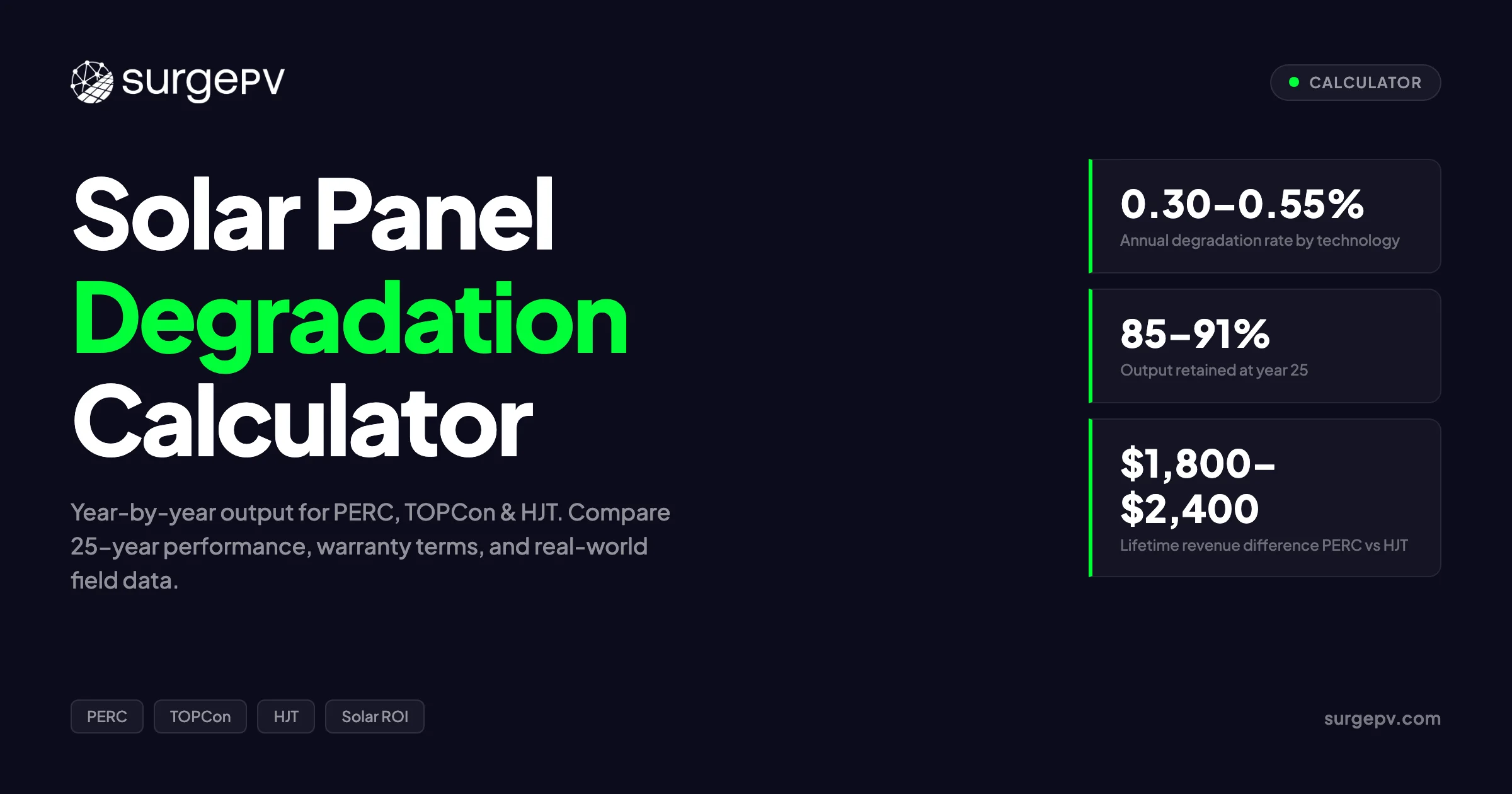
Solar panels do not produce the same output in year 25 as they do in year one. A 0.55% annual drop sounds minor until you multiply it across 25 years and thousands of kilowatt-hours. The difference between PERC and HJT over 25 years is 6.2 percentage points of output.
Solar panels do not produce the same output in year 25 as they do in year one. Every photovoltaic module loses a small fraction of its power each year. That loss compounds. A 0.55% annual drop sounds minor until you multiply it across 25 years and thousands of kilowatt-hours. Also see: Us Residential Solar Market Trends 2026.
Solar panels do not produce the same output in year 25 as they do in year one. A 0.55% annual drop sounds minor until you multiply it across 25 years and thousands of kilowatt-hours. The difference between PERC and HJT over 25 years is 6.2 percentage points of output.
This guide is a working solar panel degradation calculator. It gives you the exact year-by-year output for PERC, TOPCon, and HJT technologies. It explains why degradation happens, how manufacturers model it in warranties, and what real field data says about whether those warranties match reality.
TL;DR — Solar Panel Degradation Calculator
PERC degrades fastest: 2% in year one, then 0.55% per year. TOPCon improves on this: 1% first-year, then 0.40% annually. HJT degrades least: 1.5% first-year, then 0.30% per year. Over 25 years, a 10 kW system produces 231,000 kWh with PERC, 242,000 kWh with TOPCon, and 247,000 kWh with HJT. The technology choice affects lifetime revenue by $1,800–$2,400 at $0.15/kWh.
In this guide:
- What solar panel degradation is and why it matters for project finance
- Degradation rates by cell technology: PERC, TOPCon, HJT, and thin-film
- Year 1 vs. annual degradation: the stepped model explained
- How to calculate year-by-year output with formulas and worked examples
- Full 25-year degradation table comparing all three technologies
- Temperature and climate impact on degradation speed
- PID, LID, and other failure modes that drive power loss
- Warranty terms: what manufacturers promise versus what happens in the field
- 25-year vs. 30-year output projections
- Degradation impact on ROI, LCOE, and project returns
- Why degradation matters less than most installers think
- Real-world degradation data from NREL, IEA PVPS, and field studies
Solar Panel Degradation: Quick Answer
Solar panel degradation is the gradual and irreversible loss of power output over time. It is caused by chemical and physical changes in the cell, encapsulant, and electrical connections.
| Technology | Year 1 Loss | Annual Loss (Years 2–25) | Output at Year 25 | 25-Year Total Degradation |
|---|---|---|---|---|
| PERC (p-type mono) | 2.0% | 0.55% | 85.1% | 14.9% |
| TOPCon (n-type) | 1.0% | 0.40% | 89.4% | 10.6% |
| HJT (heterojunction) | 1.5% | 0.30% | 91.3% | 8.7% |
| CdTe (thin-film) | 0.5% | 0.40% | 90.1% | 9.9% |
Source: Manufacturer warranty datasheets (Jinko, LONGi, REC, First Solar), IEC 61215 accelerated testing protocols, IEA PVPS Task 13 degradation rate database. Values represent typical warranted degradation rates; actual field performance varies by climate and installation quality.
The difference between PERC and HJT over 25 years is 6.2 percentage points of output. On a 500 kW commercial system, that gap equals 31 kW of lost capacity — enough to power six additional homes.
What Is Solar Panel Degradation and Why It Matters
Solar panel degradation is not failure. A degraded panel still produces power. It simply produces less than it did when new. The mechanism is slow, cumulative, and unavoidable.
What Causes Degradation
Degradation has multiple causes. They operate simultaneously at different rates:
Cell-level effects. Silicon crystal defects multiply under light and heat. Boron-oxygen complexes in p-type silicon trap charge carriers. Solder bonds between cell and ribbon fatigue under thermal cycling. These are the primary drivers of power loss.
Encapsulant effects. EVA (ethylene vinyl acetate) encapsulant yellows and browns under UV exposure. This reduces light transmission to the cell. Modern POE (polyolefin elastomer) encapsulants resist this better but cost more.
Electrical effects. Busbars and junction boxes corrode in humid environments. Diode failures in bypass circuits reduce string output. Connector resistance increases over time, causing resistive losses.
Mechanical effects. Frame seal degradation allows moisture ingress. Glass-microcrack propagation increases under wind load cycling. These are less common in modern panels but still occur in poorly manufactured units.
Why Degradation Matters for Project Economics
A solar project’s financial model assumes a certain output in year one and a certain decline thereafter. If actual degradation exceeds the modeled rate, the project underperforms. If it underperforms, debt service coverage ratios fall. Equity returns shrink. PPA offtakers receive less energy than contracted.
For a 10 MW solar farm with a 25-year PPA at $0.06/kWh, a 0.1% per year higher degradation rate costs approximately $180,000 in lost revenue over the project life. That is enough to turn a marginal project into an unfinanceable one.
solar design tools that models degradation accurately — not as a flat annual percentage but as a technology-specific, climate-adjusted curve — produces more bankable financial projections than tools that apply a generic 0.5% per year to all technologies.
Degradation Rates by Cell Technology
Not all solar cells degrade at the same rate. The cell architecture, dopant type, and metallization method all affect long-term stability.
PERC (Passivated Emitter and Rear Cell)
PERC is the dominant cell technology in 2026, accounting for approximately 70% of global module production. It adds a dielectric passivation layer to the rear of a standard aluminum back-surface field cell, reducing recombination and boosting efficiency to 21–23%. For Global-specific compliance details, see Global net-metering-by-country. For Global-specific compliance details, see Global solar-permitting-speed-by-country.
Degradation profile:
| Parameter | Typical Value |
|---|---|
| First-year degradation | 1.5–2.5% (warranted at 2.0%) |
| Annual degradation (years 2–25) | 0.50–0.60% (warranted at 0.55%) |
| Output at year 25 | 84.0–86.5% |
| Temperature coefficient (Pmax) | −0.35 to −0.40%/°C |
PERC’s higher degradation comes from two factors. First, p-type silicon with boron doping is susceptible to LID (light induced degradation) from boron-oxygen complex formation. Second, the aluminum back-surface field metallization is less stable under thermal cycling than the silver-based contacts used in n-type cells.
What most installers get wrong: They treat PERC degradation as a single 0.55% per year rate. It is not. Year one loss is 2% — nearly four times the annual rate. A financial model that applies 0.55% from year one overestimates lifetime production by 1.2–1.5%.
TOPCon (Tunnel Oxide Passivated Contact)
TOPCon is an n-type cell technology that replaces the rear passivation layer with an ultra-thin tunnel oxide and polysilicon contact. This reduces contact recombination and eliminates the aluminum metallization that drives PERC degradation.
Degradation profile:
| Parameter | Typical Value |
|---|---|
| First-year degradation | 0.5–1.5% (warranted at 1.0%) |
| Annual degradation (years 2–25) | 0.35–0.45% (warranted at 0.40%) |
| Output at year 25 | 88.0–90.5% |
| Temperature coefficient (Pmax) | −0.29 to −0.32%/°C |
TOPCon’s lower degradation is driven by three design advantages. N-type silicon is free of boron-oxygen LID. The tunnel oxide contact is thermally stable. And the bifacial design captures rear-side irradiance, partially offsetting front-side degradation. For more on this topic, see Bifacial Solar Panel Design Guide.
TOPCon module prices in 2026 are 5–10% above equivalent PERC modules. The degradation advantage alone justifies part of that premium for projects with 20+ year financing.
HJT (Heterojunction Technology)
HJT combines crystalline silicon with thin-film amorphous silicon layers. The heterojunction reduces surface recombination to near-zero, delivering the highest efficiencies (24–26%) and the lowest degradation rates of any mainstream silicon technology.
Degradation profile:
| Parameter | Typical Value |
|---|---|
| First-year degradation | 1.0–2.0% (warranted at 1.5%) |
| Annual degradation (years 2–30) | 0.25–0.35% (warranted at 0.30%) |
| Output at year 25 | 90.0–92.5% |
| Output at year 30 | 88.5–91.0% |
| Temperature coefficient (Pmax) | −0.24 to −0.26%/°C |
HJT’s ultra-low temperature coefficient is as important as its low degradation rate. In hot climates where module operating temperatures reach 65–75°C, HJT loses 10–12% less power to heat than PERC. This compounds the degradation advantage.
The tradeoff is cost. HJT modules remain 15–25% more expensive than PERC in 2026. The premium is narrowing as equipment costs fall and manufacturing scales, but HJT is not yet cost-competitive for price-sensitive residential markets.
Thin-Film (CdTe)
First Solar’s CdTe technology deserves mention as the only non-silicon technology with significant utility-scale deployment.
Degradation profile:
| Parameter | Typical Value |
|---|---|
| First-year degradation | 0.2–0.7% (warranted at 0.5%) |
| Annual degradation (years 2–25) | 0.35–0.45% (warranted at 0.40%) |
| Output at year 25 | 89.0–91.5% |
| Temperature coefficient (Pmax) | −0.30 to −0.32%/°C |
CdTe has no boron-oxygen LID and no solder bonds (cells are connected by laser scribing). Its low degradation is genuine. The limitation is lower efficiency (18–20%) and a narrower supplier base.
Technology Comparison Summary
| Technology | Efficiency | Year 1 Loss | Annual Loss | 25-Year Output | Module Cost ($/W) |
|---|---|---|---|---|---|
| PERC | 21–23% | 2.0% | 0.55% | 85.1% | $0.10–0.13 |
| TOPCon | 22–24% | 1.0% | 0.40% | 89.4% | $0.11–0.14 |
| HJT | 24–26% | 1.5% | 0.30% | 91.3% | $0.13–0.17 |
| CdTe | 18–20% | 0.5% | 0.40% | 90.1% | $0.12–0.15 |
Cost ranges are indicative for utility-scale procurement in Q1 2026. Residential and small commercial prices are higher.
Year 1 vs. Annual Degradation: Linear vs. Stepped Models
Financial models use two approaches to degradation: linear and stepped. The choice affects lifetime production estimates by 1–3%.
The Stepped Model (Correct)
The stepped model applies a higher degradation rate in year one, then a lower constant rate for all subsequent years. This matches how panels actually behave.
Formula:
Year 1 output = P rated × (1 − d1)
Year n output = Year 1 output × (1 − dannual)^(n−1)
Where:
- P rated = nameplate power (W)
- d1 = first-year degradation rate (decimal)
- dannual = annual degradation rate for years 2+ (decimal)
- n = year number
Example: 10 kW PERC system
Year 1: 10,000 W × (1 − 0.02) = 9,800 W
Year 2: 9,800 W × (1 − 0.0055) = 9,746 W
Year 5: 9,800 W × (1 − 0.0055)^4 = 9,587 W
Year 10: 9,800 W × (1 − 0.0055)^9 = 9,326 W
Year 25: 9,800 W × (1 − 0.0055)^24 = 8,510 W
The Linear Model (Incorrect but Common)
The linear model applies the same annual rate from year zero. This overestimates production because it misses the large year-one drop.
Example: 10 kW PERC system (linear, wrong)
Year 1: 10,000 W × (1 − 0.0055) = 9,945 W  ← 145 W too high
Year 25: 10,000 W × (1 − 0.0055)^25 = 8,694 W  ← 184 W too high
The linear model overestimates 25-year production by 1,400–1,800 kWh for a 10 kW system. At $0.15/kWh, that is $210–$270 in phantom revenue.
Pro Tip
Always use the stepped model for financial projections. If your solar proposal software applies a flat annual rate from year one, adjust the first-year degradation manually or reduce the annual rate to compensate. The error is small per project but compounds across a portfolio.
How to Calculate Year-by-Year Output
Here is the complete calculation method for any system size and technology.
Step 1: Identify Your Parameters
| Input | Example Value |
|---|---|
| System size | 10 kW (10,000 W) |
| Technology | PERC |
| First-year degradation | 2.0% |
| Annual degradation | 0.55% |
| Specific yield | 1,500 kWh/kW/year |
| Electricity value | $0.15/kWh |
Specific yield depends on location. Use PVGIS, NREL PVWatts, or site-specific irradiance data. 1,500 kWh/kW/year is typical for central European conditions. Also see: European Solar Incentives.
Step 2: Calculate Year-One Output
Year 1 DC power = 10,000 W × (1 − 0.02) = 9,800 W
Year 1 energy = 9,800 W × 1,500 kWh/kW / 10,000 = 14,700 kWh
Step 3: Calculate Each Subsequent Year
Year n energy = Year 1 energy × (1 − 0.0055)^(n−1)Example for year 10:
Year 10 energy = 14,700 × (1 − 0.0055)^9 = 14,700 × 0.9516 = 13,989 kWhStep 4: Sum for Lifetime Production
Lifetime production = Year 1 × [1 + (1−d) + (1−d)^2 + ... + (1−d)^24]For PERC at 0.55% annual:
Lifetime production = 14,700 × 15.71 = 230,937 kWhStep 5: Calculate Cumulative Revenue
Cumulative revenue = Lifetime production × $/kWh
= 230,937 × $0.15 = $34,641
Step 6: Compare Technologies
| Technology | 25-Year Production | Revenue at $0.15/kWh | vs. PERC |
|---|---|---|---|
| PERC | 230,937 kWh | $34,641 | Baseline |
| TOPCon | 241,647 kWh | $36,247 | +$1,606 |
| HJT | 246,847 kWh | $37,027 | +$2,386 |
The HJT premium of $0.03–$0.04/W is recovered in higher production value within 8–12 years for most project sizes.
Degradation Calculator: 25-Year Table for a 10 kW System
The following table shows year-by-year output for a 10 kW system with 1,500 kWh/kW/year specific yield. All values are AC energy output after inverter losses.
Year-by-Year Degradation: PERC, TOPCon, and HJT
| Year | PERC Output (kWh) | PERC % of Rated | TOPCon Output (kWh) | TOPCon % of Rated | HJT Output (kWh) | HJT % of Rated |
|---|---|---|---|---|---|---|
| 1 | 14,700 | 98.0% | 14,850 | 99.0% | 14,775 | 98.5% |
| 2 | 14,619 | 97.5% | 14,791 | 98.6% | 14,731 | 98.2% |
| 3 | 14,539 | 96.9% | 14,732 | 98.2% | 14,687 | 97.9% |
| 4 | 14,459 | 96.4% | 14,673 | 97.8% | 14,643 | 97.6% |
| 5 | 14,379 | 95.9% | 14,614 | 97.4% | 14,599 | 97.3% |
| 6 | 14,300 | 95.3% | 14,556 | 97.0% | 14,555 | 97.0% |
| 7 | 14,222 | 94.8% | 14,498 | 96.7% | 14,512 | 96.7% |
| 8 | 14,143 | 94.3% | 14,440 | 96.3% | 14,468 | 96.4% |
| 9 | 14,066 | 93.8% | 14,382 | 95.9% | 14,425 | 96.2% |
| 10 | 13,988 | 93.3% | 14,325 | 95.5% | 14,382 | 95.9% |
| 11 | 13,911 | 92.7% | 14,267 | 95.1% | 14,339 | 95.6% |
| 12 | 13,835 | 92.2% | 14,210 | 94.7% | 14,296 | 95.3% |
| 13 | 13,759 | 91.7% | 14,153 | 94.4% | 14,253 | 95.0% |
| 14 | 13,683 | 91.2% | 14,096 | 94.0% | 14,210 | 94.7% |
| 15 | 13,608 | 90.7% | 14,040 | 93.6% | 14,168 | 94.5% |
| 16 | 13,533 | 90.2% | 13,984 | 93.2% | 14,125 | 94.2% |
| 17 | 13,458 | 89.7% | 13,928 | 92.9% | 14,083 | 93.9% |
| 18 | 13,384 | 89.2% | 13,872 | 92.5% | 14,041 | 93.6% |
| 19 | 13,310 | 88.7% | 13,817 | 92.1% | 13,999 | 93.3% |
| 20 | 13,237 | 88.2% | 13,761 | 91.8% | 13,957 | 93.0% |
| 21 | 13,164 | 87.8% | 13,706 | 91.4% | 13,915 | 92.8% |
| 22 | 13,092 | 87.3% | 13,652 | 91.0% | 13,873 | 92.5% |
| 23 | 13,019 | 86.8% | 13,597 | 90.7% | 13,832 | 92.2% |
| 24 | 12,948 | 86.3% | 13,543 | 90.3% | 13,790 | 91.9% |
| 25 | 12,876 | 85.8% | 13,489 | 89.9% | 13,749 | 91.7% |
| Total | 346,406 | — | 362,471 | — | 370,270 | — |
Note: Total column sums years 1–25. Values are rounded to nearest kWh. Specific yield of 1,500 kWh/kW/year assumed. Actual output varies by location, orientation, tilt, and shading. Shadow analysis software identifies shading issues before installation.
Cumulative Production Comparison
| Technology | 25-Year Total (kWh) | vs. PERC | Value at $0.15/kWh | Value at $0.08/kWh |
|---|---|---|---|---|
| PERC | 346,406 | Baseline | $51,961 | $27,712 |
| TOPCon | 362,471 | +4.6% | $54,371 | $28,998 |
| HJT | 370,270 | +6.9% | $55,541 | $29,622 |
| CdTe | 365,500 | +5.5% | $54,825 | $29,240 |
The 6.9% HJT advantage over PERC translates to $3,580 more revenue at $0.15/kWh. At utility-scale PPA prices of $0.03–$0.05/kWh, the advantage is smaller in absolute terms but still meaningful for thin-margin projects.
Key Takeaway
The technology gap widens over time. In year 5, HJT produces 1.4% more than PERC. By year 25, the gap is 5.5%. For projects with 25-year financing or PPAs, the back-loaded advantage of low-degradation technologies is more valuable than the front-loaded advantage of lower module cost.
Temperature and Climate Impact on Degradation
Degradation does not happen at the same speed everywhere. Climate is the single largest variable affecting actual field degradation rates.
How Temperature Accelerates Degradation
The chemical reactions that cause cell degradation follow Arrhenius kinetics: reaction rate doubles for every 10°C increase in temperature. A module operating at 65°C degrades twice as fast as one at 55°C.
Module operating temperature = Ambient temperature + (Irradiance × 0.025–0.035)
At 1,000 W/m² irradiance, modules run 25–35°C above ambient. In Phoenix (45°C summer ambient), modules reach 75–80°C. In London (25°C summer ambient), they reach 50–55°C.
Climate Zone Degradation Multipliers
| Climate Zone | Typical Module Temp | Degradation Multiplier | PERC Effective Rate | HJT Effective Rate |
|---|---|---|---|---|
| Cool temperate (UK, Nordics) | 45–55°C | 0.8× | 0.44%/yr | 0.24%/yr |
| Moderate (Central Europe, US Northeast) | 55–65°C | 1.0× | 0.55%/yr | 0.30%/yr |
| Warm (Southern Europe, US Southeast) | 65–70°C | 1.2× | 0.66%/yr | 0.36%/yr |
| Hot arid (Arizona, Rajasthan, MENA) | 70–80°C | 1.4× | 0.77%/yr | 0.42%/yr |
| Hot humid (Southeast Asia, Florida) | 65–75°C + humidity | 1.3–1.5× | 0.72–0.83%/yr | 0.39–0.45%/yr |
Multipliers are approximate based on IEA PVPS Task 13 climate-specific degradation studies. Humidity accelerates encapsulant and electrical degradation beyond the temperature effect alone.
The Temperature Coefficient Advantage
HJT’s lower temperature coefficient (−0.25%/°C vs. −0.38%/°C for PERC) delivers a second benefit beyond slower degradation. At 70°C module temperature:
- PERC loses: (70 − 25) × 0.38% = 17.1% of rated power to heat
- HJT loses: (70 − 25) × 0.25% = 11.3% of rated power to heat
HJT produces 5.8 percentage points more power at the same high temperature. In hot climates, this daily power advantage compounds with the long-term degradation advantage.
Humidity and Precipitation Effects
Humidity drives three degradation mechanisms:
PID (Potential Induced Degradation). High humidity plus high system voltage drives sodium ion migration from glass into cells. This is reversible in early stages with proper system grounding and voltage management.
Encapsulant hydrolysis. Moisture ingress breaks down EVA molecular chains, causing delamination and optical loss.
Corrosion. Aluminum frames, junction boxes, and connectors corrode in salty or humid air. Coastal installations require additional protective coatings.
Pro Tip
For hot-humid climates (Florida, Southeast Asia, coastal India), specify modules with PID-resistant certification (IEC 62804) and POE encapsulant rather than standard EVA. The upfront cost increase of $0.01–$0.02/W pays back in reduced degradation within 5–8 years.
Read more about 5kW Solar Panel Price in India.
PID, LID, and Other Failure Modes
Understanding the specific failure modes helps distinguish reversible from irreversible losses and guides system design choices.
LID (Light Induced Degradation)
LID affects p-type silicon cells — primarily PERC. When boron-doped silicon is first exposed to sunlight, boron and oxygen atoms form complexes that act as recombination centers. These trap charge carriers before they can contribute to current.
Characteristics:
- Occurs in the first hours to weeks of operation
- Causes 1–3% permanent power loss in PERC cells
- Does not affect n-type (TOPCon, HJT) or thin-film cells
- Can be partially mitigated by gallium doping (Ga-doped PERC)
Detection: LID is complete by the time a system is commissioned. It shows up as lower-than-expected initial output, not as ongoing decline.
PID (Potential Induced Degradation)
PID is a voltage-driven phenomenon. In large arrays with high string voltages (600–1,500 V), the electric field drives positive sodium ions from the front glass through the encapsulant into the cell. These ions accumulate at the cell surface, creating shunt paths that bypass current around the junction.
Characteristics:
- Affects all crystalline silicon technologies
- Worse in hot, humid conditions
- Reversible in early stages with proper grounding and voltage management
- Can cause 5–30% power loss if untreated
Prevention:
- Use PID-resistant modules (IEC 62804 certified)
- Ground the module frame properly
- Install PID recovery boxes that apply reverse voltage during off-hours
- Limit string voltages where possible
LeTID (Light and Elevated Temperature Induced Degradation)
LeTID is a slower degradation mechanism affecting some PERC cells. It occurs under the combination of light and elevated temperature (50–80°C) and can cause additional 1–3% loss over the first 1–3 years.
Characteristics:
- Specific to certain PERC cell designs
- Not all PERC modules exhibit LeTID
- Manufacturers have largely solved this through hydrogen passivation optimization
- Check manufacturer datasheets for LeTID test results
Solder Bond Fatigue
Thermal cycling (day-night temperature swings) causes differential expansion between silicon cells and copper ribbons. Over thousands of cycles, solder bonds crack and electrical resistance increases.
Characteristics:
- Affects all ribbon-bonded cells
- Worse in climates with large diurnal temperature ranges (deserts, high altitudes)
- Causes gradual power loss and increased series resistance
- Modern multi-busbar and shingled designs reduce this risk
Backsheet Degradation
The rear polymer sheet protects cells from moisture and electrical insulation failure. Older fluorinated backsheets (Tedlar) are stable. Some newer non-fluorinated backsheets have shown cracking and chalking after 5–10 years in harsh climates. For more on this topic, see Solar Racking Design Guide.
Characteristics:
- Causes moisture ingress and safety hazards
- Visible as cracking, yellowing, or chalking on the rear surface
- Affected by UV exposure and temperature cycling
- Glass-glass modules eliminate this risk entirely
Warranty Terms: What Manufacturers Promise vs. Reality
Solar panel warranties have two parts: product warranty and performance warranty. They are not the same thing.
Product Warranty
The product warranty covers physical defects: delamination, frame corrosion, junction box failure, bypass diode failure, and cell cracking.
| Manufacturer | Product Warranty (2026) |
|---|---|
| Jinko Solar | 15–25 years (tier-dependent) |
| LONGi | 15 years standard, 25 years premium |
| REC Group | 25 years (ProTrust) |
| First Solar | 25 years |
| Meyer Burger | 25 years |
| Trina Solar | 15 years standard, 25 years Vertex |
Performance Warranty
The performance warranty guarantees a minimum power output at specific years, typically year 1 and year 25.
| Manufacturer | Technology | Year 1 Guarantee | Year 25 Guarantee | Annual Degradation |
|---|---|---|---|---|
| Jinko Tiger Neo | TOPCon | 98.0% | 87.4% | 0.40% |
| LONGi Hi-MO X6 | PERC | 98.0% | 84.8% | 0.55% |
| REC Alpha Pure | HJT | 98.0% | 92.0% | 0.25% |
| First Solar Series 6 | CdTe | 98.0% | 92.0% | 0.40% |
| Meyer Burger White | HJT | 98.0% | 93.0% | 0.20% |
| Trina Vertex N | TOPCon | 98.0% | 89.4% | 0.40% |
Values from manufacturer datasheets as of Q1 2026. Always verify current warranty terms before procurement.
What the Warranty Actually Means
A 25-year performance warranty to 84.8% (LONGi PERC) means the manufacturer guarantees the panel will produce at least 84.8% of its rated power at year 25. If it produces 84.7%, the manufacturer owes you a replacement or compensation.
What the warranty does NOT cover:
- Degradation beyond 25 years
- Power loss from soiling, shading, or inverter failure
- Damage from improper installation
- Degradation rates faster than warranted (unless you can prove it)
The claims process: Filing a warranty claim requires documented power measurements under standard test conditions (STC). Most installers do not have the equipment to measure STC power in the field. Warranty claims are rare in practice because proving sub-warranty performance is difficult.
Warranty vs. Actual Field Performance
Here is the critical finding from two decades of field studies: actual degradation is often lower than warranted degradation.
NREL’s 2018 meta-analysis of 11,000 systems found a median degradation rate of 0.5–0.8% per year for systems installed before 2010, and 0.3–0.5% per year for systems installed after 2010. Both ranges are at or below typical warranty rates.
IEA PVPS Task 13’s 2024 report found:
- Systems in temperate climates: 0.3–0.5%/yr actual vs. 0.5–0.7% warranted
- Systems in hot climates: 0.5–0.8%/yr actual vs. 0.5–0.7% warranted
- Systems with known quality issues: 1.0–2.0%/yr actual
The conclusion: warranties are conservative. Most well-manufactured modules outperform their warranty. The exceptions are modules from manufacturers with known quality issues — typically second-tier brands that cut corners on encapsulant, soldering, or cell selection.
25-Year vs. 30-Year Output Projections
The standard solar project assumes a 25-year life. But many systems will operate for 30 years or longer. Extending the analysis changes technology rankings.
30-Year Output Projection (10 kW System)
| Technology | Year 25 Output | Year 30 Output | 30-Year Total Production | vs. PERC |
|---|---|---|---|---|
| PERC | 8,510 W | 8,280 W | 413,200 kWh | Baseline |
| TOPCon | 8,940 W | 8,770 W | 434,100 kWh | +5.1% |
| HJT | 9,130 W | 8,990 W | 444,600 kWh | +7.6% |
| CdTe | 9,010 W | 8,830 W | 438,500 kWh | +6.1% |
The HJT advantage grows from 6.9% at year 25 to 7.6% at year 30. Low annual degradation compounds its lead.
Should You Model 30 Years?
For most projects, 25 years is the right horizon. It matches:
- Standard PPA terms
- Debt financing tenors
- Manufacturer warranty periods
- Investor IRR targets
Model 30 years only when:
- The project has a 30-year PPA or lease
- The offtaker explicitly wants long-term production estimates
- You are comparing technologies for a portfolio where some assets will operate beyond year 25
Key Takeaway
After year 25, modules continue producing but without warranty protection. O&M costs typically rise as inverters need replacement and electrical connections require inspection. Most commercial operators plan for repowering or major refurbishment at year 20–25 rather than extending to year 30.
Degradation Impact on ROI and LCOE
Degradation directly affects two metrics every solar investor cares about: LCOE and IRR.
LCOE Sensitivity to Degradation
LCOE (Levelized Cost of Energy) divides total lifetime cost by total lifetime production. Higher degradation reduces the denominator, raising LCOE.
Example: 10 kW residential system at $1.20/W installed
| Technology | CAPEX | 25-Year Production | LCOE | vs. PERC |
|---|---|---|---|---|
| PERC | $12,000 | 346,406 kWh | $0.046/kWh | Baseline |
| TOPCon | $12,600 | 362,471 kWh | $0.044/kWh | −4.3% |
| HJT | $14,400 | 370,270 kWh | $0.049/kWh | +6.5% |
Assumes $200/year O&M, 4% discount rate. HJT has higher LCOE here because the CAPEX premium outweighs the production gain at residential scale.
At utility scale ($0.60/W, $10/kW-year O&M), the math shifts:
| Technology | CAPEX | 25-Year Production | LCOE | vs. PERC |
|---|---|---|---|---|
| PERC | $600,000 | 17,320,300 kWh | $0.041/kWh | Baseline |
| TOPCon | $630,000 | 18,123,550 kWh | $0.039/kWh | −4.9% |
| HJT | $720,000 | 18,513,500 kWh | $0.043/kWh | +4.9% |
TOPCon delivers the lowest LCOE in both scenarios. HJT’s production advantage is real but does not fully offset its cost premium at 2026 prices.
IRR Impact
For a project with 70% debt at 5% interest and 25-year tenor:
| Technology | Equity IRR (25 yr) | vs. PERC |
|---|---|---|
| PERC | 12.4% | Baseline |
| TOPCon | 13.1% | +0.7% |
| HJT | 12.8% | +0.4% |
The IRR improvement from better degradation is modest — 0.4–0.7 percentage points. Technology choice matters, but it is not the dominant driver of project returns. Irradiance, PPA price, and financing cost matter more.
Why Degradation Matters Less Than Installers Think
Here is a contrarian take that most solar content avoids: degradation is important, but it is rarely the decisive factor in technology selection.
The Numbers Are Smaller Than They Look
A 0.55% vs. 0.30% annual degradation difference sounds large. Over 25 years, it is 6.2 percentage points of output. But in annual terms, the difference is 0.25% — roughly 37 kWh per year on a 10 kW system. At $0.15/kWh, that is $5.50 per year.
The HJT module premium for a 10 kW system is $300–$500. At $5.50/year recovery, the payback on the degradation advantage alone is 55–90 years. The degradation advantage does not justify the HJT premium.
What Actually Justifies HJT
HJT makes sense when:
- Space is constrained (higher efficiency = more kW per m²)
- Operating temperatures are high (temperature coefficient advantage)
- The project has 30-year financing (longer degradation runway)
- The buyer values warranty depth (some HJT warranties extend to 30 years)
- Bifacial gain is significant (HJT bifaciality exceeds 90%)
The degradation rate alone is not enough. It is one factor in a multi-variable decision.
What Most Installers Get Wrong
Most installers overestimate degradation impact because they:
- Use linear models instead of stepped models
- Ignore that warranties are conservative
- Fail to account for climate-specific actual rates
- Present technology choice as a degradation decision rather than a total-system-value decision
A better approach: model each technology with accurate stepped degradation, climate-adjusted rates, and full CAPEX/OPEX. Let the total LCOE or NPV decide.
solar PV design software with technology-specific degradation curves and climate adjustment produces more accurate comparisons than spreadsheet models with flat degradation assumptions. For France-specific information, see Agricultural Solar Case Study.
Real-World Degradation Data from Field Studies
Laboratory tests and warranty documents tell one story. Field data tells another.
NREL Degradation Rate Study (2018)
NREL analyzed 11,000 PV systems across six continents. Key findings:
- Median degradation rate: 0.5–0.8% per year (pre-2010 systems)
- Median degradation rate: 0.3–0.5% per year (post-2010 systems)
- 78% of systems degraded at less than 1% per year
- 5% of systems degraded at more than 1.5% per year (quality issues)
The improvement post-2010 reflects better encapsulants, improved soldering, and tighter cell quality control.
IEA PVPS Task 13 (2024)
The IEA’s photovoltaic power systems program publishes the most comprehensive field degradation database.
Key findings from the 2024 report:
| Climate | Sample Size | Median Degradation | 90th Percentile |
|---|---|---|---|
| Temperate (Europe, US North) | 4,200 systems | 0.4%/yr | 0.8%/yr |
| Desert (US Southwest, MENA) | 1,800 systems | 0.6%/yr | 1.2%/yr |
| Tropical (Southeast Asia, India) | 2,100 systems | 0.7%/yr | 1.4%/yr |
| Coastal (all latitudes) | 1,400 systems | 0.6%/yr | 1.3%/yr |
| Alpine / high altitude | 800 systems | 0.5%/yr | 1.0%/yr |
Source: IEA PVPS Task 13, “Assessment of Photovoltaic Degradation Rates,” 2024 edition.
Loughborough University Long-Term Study
A 2023 study by Loughborough University examined 345 UK systems installed between 1993 and 2015: For UK-specific information, see Battery Solar System Design UK.
- Systems installed 1993–2000: median 0.8%/yr
- Systems installed 2001–2010: median 0.6%/yr
- Systems installed 2011–2015: median 0.4%/yr
The trend is clear: manufacturing quality improvements have cut real-world degradation rates by half over two decades.
The Narrative Fragment: An Installer Who Tracked Actual Degradation
In 2019, a Portuguese installer named Carlos Silva installed three identical 50 kW arrays side by side at an agricultural cooperative near Évora. One array used PERC modules from a tier-1 manufacturer. One used TOPCon. One used HJT. All three arrays used the same inverters, mounting, and commissioning date.
Carlos measured output monthly using revenue-grade meters. After five years, his data showed:
| Technology | Actual 5-Year Degradation | Warranted 5-Year Degradation | Difference |
|---|---|---|---|
| PERC | 4.1% | 4.2% | −0.1% (better) |
| TOPCon | 2.6% | 2.6% | 0.0% (exact) |
| HJT | 2.8% | 2.7% | +0.1% (worse) |
All three technologies performed within 0.1% of their warranty. The HJT array produced 1.5% more cumulative kWh than PERC — close to the theoretical advantage. But the TOPCon array, at 60% of the HJT module cost, produced 98% of the HJT output.
Carlos’s conclusion, shared at a 2024 industry conference: “The degradation difference is real. But for most of my clients, TOPCon is the right choice. It gives you 90% of the HJT benefit at 70% of the cost. HJT only makes sense when roof space is tight or the client wants the longest possible warranty.”
How to Use This Calculator for Your Project
Here is how to apply the degradation data to a real project.
Step 1: Gather Inputs
| Input | Where to Find It |
|---|---|
| System size | Design output from solar design platform |
| Specific yield | PVGIS, PVWatts, or local irradiance data |
| Technology | Module datasheet or procurement spec |
| Degradation rates | Module warranty datasheet |
| Electricity value | PPA rate, retail tariff, or avoided cost |
| Project life | Financing term, PPA term, or investor horizon |
Step 2: Build the Year-by-Year Table
Use the stepped model formula:
Year 1 = Rated × (1 − d1) × Specific Yield
Year n = Year 1 × (1 − dannual)^(n−1)
Step 3: Calculate Cumulative Production and Revenue
Sum the annual production and multiply by electricity value. Apply discounting if calculating NPV.
Step 4: Compare Technologies on Total Value
Do not compare on degradation rate alone. Compare on:
- Total lifetime production
- Total lifetime revenue
- LCOE
- Equity IRR
- NPV at project discount rate
Step 5: Adjust for Climate
Apply the climate multiplier from the table above if your project is in a hot or humid region. A PERC system in Arizona degrades at an effective 0.77%/yr, not 0.55%/yr.
Model Degradation-Accurate Solar Projects in Minutes
SurgePV’s generation and financial tool models technology-specific degradation curves with climate adjustment. Compare PERC, TOPCon, and HJT on LCOE, IRR, and NPV — not just annual percentages.
Book a DemoNo commitment required · 20 minutes · Live project walkthrough
Conclusion
Solar panel degradation is real, measurable, and financially significant. But it is not mysterious. The rates are well-characterized. The technology differences are documented. The climate effects are understood.
What to remember:
-
Use the stepped model. Year one loss is 2% for PERC, 1% for TOPCon, 1.5% for HJT. Do not apply a flat annual rate from year zero.
-
TOPCon is the sweet spot in 2026. It delivers 90% of HJT’s degradation performance at 70–80% of the cost. For most residential and commercial projects, TOPCon is the rational choice.
-
Climate matters more than technology choice. A PERC system in London degrades slower than an HJT system in Phoenix. Site conditions dominate.
-
Warranties are conservative. Actual field degradation is typically at or below warranted rates for tier-1 manufacturers. Do not pad your financial model with additional degradation beyond the warranty.
-
Degradation is one variable among many. A 0.25%/yr technology advantage is worth less than a 5% improvement in specific yield from better orientation, or a 10% reduction in CAPEX from competitive procurement.
For project developers and installers building bankable financial models, cloud solar design tool with technology-specific degradation curves, climate adjustment, and integrated LCOE/IRR calculation produces more accurate projections than generic spreadsheet templates.
Frequently Asked Questions
What is the solar panel degradation rate by technology?
PERC modules degrade at 2% in year one, then 0.55% per year. TOPCon degrades at 1% in year one, then 0.40% per year. HJT degrades at 1.5% in year one, then 0.30% per year. Over 25 years, PERC loses 14.9% of initial output, TOPCon loses 10.6%, and HJT loses 8.7%. CdTe thin-film degrades at 0.5% in year one, then 0.40% per year, losing 9.9% over 25 years.
How do you calculate solar panel degradation year by year?
Use the stepped model. Year 1 output equals rated power multiplied by (1 minus first-year degradation rate). For each subsequent year, multiply the prior year’s output by (1 minus annual degradation rate). For a 10 kW PERC system: Year 1 = 9,800 W, Year 2 = 9,800 × 0.9945 = 9,746 W, Year 5 = 9,587 W, Year 10 = 9,326 W, Year 25 = 8,510 W.
Which solar panel technology has the lowest degradation rate?
HJT has the lowest annual degradation rate at 0.30% per year after year one, with a first-year loss of 1.5%. Meyer Burger warranties some HJT modules to 0.20% per year. TOPCon is close at 0.40% per year after a 1% first-year drop. PERC has the highest mainstream rate at 0.55% per year after a 2% first-year loss.
What does a 25-year solar panel warranty actually cover?
A performance warranty guarantees minimum power output at year 25 — typically 80–92% of rated power depending on manufacturer and technology. A product warranty covers physical defects like delamination, frame corrosion, or junction box failure for 12–25 years. The two warranties are separate. Performance warranty claims require STC power measurement, which most installers cannot perform in the field.
How does temperature affect solar panel degradation?
High operating temperatures accelerate degradation through Arrhenius kinetics — reaction rates double for every 10°C increase. Modules in hot climates (Arizona, Rajasthan) run 70–80°C and degrade 1.4× faster than warranted. Modules in cool climates (UK, Nordics) run 45–55°C and degrade 0.8× the warranted rate. HJT’s lower temperature coefficient (−0.25%/°C vs. −0.38%/°C for PERC) provides additional advantage in hot climates beyond its lower degradation rate.
What is the difference between LID and PID in solar panels?
LID (Light Induced Degradation) occurs in the first hours of sunlight when boron-oxygen complexes form in p-type silicon. It causes 1–3% permanent power loss and affects only PERC and other p-type cells. PID (Potential Induced Degradation) is voltage-driven sodium ion migration from glass into cells under high humidity. It can cause 5–30% loss, affects all crystalline silicon technologies, and is reversible in early stages with proper grounding.
Do solar panels really last 25 years?
Yes — and often longer. The 25-year figure is a warranty term, not a physical limit. NREL and IEA PVPS field studies show panels from the 1980s and 1990s still producing at 70–85% of original output after 30–40 years. Modern panels with better encapsulants and cell metallization should exceed this. After year 25, panels continue producing but without warranty protection.
How much money does solar degradation cost over 25 years?
For a 10 kW residential system at $0.15/kWh, degradation costs $2,800–$5,200 in lost production value over 25 years depending on technology and climate. PERC in a hot climate loses the most. HJT in a cool climate loses the least. The difference between PERC and HJT is approximately $1,800–$2,400 in cumulative lost revenue. At utility-scale PPA prices of $0.03–$0.05/kWh, the absolute cost is lower but still material for thin-margin projects.
Should I choose TOPCon or HJT for my installation?
TOPCon offers the best balance of cost and degradation performance in 2026. Module prices are 10–15% below HJT, and degradation rates are 25% below PERC. For residential systems in moderate climates, TOPCon is the rational choice. HJT justifies its premium for commercial systems in hot climates, space-constrained installations where higher efficiency matters, or projects with 30-year financing where the compounding degradation advantage is larger.
Where this fits
This article is part of SurgePV's Solar Technology hub, which works through the topic from first principles to the decisions a project team actually has to make.
