

Quick Answer
Solar hydrogen production uses PV electricity to power electrolyzers that split water into hydrogen and oxygen. Green hydrogen costs $3–$6/kg in 2026, down from $6–$10/kg in 2022. A 100 MW solar plant paired with a 50 MW electrolyzer produces approximately 10 tonnes of H2 daily. LCOH targets $1–$2/kg by 2030.
Solar hydrogen production is moving from laboratory curiosity to commercial reality. In 2026, projects in the Middle East and Australia are producing green hydrogen for under $3 per kilogram. The solar design software that installers use today may soon need to model hydrogen offtake alongside grid export. For Australia-specific compliance details, see Australia comparisons/lgc-vs-stc.
Solar hydrogen production uses PV electricity to power electrolyzers that split water into hydrogen and oxygen. Green hydrogen costs $3–$6/kg in 2026, down from $6–$10/kg in 2022. A 100 MW solar plant paired with a 50 MW electrolyzer produces approximately 10 tonnes of H2 daily.
Solar hydrogen production uses PV electricity to power electrolyzers that split water into hydrogen and oxygen. Green hydrogen costs $3–$6/kg in 2026, down from $6–$10/kg in 2022. A 100 MW solar plant paired with a 50 MW electrolyzer produces approximately 10 tonnes of H2 daily. LCOH targets $1–$2/kg by 2030.
This guide covers the full PV-to-electrolysis chain. We explain how solar-powered electrolysis works, compare the four electrolyzer technologies, analyze real plant economics, and size systems the way an EPC engineer would. If your company installs commercial solar, this is what hydrogen readiness looks like.
TL;DR — Solar Hydrogen Production
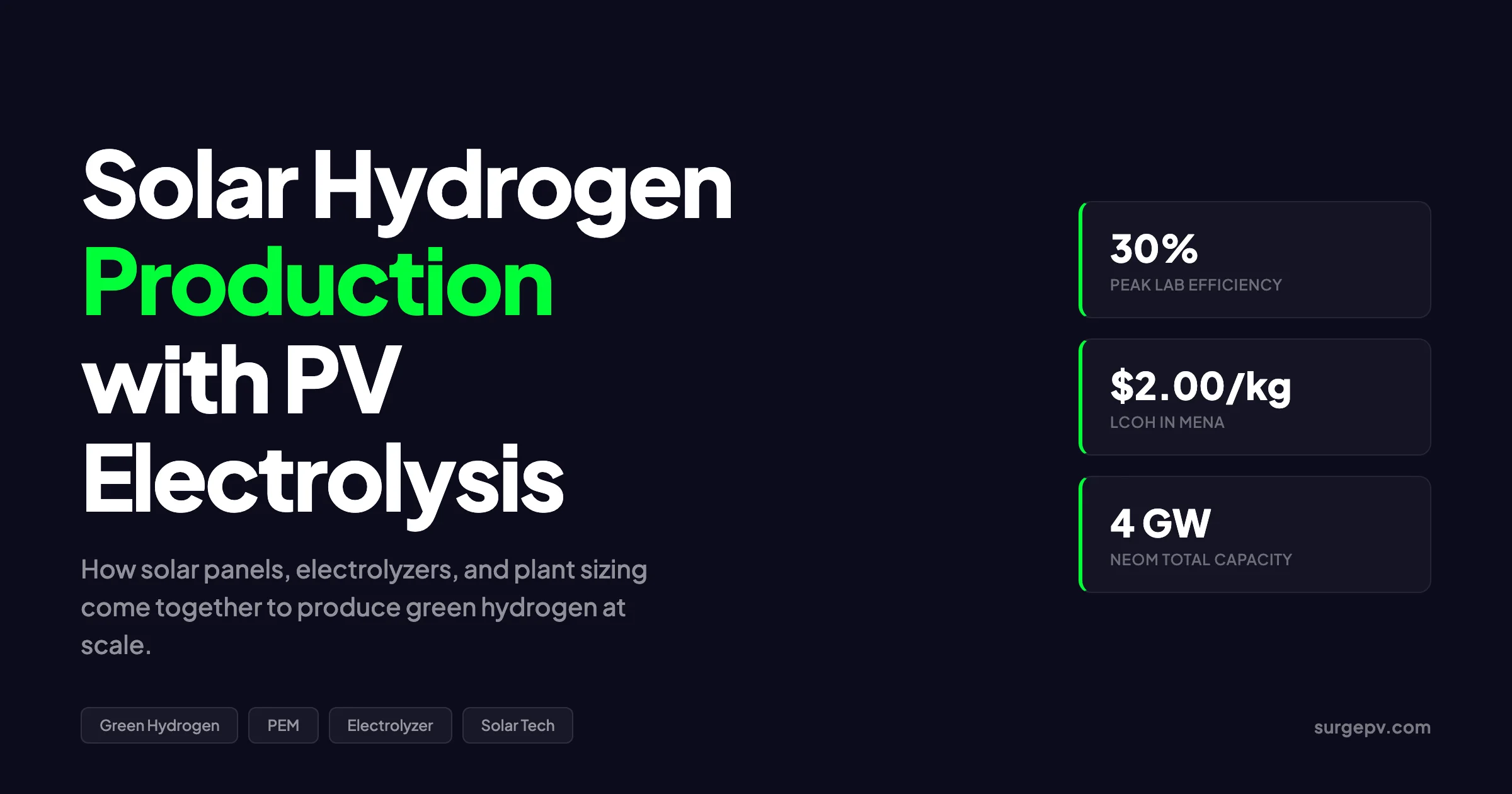
Solar hydrogen production uses PV electricity to split water into hydrogen and oxygen. In 2026, the cheapest projects in MENA and Australia produce green hydrogen at $2.00–$2.50/kg using a 2:1 PV-to-electrolyzer ratio. PEM electrolyzers respond fastest to solar variability, but alkaline units cost less. Capacity factors for solar-only systems stay in the 20–30% range, which is the single biggest driver of cost.
Here is what this guide covers:
- How PV electrolysis works at a system level
- PEM, alkaline, SOEC, and AEM electrolyzers compared
- Solar-to-hydrogen efficiency: lab records versus field data
- Plant sizing ratios and why the 2:1 rule dominates
- LCOH economics in 2026 by region
- Direct-coupled, grid-coupled, and hybrid project architectures
- Real projects: NEOM, Fukushima, NortH2, and others
- Water, land, and balance-of-system constraints
- What solar companies and installers should do now
The State of Solar Hydrogen Production in 2026
Global installed electrolyzer capacity reached approximately 3 GW by the end of 2025, up from under 300 MW in 2020. Solar-powered electrolysis accounts for roughly one-third of that total. The growth is driven by three forces: falling solar generation costs, electrolyzer CAPEX declines, and government subsidies. For installers using solar software to model commercial projects, this shift opens a new category of project economics built around on-site hydrogen offtake.
Market Size and Growth
The International Renewable Energy Agency (IRENA) estimates that global green hydrogen demand could reach 95 million tonnes annually by 2050. In 2025, production was under 2 million tonnes, almost entirely from pilot and demonstration plants. The gap between ambition and output is large, but the pipeline is accelerating.
Key demand centers include steel production, ammonia synthesis, refining, shipping fuels, and heavy transport. Steel alone could consume 50 million tonnes of green hydrogen per year by 2050 if the sector decarbonizes on schedule. Ammonia, used in fertilizers and increasingly as a shipping fuel carrier, is the nearest-term market.
Regional Production Hubs
Three regions dominate green hydrogen project development in 2026:
| Region | Installed Electrolyzer Capacity (2025) | Notable Projects | Key Advantage |
|---|---|---|---|
| Middle East & North Africa (MENA) | ~1.2 GW | NEOM, Al Reyadah | Cheap solar ($0.015–0.025/kWh), land availability |
| Australia | ~0.4 GW | H2Global, Port Bonython | High irradiance, export ports, government funding |
| Europe | ~0.8 GW | NortH2, HyDeal | Policy support (REPowerEU), industrial demand |
| China | ~0.5 GW | Multiple domestic | Low electrolyzer manufacturing cost |
| United States | ~0.3 GW | SGH2, multiple Gulf Coast | IRA 45V tax credit up to $3.00/kg |
The table shows MENA in the lead on installed capacity, but China dominates electrolyzer manufacturing. Over 60% of the world’s electrolyzer stacks are produced in China, primarily alkaline units. Europe leads on project announcements under REPowerEU, though many remain in development.
Policy and Incentive Environment
Government support shapes where projects get built. The U.S. Inflation Reduction Act’s 45V tax credit offers up to $3.00 per kilogram for hydrogen with very low lifecycle emissions. This credit can bring the net cost of solar hydrogen below $1.00/kg in the best U.S. locations. However, final 45V rules were only released in January 2025, and project delays have followed.
The European Union’s REPowerEU plan targets 10 million tonnes of domestic green hydrogen production by 2030, plus 10 million tonnes of imports. The EU has allocated approximately EUR 18 billion through the European Hydrogen Bank and national schemes. Member states including Germany, Spain, and the Netherlands have dedicated hydrogen pipeline and import terminal programs. Also see: Germany solar subsidies. Also see: Spain net metering.
In Saudi Arabia, the NEOM Green Hydrogen Company completed an $8.4 billion financial close in 2023. The project is backed by a 30-year exclusive offtake agreement with Air Products, not production subsidies. This offtake-first model is becoming the template for bankable green hydrogen finance.
Why Solar, Not Wind or Nuclear?
Solar dominates new green hydrogen projects for three reasons. First, solar LCOE in the best locations has fallen below $0.02 per kilowatt-hour. At that price, electricity cost is no longer the primary barrier to cheap hydrogen. Second, solar is modular. A project can start with a few megawatts and scale. Third, solar resources align geographically with many of the best hydrogen export locations: the Arabian Peninsula, North Africa, and Australia. For Africa-specific compliance details, see Africa solar compliance.
Wind hydrogen projects exist, particularly in Northern Europe and offshore zones. Nuclear-powered electrolysis is technically viable but faces long construction timelines and regulatory complexity. For green hydrogen at scale before 2035, solar is the default choice.
How PV Electrolysis Works: The Technical Foundation
A solar hydrogen production system has three main components: the photovoltaic array, the power conditioning and control system, and the electrolyzer. Water purification, hydrogen compression, and storage complete the chain.
The Chemistry of Water Splitting
Electrolysis splits water (H2O) into hydrogen gas (H2) and oxygen gas (O2) using electrical energy. The reaction is:
At the cathode: 2H2O + 2e− → H2 + 2OH− (alkaline) or 2H+ + 2e− → H2 (acidic/PEM)
At the anode: 2OH− → H2O + 1/2O2 + 2e− (alkaline) or H2O → 2H+ + 1/2O2 + 2e− (acidic/PEM)
The theoretical minimum energy required to split 1 kg of water is 39.4 kWh (lower heating value, LHV). In practice, electrolyzers consume 47–66 kWh per kg of hydrogen, depending on the technology and operating point. The difference between theoretical and actual consumption is the system inefficiency, caused by overpotentials at the electrodes, ohmic losses in the electrolyte and membrane, and auxiliary power for pumps and controls.
System Components
Photovoltaic Array: The PV system generates DC electricity. For solar hydrogen, utility-scale ground-mounted systems are most common. Bifacial panels are increasingly used because they capture reflected light from the ground, boosting output by 5–10% in high-albedo locations like desert sand. Read Bifacial Solar Panel Design Guide for a complete walkthrough.
Power Conditioning: The DC output from PV must be converted to the appropriate voltage and current for the electrolyzer. Some systems use DC-DC converters directly. Others invert to AC and use standard rectifiers. Direct DC coupling avoids inverter losses but requires careful voltage matching between the PV array and electrolyzer stack.
Electrolyzer Stack: The core unit where water splitting occurs. Stacks contain multiple cells in series. A 1 MW alkaline stack might contain 50–100 cells, each operating at 1.5–2.0 volts. A PEM stack contains fewer cells at higher current density.
Gas Processing: Raw hydrogen from the electrolyzer contains water vapor and trace oxygen. It passes through a gas dryer to reach 99.9% purity or higher. For industrial use, further purification to 99.999% (five nines) may be needed.
Hydrogen Storage: Hydrogen is stored as compressed gas, liquid, or in metal hydrides. Most solar hydrogen projects use compressed gas at 350 or 700 bar. Underground salt caverns and depleted gas fields are being explored for large-scale seasonal storage.
Water Treatment: Electrolyzers need purified water. Tap water contains minerals that foul membranes and electrodes. Reverse osmosis and ion exchange systems remove impurities. Demineralized water quality is typically required for PEM systems; alkaline systems are more tolerant.
Energy Flow and Losses
A typical solar hydrogen production chain loses energy at every step. A 1,000 kWh solar input might yield 120–150 kWh of hydrogen energy content. The major loss points are:
- PV conversion efficiency: 20–22% of solar energy becomes electricity
- DC cabling and power conditioning: 2–5% loss
- Electrolyzer efficiency: 60–83% of electrical energy becomes hydrogen
- Gas compression and storage: 5–10% of hydrogen energy
The combined solar-to-hydrogen efficiency for commercial systems is typically 10–16%. Research demonstrations have reached 30%, but only under ideal laboratory conditions with concentrator photovoltaics.
Pro Tip
If you are sizing a system for a client, use 50–55 kWh of electricity per kilogram of hydrogen as your rule of thumb. This accounts for real-world electrolyzer efficiency, auxiliary loads, and margin for voltage fluctuation from variable solar output.
Electrolyzer Technologies Compared: PEM vs Alkaline vs SOEC vs AEM
Four electrolyzer technologies compete for the solar hydrogen market. Each has distinct advantages and trade-offs. The right choice depends on the project scale, solar resource quality, capital budget, and operating strategy.
Alkaline Water Electrolysis (AWE)
Alkaline electrolyzers use a liquid potassium hydroxide (KOH) electrolyte, typically at 20–30% concentration, and operate at temperatures of 60–80 degrees Celsius. They use non-precious metal catalysts, primarily nickel and iron, which keeps material costs low.
Advantages: The lowest CAPEX of any commercial technology, typically $500–800 per kilowatt in 2026. Proven at industrial scale for decades. Long stack lifetime, often exceeding 60,000 hours. Tolerant of lower water purity than PEM.
Disadvantages: Lower efficiency than PEM, typically 50–68% LHV. Slower response to power fluctuations. Minimum load of 20–40% rated capacity, meaning they cannot run efficiently at very low solar output. Hydrogen purity is lower than PEM, requiring additional purification for fuel cell use. Large footprint due to liquid electrolyte circulation.
Solar coupling suitability: Moderate. The slow ramp rate is a challenge for direct solar coupling without a battery buffer. Newer alkaline designs are improving dynamic response, but PEM remains the leader for variable renewables.
Proton Exchange Membrane (PEM)
PEM electrolyzers use a solid polymer membrane (usually Nafion) that conducts protons. They operate at 50–80 degrees Celsius and use platinum and iridium catalysts on the electrodes.
Advantages: Fastest dynamic response of any technology. Can ramp from 0% to 100% in seconds. High efficiency, 65–83% LHV. Compact design. Produces very high-purity hydrogen (99.999%) directly. Operates at high pressure (up to 30 bar), reducing downstream compression costs.
Disadvantages: Highest CAPEX, $700–1,000 per kilowatt in 2026. Relies on scarce noble metals (iridium, platinum), creating supply chain risk. Membrane degradation limits stack life to 40,000–60,000 hours. More sensitive to water impurities than alkaline.
Solar coupling suitability: Excellent. The rapid ramp response makes PEM the default choice for direct-coupled solar hydrogen systems. When clouds pass or output dips at sunset, the PEM stack adjusts almost instantly.
Solid Oxide Electrolyzer Cells (SOEC)
SOECs operate at very high temperatures, 700–1,000 degrees Celsius, using a ceramic electrolyte that conducts oxygen ions. The high temperature enables co-electrolysis of water and carbon dioxide to produce syngas.
Advantages: Highest electrical efficiency of any technology. IRENA estimates SOECs are 10–26% more efficient than alkaline or PEM by kWh per kg of hydrogen. Can use waste heat from industrial processes or concentrated solar thermal plants. Co-electrolysis capability for syngas production.
Disadvantages: Not yet commercially scalable for standalone PV plants. Thermal cycling causes ceramic degradation, limiting operational flexibility. Long startup times from cold. Very high operating temperature requires specialized materials and safety systems. Limited track record at scale.
Solar coupling suitability: Specialized. SOECs pair best with concentrated solar power (CSP) plants that provide both steam and electricity, or with industrial waste heat sources. For standard PV-only systems, SOEC is not yet viable.
Anion Exchange Membrane (AEM)
AEM electrolyzers combine aspects of PEM and alkaline designs. They use a solid polymer membrane that conducts hydroxide ions, with non-noble metal catalysts.
Advantages: Potentially lower cost than PEM because it avoids iridium and platinum. Better efficiency than alkaline. Can operate with lower water purity than PEM. Compact like PEM.
Disadvantages: Still in early commercialization. Membrane durability is a concern. Limited operational data at scale. Fewer suppliers than PEM or alkaline.
Solar coupling suitability: Promising but unproven. AEM could become a cost-effective alternative to PEM for solar coupling if membrane lifetime improves. Watch this space for 2027–2028.
Comparison Table
| Parameter | Alkaline (AWE) | PEM | SOEC | AEM |
|---|---|---|---|---|
| Efficiency (LHV) | 50–68% | 65–83% | 80–90% | 60–75% |
| CAPEX 2026 ($/kW) | $500–800 | $700–1,000 | Not commercially available | $600–900 (projected) |
| Response time | Minutes | Seconds | Hours | Seconds–minutes |
| Minimum load | 20–40% | 0–5% | Not applicable | 5–15% |
| H2 purity | 99.5–99.8% | 99.999% | 99.9% | 99.5–99.9% |
| Stack lifetime | 60,000+ h | 40,000–60,000 h | Unknown | Unknown |
| Catalysts | Nickel, iron | Platinum, iridium | Ceramic, nickel | Non-noble metal |
| Commercial maturity | High | High | Low | Emerging |
| Best for solar coupling | Grid-coupled with buffer | Direct-coupled | CSP/thermal hybrids | Future alternative |
The table shows why most 2026 solar hydrogen projects choose PEM for direct coupling and alkaline for grid-connected plants with stable baseload. SOEC remains a research and pilot technology for PV applications.
Design Solar Projects That Scale
Whether you are sizing a 100 kW rooftop or a 10 MW hydrogen-ready solar farm, the right design tool makes the difference. SurgePV handles multi-megawatt layouts, shadow analysis, and financial modeling in one platform.
Book a DemoNo commitment required · 20 minutes · Live project walkthrough
For a direct comparison, see Arka 360 vs SurgePV.
Solar-to-Hydrogen Efficiency: Lab Records vs Real-World Performance
Solar-to-hydrogen (STH) efficiency measures what percentage of incoming solar energy ends up as chemical energy stored in hydrogen. It is the single most important performance metric for a PV-electrolysis system.
How STH Is Calculated
STH efficiency equals the energy content of the hydrogen output divided by the total solar energy input, expressed as a percentage:
STH (%) = (H2 production rate × LHV of H2) / (Solar irradiance × PV area) × 100
Using the lower heating value (LHV) of hydrogen, 33.3 kWh per kilogram, a system producing 1 kg of hydrogen per day from a 10 square meter PV array receiving 5 kWh per square meter per day would have an STH of:
(33.3 kWh) / (5 kWh/m2 × 10 m2) × 100 = 66.6%. This is not physically possible because it ignores all system losses.
A realistic calculation for a commercial system: 1 kg H2 from a 50 square meter array at 5 kWh/m2/day = (33.3) / (250) × 100 = 13.3% STH.
Laboratory Records
Research demonstrations have pushed STH well beyond commercial levels. A landmark 2016 paper in Nature Communications reported 30.0% STH using a concentrator photovoltaic (CPV) system paired with a high-efficiency alkaline electrolyzer. The CPV module achieved 46.5% electrical efficiency under concentrated sunlight, and the electrolyzer operated at near-optimal current density.
In 2025, a Science Advances paper demonstrated a PV-electrolysis system with high STH efficiency under practical current densities. The system used a tandem photovoltaic cell with optimized bandgap matching to the electrolyzer voltage. The result validated that high STH is achievable outside concentrated-light conditions.
More recently, a concentrator PV-alkaline water electrolysis (CPV-AWE) system achieved a record 29.1% STH at current densities up to 240 mA per square centimeter. This is the highest STH reported for a practical operating current.
Commercial Reality
Commercial systems achieve far lower STH because they use standard silicon PV and operate across a wide range of conditions. A typical breakdown:
- Silicon PV module efficiency: 20–22%
- System-level PV losses (temperature, soiling, mismatch, cabling): 10–15%
- Inverter or DC-DC losses: 2–5%
- Electrolyzer efficiency at partial load: 60–75% LHV
- Auxiliary loads (pumps, cooling, controls): 3–5%
Multiplying these gives a commercial STH of roughly 10–16%. A well-optimized system with bifacial PV, high-efficiency PEM, and low auxiliary loads might reach 16–18%.
Why the Gap Matters
The gap between lab and field STH is not just an academic concern. Every percentage point of STH improvement reduces the LCOH by roughly 3–5%. A 15% STH system produces the same hydrogen as a 10% STH system using two-thirds the land and PV capacity. For large projects, that translates to millions of dollars in savings.
The practical path to higher STH in commercial systems includes:
- Bifacial and tracking PV to increase energy yield
- Higher-efficiency electrolyzers (next-gen PEM, eventual SOEC)
- Direct DC coupling to eliminate inverter losses
- Optimized operating strategies that run the electrolyzer at its most efficient point
Sizing a PV-Electrolysis Plant: The PV-to-Electrolyzer Ratio
Sizing a solar hydrogen plant is different from sizing a grid-connected solar array. The electrolyzer is the bottleneck, and its capacity factor drives economics.
The Capacity Factor Problem
Solar PV has a capacity factor of 20–35%, depending on location. An electrolyzer sized 1:1 with the PV array would sit idle 65–80% of the time. That ruins the economics because the electrolyzer is an expensive asset that must run as many hours as possible to spread its cost across maximum hydrogen output.
The solution is to oversize the PV array relative to the electrolyzer. The electrolyzer runs at higher capacity factor, and surplus PV electricity is curtailed during peak hours or exported to the grid.
The 2:1 Rule
The most common sizing ratio in operational projects is 2:1, PV capacity to electrolyzer capacity. Examples include:
- Fukushima Hydrogen Energy Research Field (Japan): 20 MW PV + 10 MW alkaline electrolyzer
- California pilot project: 1 MW PV + 500 kW PEM electrolyzer
- German small-scale project: 100 kW PV + 50 kW alkaline electrolyzer
A 2:1 ratio means the electrolyzer receives its rated power for roughly 2,500–3,000 equivalent full-load hours per year in a good solar location. That yields a capacity factor of 28–34%.
Optimization Studies
Academic studies have explored wider ratios. One analysis of a 4.2 MW PV system found that a 1 MW electrolyzer (roughly 4:1 ratio) achieved better electrolyzer utilization than a 2 MW unit (2:1 ratio), but produced half the total hydrogen. The optimal ratio depends on whether the goal is minimum LCOH or maximum hydrogen output.
Another study found that the lowest LCOH occurs at a PV-to-electrolyzer ratio between 1.4:1 and 4:1, depending on local solar resource, electricity export price, and electrolyzer cost trajectory. In general:
- Lower ratios (1.5:1–2:1) maximize hydrogen output per unit of land
- Higher ratios (3:1–4:1) minimize LCOH by boosting electrolyzer utilization
- Hybrid solar-plus-wind systems can use a 1:1 renewable-to-electrolyzer ratio because wind extends operating hours
Battery Buffering
Adding battery storage changes the calculus. A battery can store surplus midday solar energy and discharge it to the electrolyzer in the evening or during cloud events. This raises the electrolyzer capacity factor but adds CAPEX and round-trip energy losses. See Adding Battery Storage Services for detailed guidance.
A typical configuration might include 2–4 hours of battery storage per megawatt of electrolyzer capacity. The battery smooths the power curve and allows the electrolyzer to run closer to rated capacity for more hours per day. Whether this pays off depends on battery cost, local solar resource shape, and hydrogen price.
A Practical Sizing Example
Suppose a client wants to produce 1,000 kg of hydrogen per day in a location with 1,800 equivalent peak sun hours per year.
- Hydrogen target: 1,000 kg/day = 365,000 kg/year
- Energy required: 365,000 kg × 52 kWh/kg = 18.98 GWh/year (accounting for system losses)
- Required PV capacity: 18.98 GWh / 1,800 h = 10.5 MW DC
- Electrolyzer capacity at 2:1 ratio: 10.5 MW / 2 = 5.25 MW
This is a starting point. A detailed design would model hourly solar output, electrolyzer ramp constraints, and battery dispatch to refine the sizing. solar design software that includes time-series simulation is essential for this level of analysis.
Levelized Cost of Hydrogen (LCOH): The 2026 Economics
The levelized cost of hydrogen (LCOH) is the all-in cost to produce 1 kg of hydrogen over a plant’s lifetime, including capital, operation and maintenance, electricity, and financing. In 2026, LCOH from solar PV electrolysis spans a wide range depending on location and project structure.
Current LCOH by Region
| Region | LCOH Range ($/kg) | Key Drivers |
|---|---|---|
| MENA (Saudi Arabia, UAE) | $2.00–$2.50 | Cheap solar ($0.015–0.025/kWh), low land cost, high irradiance |
| Australia | $2.50–$3.50 | Good solar, export infrastructure, government support |
| Chile, Brazil | $2.50–$3.50 | Excellent solar in Atacama and Northeast, growing pipeline |
| United States (best sites) | $2.50–$4.00 | IRA 45V credit, good solar in Southwest |
| Europe (Southern) | $3.50–$5.00 | Moderate solar, high labor and regulatory costs |
| Europe (Northern) | $4.50–$6.00 | Poor solar resource, reliance on imports or grid power |
| China (manufacturing cost basis) | $2.00–$3.00 | Low electrolyzer CAPEX, cheap domestic manufacturing |
The spread between the cheapest and most expensive regions is roughly 3x. This is why hydrogen trade is emerging as a real economic force. Production will concentrate in low-cost regions and flow to high-demand centers.
Cost Breakdown
For a typical solar hydrogen project, the cost components are:
| Cost Component | Share of LCOH | Notes |
|---|---|---|
| Electricity | 55–70% | Dominant driver; every $10/MWh change shifts LCOH by ~$0.50/kg |
| Electrolyzer CAPEX | 15–25% | Falling rapidly; $700–1,000/kW for PEM in 2026 |
| PV CAPEX | 5–10% | Already low; $0.50–0.80/W for utility-scale |
| Balance of plant | 5–10% | Compression, storage, water treatment, piping |
| O&M | 3–5% | Includes stack replacement every 5–7 years |
| Financing | 3–8% | Varies by project risk and offtake certainty |
Electricity dominates. At a solar LCOE of $0.02/kWh, the electricity cost for 52 kWh/kg is $1.04/kg. At $0.05/kWh, it rises to $2.60/kg. This is why project site selection is the single most important decision.
CAPEX Trajectory
Electrolyzer costs have fallen steeply and will continue:
- 2020: $1,200–1,500/kW (PEM), $900–1,200/kW (alkaline)
- 2023: $900–1,200/kW (PEM), $700–1,000/kW (alkaline)
- 2026: $700–1,000/kW (PEM), $500–800/kW (alkaline)
- 2030 (projected): $400–600/kW (PEM), $300–500/kW (alkaline)
The decline is driven by scale economies, manufacturing automation, and technology improvements. Chinese manufacturers are leading on cost, with alkaline stacks now available below $400/kW at volume.
U.S. DOE Targets
The U.S. Department of Energy’s Hydrogen Shot program has set aggressive targets:
- $2/kg by 2026 — clean hydrogen cost target
- $1/kg by 2031 — ultimate stretch goal
These targets assume continued cost declines in both renewables and electrolyzers, plus policy support. The $1/kg target is achievable in the best locations with the IRA 45V credit, which offers up to $3.00/kg for very low-emission hydrogen.
Grid-Coupled vs Off-Grid Economics
Off-grid solar hydrogen avoids grid connection costs and can achieve very low electricity prices in high-resource locations. However, it requires oversizing the PV array or adding batteries to ensure the electrolyzer runs enough hours.
Grid-coupled systems can buy cheap daytime solar power and supplement with grid electricity at night. This increases the electrolyzer capacity factor but exposes the project to electricity price volatility. In markets with negative daytime prices or high renewable penetration, grid-coupled systems can achieve lower LCOH than off-grid ones.
The Importance of Offtake Agreements
The NEOM project proved that bankable green hydrogen finance depends on demand certainty, not just production subsidies. The $8.4 billion project was financed on the strength of a 30-year exclusive offtake contract with Air Products. This removed price risk and made the project investable for 23 banks.
For smaller solar hydrogen projects, offtake agreements with local industrial users, ammonia producers, or hydrogen refueling station operators are critical. Without contracted demand, financing is difficult regardless of how low the LCOH is.
Project Architectures: Direct-Coupled, Grid-Coupled, and Hybrid
Solar hydrogen projects use three main architectures. Each has different economics, complexity, and risk profile.
Direct-Coupled (DC-Coupled)
In a direct-coupled system, the PV array connects directly to the electrolyzer through a DC-DC converter. No grid connection is required. The electrolyzer runs only when the sun shines.
Advantages: No grid interconnection cost or approval. Simple system architecture. Lowest electricity cost because there are no grid fees or transmission losses. No grid dependence.
Disadvantages: Electrolyzer capacity factor limited to solar availability, typically 20–30%. No revenue from electricity export during surplus periods. Requires oversized PV or battery to smooth output. No backup if solar is low for extended periods.
Best for: Remote locations with no grid access. Islands. Industrial sites with consistent daytime hydrogen demand. Demonstration and pilot projects.
Grid-Coupled (AC-Coupled)
In a grid-coupled system, the PV array feeds into the grid through a standard inverter. The electrolyzer draws power from the grid. The PV and electrolyzer are not electrically connected.
Advantages: Electrolyzer can run 24/7 using grid power, achieving high capacity factor. Surplus PV electricity earns export revenue. Can purchase cheap grid power when renewable generation is high. Grid acts as an infinite buffer.
Disadvantages: Grid electricity may be expensive or carbon-intensive. Grid connection fees and demand charges add cost. Regulatory complexity for grid interconnection. If grid power is not green, the hydrogen is not green.
Best for: Industrial sites with existing grid connection. Locations where daytime grid prices are low due to high renewable penetration. Projects that need high electrolyzer utilization.
Hybrid Solar-Plus-Wind
Hybrid systems combine solar PV with wind turbines and sometimes battery storage. The two renewable sources complement each other: solar peaks at midday, wind often peaks at night or in different seasons.
Advantages: Much higher electrolyzer capacity factor, often 50–70%. More stable hydrogen production. Better utilization of expensive electrolyzer assets. Can achieve lower LCOH than solar-only in windy locations.
Disadvantages: Higher complexity. Wind resource is more site-specific than solar. Two sets of permits and maintenance contracts. Wind turbines have higher visual and environmental impact.
Best for: Coastal and offshore locations. Plains and ridge sites with strong wind. Large-scale export-oriented projects that need maximum output per unit of electrolyzer capacity.
Hybrid with Battery Storage
Battery storage can be added to any architecture. It stores surplus renewable energy and discharges it when generation is low.
Advantages: Smooths power output to the electrolyzer. Enables the electrolyzer to run at optimal efficiency point more often. Reduces ramping stress on the stack. Can shift production to times of higher hydrogen prices.
Disadvantages: Adds CAPEX (battery cost plus inverters). Round-trip energy losses of 10–15%. Additional maintenance and replacement cycle. May not be cost-effective at current battery prices for hydrogen-only projects.
Best for: Projects where hydrogen price varies by time of day. Systems with strict electrolyzer ramp rate limits. Locations where battery costs are subsidized.
Architecture Selection Framework
| Factor | Direct-Coupled | Grid-Coupled | Hybrid |
|---|---|---|---|
| Grid access | None needed | Required | Optional |
| Electrolyzer capacity factor | 20–30% | 50–90% | 50–70% |
| System complexity | Low | Medium | High |
| LCOH potential | Low in best solar sites | Variable | Lowest overall |
| Green hydrogen guarantee | Absolute | Depends on grid mix | Absolute |
| Best project size | 1–20 MW | 10 MW+ | 50 MW+ |
For most solar companies entering the hydrogen market, a grid-coupled architecture at an existing industrial site is the lowest-risk first step. Direct-coupled systems are ideal for off-grid or demonstration projects. Hybrid architectures make sense at scale for export-oriented producers.
Major Projects and Lessons Learned
Real projects reveal what works and what does not. Here are the most important solar hydrogen installations in operation or advanced construction as of 2026.
NEOM Green Hydrogen Company (Saudi Arabia)
The NEOM Green Hydrogen Company is the world’s largest green hydrogen project under construction. It is a joint venture between ACWA Power, Air Products, and NEOM.
- Capacity: 4 GW of combined solar and wind
- Electrolyzer: 1.2 GW (Thyssenkrupp alkaline)
- Output: 600 tonnes of hydrogen per day (as green ammonia)
- Investment: $8.4 billion
- Offtake: 30-year exclusive contract with Air Products
- Status: Solar and wind infrastructure over 95% complete as of early 2026; production start targeted for mid-2027
The lesson from NEOM is that scale and offtake certainty matter more than technology novelty. The project uses proven alkaline electrolyzers, not experimental technology. The financing was secured by a binding long-term purchase agreement, not by government subsidies alone.
Fukushima Hydrogen Energy Research Field (Japan)
The Fukushima FH2R is one of the largest operational solar hydrogen facilities. It was developed by Toshiba, Tohoku Electric Power, and Iwatani. For UK-specific information, see Battery Solar System Design UK. For UK-specific information, see Heritage Building Solar Case Study.
- Capacity: 20 MW solar PV + 10 MW alkaline electrolyzer
- Output: Up to 1,200 Nm3/h of hydrogen
- Use case: Power-to-gas and fuel cell vehicle refueling
- Status: Operational since 2020
FH2R demonstrated the 2:1 PV-to-electrolyzer ratio in practice. The project also proved that alkaline electrolyzers can handle solar variability with appropriate power conditioning, though with slower response than PEM. Japan’s limited land area and high electricity prices make domestic solar hydrogen expensive, so the project is primarily a research and demonstration platform.
NortH2 (Netherlands)
NortH2 is a large-scale green hydrogen initiative in the Netherlands, led by Shell, Equinor, RWE, and Gasunie.
- Planned capacity: 4 GW electrolyzer by 2030, scaling to 10 GW by 2040
- Power source: Offshore wind (primary) plus onshore solar
- Use case: Industrial decarbonization, export to Germany
- Status: In development; first electrolyzer phase under construction
NortH2 is notable for its hybrid architecture. Offshore wind provides the baseload, while solar PV supplements during summer months. The project plans to use existing natural gas pipeline infrastructure for hydrogen transport, avoiding the cost of new dedicated pipelines.
H2Global and European Projects
The European Hydrogen Bank and national programs have funded dozens of projects. Notable examples include:
- HyDeal (Spain/France): Ambition to produce 3.6 million tonnes of green hydrogen annually by 2030 at EUR 1.50/kg, using Iberian solar.
- Port of Rotterdam hydrogen import hub: Planned terminal to receive green ammonia from MENA and Australia, then crack it back to hydrogen.
- German national hydrogen core network: A 9,000 km pipeline network under development to connect production, storage, and demand centers. Also see: France solar feed-in tariffs.
Europe’s challenge is that solar resources in Northern Europe are insufficient for cheap domestic production. Southern Europe (Spain, Portugal, Italy) has better solar but less industrial demand. The solution is cross-border trade, which is why hydrogen pipeline infrastructure is a policy priority. Also see: solar panel ROI in Italy. For Italy-specific information, see Commercial Rooftop Solar Case Study Italy.
Lessons for Solar Installers
Four lessons emerge from these projects that are relevant to solar companies:
-
Start with the offtake. A project without a buyer for its hydrogen is not a project. Identify the hydrogen user before designing the system.
-
Oversize the PV array. The 2:1 PV-to-electrolyzer ratio is proven. Do not try to run a 1:1 system unless the electrolyzer is cheap enough to tolerate low utilization.
-
Use proven technology. Alkaline and PEM electrolyzers are the only technologies with enough field data to risk capital on. SOEC and AEM are for pilot projects, not commercial revenue.
-
Model hourly, not annually. Annual average calculations miss the critical details of electrolyzer ramping, curtailment, and battery dispatch. Use hourly time-series modeling for any serious project.
Water, Land, and System Balance: The Often-Overlooked Constraints
Hydrogen production requires more than just panels and an electrolyzer. Water, land, and balance-of-plant equipment are often underestimated.
Water Consumption
Electrolysis consumes water. The stoichiometry of the reaction means approximately 9 liters of water are needed to produce 1 kilogram of hydrogen. For a 10 MW electrolyzer running at 50% capacity factor, producing roughly 500 kg of hydrogen per day, daily water consumption is about 4,500 liters.
This sounds modest, but there are two catches. First, the water must be purified. Tap water contains minerals, chlorine, and organics that damage electrolyzer membranes. Reverse osmosis and deionization systems add CAPEX and energy consumption. Second, in arid regions where solar resources are best, water may be scarce. Seawater desalination is possible but adds cost and complexity.
Floating solar (FPV) is an interesting solution because it places the PV array directly on a water body, reducing land use and potentially providing a direct water source for the electrolyzer. Offshore FPV combined with desalination and electrolysis is an emerging concept for coastal hydrogen production.
Land Requirements
A solar hydrogen plant needs land for the PV array, the electrolyzer building, hydrogen storage, and supporting infrastructure. A rough estimate:
- PV array: 2–2.5 hectares per MW (ground-mounted, single-axis tracking)
- Electrolyzer and balance of plant: 0.1–0.2 hectares per MW
- Hydrogen storage (compressed gas): 0.05–0.1 hectares per MW
- Total: roughly 2.5 hectares per MW of electrolyzer capacity (at 2:1 PV ratio)
For a 100 MW electrolyzer plant, that is 250 hectares, or about 2.5 square kilometers. This is comparable to a large utility-scale solar farm. Land availability and permitting are significant constraints in densely populated regions.
Balance of Plant
The balance of plant (BOP) includes everything between the PV array and the hydrogen offtake point:
- Power electronics: DC-DC converters or inverters, switchgear, transformers
- Water treatment: Reverse osmosis, deionization, storage tanks
- Gas processing: Gas dryers, oxygen venting systems, hydrogen purifiers
- Compression: Compressors to raise hydrogen to storage pressure (350 or 700 bar)
- Storage: High-pressure tanks or tube trailers
- Cooling: Electrolyzers generate heat that must be rejected; cooling towers or dry coolers are needed
- Controls: SCADA systems for monitoring and automation
- Safety: Hydrogen detection, ventilation, explosion-proof electrical systems
BOP costs typically add 20–30% to the electrolyzer CAPEX. For a $1,000/kW PEM electrolyzer, the BOP might add $200–300/kW. These costs are often underestimated in early project budgets.
Hydrogen Transportation and Storage
Hydrogen is difficult to transport. It has a very low volumetric energy density, even when compressed. Options include:
| Method | Energy Density (MJ/L) | Suitability |
|---|---|---|
| Compressed gas (350 bar) | 4.5 | Short-distance trucking, local use |
| Compressed gas (700 bar) | 5.6 | Vehicle refueling, longer trucking |
| Liquid hydrogen (-253 C) | 8.5 | Long-distance shipping, large scale |
| Ammonia (liquid) | 11.3 | International trade, industrial use |
| LOHC (liquid organic carrier) | 2.0 | Existing liquid fuel infrastructure |
For export projects, ammonia is the dominant carrier. The NEOM project exports hydrogen as green ammonia because ammonia is easier to transport than liquid hydrogen and has an established global trade network. The ammonia is cracked back to hydrogen at the destination, with an energy loss of roughly 15–20%.
Regulatory and Permitting
Hydrogen projects face complex regulatory requirements. In most jurisdictions, hydrogen is classified as an industrial chemical, not an energy carrier. This affects building codes, safety standards, and environmental permits.
Key permitting considerations:
- Safety distances: Hydrogen facilities require setback distances from buildings and roads due to explosion risk
- Environmental impact: Water consumption, land use, and noise from compressors
- Grid interconnection: If grid-coupled, standard renewable energy interconnection processes apply
- Building codes: Hydrogen-specific codes may not exist; projects often use industrial gas standards
- Export approvals: Ammonia and liquid hydrogen exports require maritime safety certifications
Early engagement with local authorities is essential. Many regulators have limited experience with hydrogen projects, which can slow permitting timelines.
What Solar Installers and Solar Companies Should Know Now
The hydrogen market is still early, but the window for solar companies to position themselves is closing. Here is what to do now.
Understand Your Region’s Hydrogen Potential
Not every location is suitable for solar hydrogen. The best sites have:
- High solar irradiance: Over 1,800 equivalent peak sun hours per year
- Low land cost: Industrial or desert land at under $10,000 per hectare
- Water access: Reliable supply of purified water
- Industrial demand: Nearby steel, ammonia, refining, or transport users
- Policy support: Subsidies, offtake programs, or mandates
If your region lacks these conditions, focus on grid-connected solar and wait for hydrogen transport infrastructure to mature.
Add Hydrogen Modeling to Your Design Capability
Solar companies that design commercial and industrial projects should start modeling hydrogen production as a co-revenue stream. If a client has a large rooftop or ground-mounted system, excess daytime electricity could be directed to an electrolyzer instead of exported to the grid at low prices.
The analysis requires hourly modeling of:
- Solar generation profile
- Site electricity demand
- Grid export prices and constraints
- Electrolyzer operation and hydrogen revenue
This is a natural extension of the solar design software and solar financial modeling workflows that solar companies already use. Accurate solar shadow analysis software becomes even more important when an electrolyzer is on the load side, because any production shortfall translates directly into lost hydrogen output. The financial model should compare hydrogen revenue against grid export revenue for the same electrons, with solar proposal software generating the side-by-side scenarios for the client.
Watch the Electrolyzer Market
Electrolyzer prices are falling fast. Solar companies should track the supplier market and understand which technologies are ready for commercial deployment. Key suppliers to watch include:
- Alkaline: Thyssenkrupp, Siemens Energy, Cummins, HydrogenPro, Longi
- PEM: ITM Power, Plug Power, Siemens Energy, Cummins, Giner ELX
- SOEC: Sunfire, Topsoe, Bosch (development)
- AEM: Enapter, Versogen, EVOLOH
Most suppliers offer containerized systems that can be dropped onto a site with minimal civil works. A 1 MW containerized electrolyzer fits in a standard shipping container and can be installed in weeks.
Build Relationships with Hydrogen Buyers
The hardest part of a hydrogen project is not the technology. It is finding a buyer. Solar companies with relationships with industrial clients are well-positioned to identify hydrogen demand. Start conversations with:
- Steel and cement plants exploring decarbonization
- Ammonia and fertilizer producers
- Refineries needing hydrogen for hydrocracking
- Logistics companies with heavy truck or bus fleets
- Ports and shipping companies
Many of these buyers are already under pressure from regulators and customers to reduce emissions. Green hydrogen is one of the few solutions for sectors that cannot electrify directly.
Consider Certification and Guarantees of Origin
Green hydrogen commands a price premium over gray hydrogen, but only if it is certified. Certification schemes including CertifHy (Europe), TUV SUD, and the Green Hydrogen Standard verify that hydrogen is produced from renewable electricity with low lifecycle emissions.
Solar companies entering hydrogen should understand these schemes and plan for the metering, documentation, and auditing requirements. A project without certification will struggle to sell hydrogen at green premiums.
Action Items for 2026-2030
Solar hydrogen is not a distant technology. Projects are operating today, and the economics are improving fast. Here is what to focus on now.
1. Track LCOH in your region. The crossover point where green hydrogen beats gray hydrogen is approaching in the best solar locations. Know when it happens in your market.
2. Model hydrogen as a design option. For large commercial and industrial solar projects, add hydrogen electrolysis to the feasibility study. Compare hydrogen revenue against pure grid export.
3. Partner with electrolyzer suppliers. Most suppliers are eager for project pipelines. Build relationships now before demand outstrips supply.
4. Understand certification requirements. Green hydrogen premiums depend on verified renewable origin. Plan for the metering and documentation from day one.
5. Watch policy closely. Subsidies, mandates, and carbon pricing will determine where hydrogen projects are built. The policy environment is changing fast, particularly in the EU, U.S., and Middle East.
Frequently Asked Questions
What is solar hydrogen production via PV electrolysis?
Solar hydrogen production uses electricity from photovoltaic panels to power an electrolyzer, which splits water into hydrogen and oxygen. The hydrogen is stored, transported, or used directly as a zero-emission fuel or industrial feedstock. When the electricity comes from solar panels without fossil backup, the result is classified as green hydrogen.
What is the solar-to-hydrogen (STH) efficiency of PV electrolysis?
Commercial PV-to-electrolysis systems achieve STH efficiency between 10% and 16%. Laboratory demonstrations have reached 30% using concentrator photovoltaics paired with alkaline electrolyzers. The practical ceiling for standard silicon PV with PEM electrolysis is roughly 12-15%.
How much does solar hydrogen cost per kilogram in 2026?
The levelized cost of hydrogen (LCOH) from solar PV electrolysis ranges from $2.00 to $6.00 per kilogram in high-resource regions, depending on solar irradiance, electrolyzer CAPEX, and financing. In Europe and North Asia, costs typically land between $3.50 and $5.00 per kilogram. The U.S. DOE targets $2/kg by 2026 and $1/kg by 2031.
Which electrolyzer technology is best for solar coupling?
PEM electrolyzers handle variable solar output best because they ramp from standby to full load in seconds. Alkaline electrolyzers are cheaper and more durable but respond more slowly to power fluctuations. Solid oxide electrolyzers offer the highest efficiency but require external heat and are not yet commercially scalable for PV-only plants.
What is the optimal PV-to-electrolyzer capacity ratio?
Most operational solar hydrogen projects use a 2:1 ratio of PV capacity to electrolyzer capacity. For example, a 4 MW solar array paired with a 2 MW electrolyzer. This balances utilization and capital efficiency. Hybrid solar-plus-wind systems may use a 50:50 electrolyzer-to-renewable ratio to boost the electrolyzer capacity factor above 70%.
What water consumption does a solar hydrogen plant require?
Producing 1 kilogram of hydrogen through water electrolysis requires approximately 9 liters of water. A 10 MW solar hydrogen plant producing roughly 500 kilograms of hydrogen per day consumes about 4,500 liters of water daily. Purified or demineralized water is usually required to protect the electrolyzer membrane.
Where this fits
This article is part of SurgePV's Solar Technology hub, which works through the topic from first principles to the decisions a project team actually has to make.
