The rep who closes same-day does not have a better product. They have a better script for the moment the customer asks, “How much is this going to cost me every month?”
Most solar deals die in the financing conversation. Not because the numbers are bad. Because the rep fumbles the transition from system specs to payment structure. A homeowner who hears “I’ll send you some options” is a homeowner who never buys.
Most residential solar installations are financed rather than purchased with cash. That means the majority of your customers need a financing script, not a price script. The 7 scripts below are organized by financing type, built on SEIA market data and NREL cost analysis, and written for the post-Section 25D sales environment. No generic frameworks. No “adapt this to your style.” Word-for-word language you can use in the room today.
TL;DR — Solar Financing Pitch Scripts
Seven word-for-word scripts for every major solar financing type: zero-down loan, PPA, lease, cash, PACE, bill comparison, and same-day objection recovery. Each script is data-anchored, compliance-safe, and designed for in-room delivery with a live proposal.
In this guide:
- Why financing scripts outperform price scripts in solar sales
- Script 1: The zero-down loan close
- Script 2: The PPA pitch for non-owners
- Script 3: The solar lease for predictable payments
- Script 4: The cash purchase reframe
- Script 5: The PACE / commercial financing pitch
- Script 6: The bill comparison script — the universal closer
- Script 7: The “I need to think about it” rebuttal
- Frequently asked questions
Why Financing Scripts Close More Deals Than Price Scripts
Financing scripts close more deals than price scripts because they translate system cost into a monthly payment the customer can compare to their utility bill. When a rep speaks in dollars per month instead of dollars per watt, the customer sees immediate budget impact rather than an abstract capital expense.
Financing scripts close more deals because they remove the customer’s need to do math in their head. Most homeowners do not reject solar because the price is too high. They reject it because they cannot picture how the payment fits their budget.
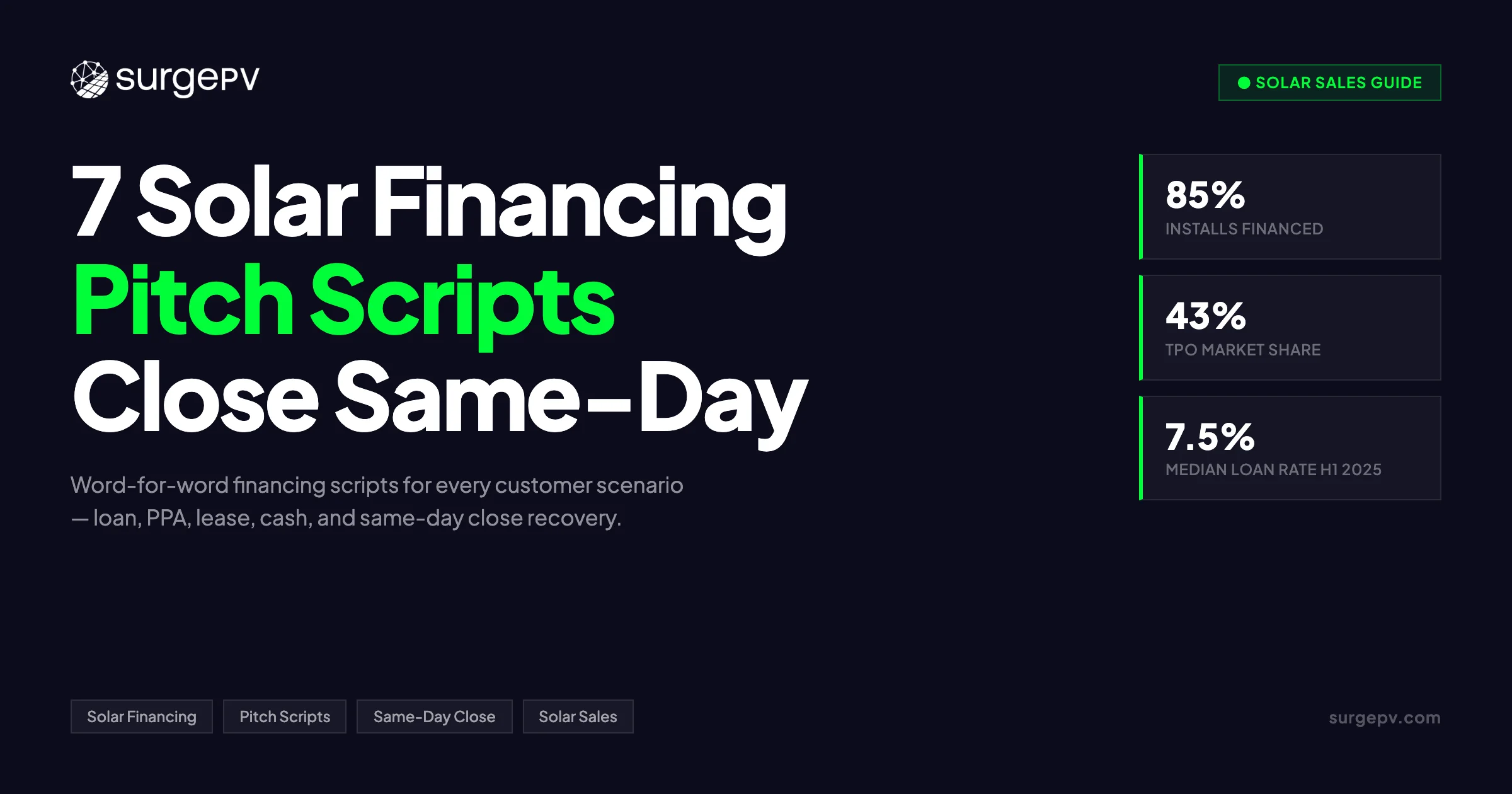
Third-party ownership has grown sharply. Lawrence Berkeley National Laboratory data shows residential third-party ownership rose from 26% in 2023 to 43% in 2024 (LBNL, 2025). Wood Mackenzie reported the TPO market surpassed loans in the second half of 2024, climbing to 52% (EnergySage, 2025). That means financing structure is the central question in most sales conversations. The majority of your customers are not asking “How much is the system?” They are asking “What is my monthly payment, and how does it compare to my electric bill?”
NREL analysis found that homeowners who use solar-specific loans can save up to 30% compared with consumers who lease through a conventional third-party owner (NREL, 2015). The levelized cost of energy for residential systems with solar loans was 19–29% lower than for systems with power purchase agreements (NREL, 2015). But that stat only works if the rep can explain it without a whiteboard and a PhD.
HubSpot’s 2025 State of Sales Report found that 35% of lost deals fail because the prospect does not see value for money (HubSpot, 2025). In solar, that objection is almost never about the sticker price. It is about the customer’s inability to connect the financing structure to their lived experience of paying a utility bill. The rep who can say, “Your loan payment replaces your utility bill at a lower fixed rate,” closes the gap. The rep who says, “This system is $17,000,” leaves the customer to do the translation alone.
EnergySage reported a median solar loan rate of 7.5% in H1 2025, with a median loan term of 25 years (EnergySage, 2025). As of H1 2025, a 7 kW system at $2.48/W finances to a monthly payment that often sits below the customer’s average utility bill. The script’s job is to make that comparison visible, immediate, and irrefutable. That is why financing scripts beat price scripts. They do not sell equipment. They sell a payment swap.
Script 1: The Zero-Down Loan Script
The zero-down loan script reframes the conversation from upfront capital to monthly cash flow. It places the fixed loan payment side by side with the rising utility bill, showing the customer that they can start saving immediately without savings in the bank. The close isolates whether the monthly number fits the budget.
The zero-down loan script turns “I don’t have the money” into “I can start saving immediately.” It works because it reframes the conversation from upfront capital to monthly cash flow. The customer does not need savings. They need a lower fixed payment.
EnergySage reported a median solar loan rate of 7.5% in H1 2025 (EnergySage, 2025). That makes this the most common script you will use. At that rate, the monthly payment on a typical 7 kW system often falls between $120 and $180. The EIA reported the average US residential electric bill was approximately $144 per month in 2024 (EIA, 2024). The script’s entire purpose is to place those two numbers side by side and let the math close.
NREL analysis found the levelized cost of energy for residential systems with solar loans was 19–29% lower than for systems with power purchase agreements (NREL, 2015). That means the customer who owns via loan keeps more lifetime value than the customer who leases. Your job is to make that advantage feel tangible, not theoretical. Do not say “lower levelized cost of energy.” Say “you pay less per kilowatt-hour, and you own the asset.”
When to use this script: The customer says, “I don’t have the money right now,” or “I was thinking about saving up and paying cash later.” This is also your default script for the rate-averse buyer who wants to own but cannot stomach a lump sum.
Pro Tip
Never lead with the loan term. Lead with the monthly payment. The customer cares about cash flow, not amortization. Introduce the term only if they ask.
Rep: “Most of our customers don’t pay anything upfront. Here’s how it works: your loan payment replaces your electric bill. Right now you’re paying the utility about $140 a month, and that number goes up every year. With the solar loan, you’re looking at about $135 a month, fixed, for 20 years. You own the system. The payment never changes. And in year 8, it’s paid off — then your power is basically free.”
Rep: “The only difference is who gets the check. Right now you send it to the utility. After this, you send a smaller check to the lender. Same roof, same panels, lower bill.”
Rep: “Let me show you the two numbers on screen. This is what you pay the utility over 25 years with rate increases. This is what you pay with the loan. Which one feels better?”
Close question: “If the loan payment fits your budget, is there any other reason we wouldn’t move forward today?”
This script works because it avoids two common errors. First, it does not mention tax credits as a selling point. The Section 25D residential investment tax credit expired on December 31, 2025 (IRS, 2025). For loan and cash customers, there is no federal credit to claim. Pitching it is non-compliant and destroys trust. Second, the script does not use jargon like “dealer fee” or “APR spread.” Those terms create confusion, and confusion kills closes.
If the customer asks about total interest paid, answer honestly. “Yes, you pay interest over 20 years. But you also avoid 25 years of utility rate hikes. EIA data shows US residential electricity prices rose approximately 2.8% annually from 2014 to 2024 (EIA, 2025). At that pace, your $140 bill becomes $280 by year 25. The loan payment stays flat. That’s the trade.”
Script 2: The PPA Script (No Ownership, Just Savings)
The PPA script sells cheaper electricity, not equipment. It targets customers who want lower power costs without ownership, maintenance, or credit hurdles. The rep locks in a per-kWh rate below the utility average, guarantees performance, and transfers responsibility for repairs to the provider. The close confirms the rate and zero-maintenance value.
The PPA pitch works for the customer who wants lower power costs but does not want to own, maintain, or insure solar panels. You are selling them cheaper electricity with zero responsibility, not equipment.
Residential solar PPA rates typically range from $0.08 to $0.20 per kWh depending on region and provider (SolarTech Online, 2025). The national average residential electricity rate was approximately $0.166 per kWh in 2024 (EIA, 2025). That gap is the entire pitch. The customer pays only for the power the panels produce. No upfront cost. No loan. No maintenance calls. The provider owns the system, claims the commercial ITC where applicable, and passes a portion of that value through as a lower rate.
Third-party ownership has expanded significantly. Lawrence Berkeley National Laboratory data shows residential TPO rose from 26% in 2023 to 43% in 2024 (LBNL, 2025). That share may rise further in 2026. Wood Mackenzie and SEIA anticipate a 19% residential market contraction in 2026 following the Section 25D expiration (SEIA/Wood Mackenzie, 2026). TPO providers can still access the 30% commercial investment tax credit under Section 48E for systems placed in service by December 31, 2027 (Solar Permits Solutions, 2026). That gives TPO providers a cost advantage that loan and cash sales no longer enjoy. The PPA pitch in 2026 is stronger than it was in 2024.
When to use this script: The customer says, “I don’t want to own the panels,” or “What if something breaks?” This is also the right script for credit-challenged buyers who may not qualify for a loan at competitive rates.
Rep: “With a PPA, you don’t buy the panels. You just buy the power they make — at a locked rate that’s lower than what the utility charges. Right now you’re paying about 17 cents per kilowatt-hour. With this PPA, you’d pay 12 cents. Locked. For 20 years.”
Rep: “If the panels underproduce, you don’t pay for what you didn’t get. If they break, the company fixes them. You never climb on the roof. You never call an electrician. You just get a cheaper electric bill.”
Rep: “Here’s the catch: you don’t get the tax credits because you don’t own the system. But you also don’t take the risk. The provider does. For a lot of people, that’s the right trade.”
Customer: “What happens if I sell the house?”
Rep: “Good question. The PPA transfers to the new owner. They keep the same locked rate. In most markets, homes with solar sell faster and for more money — even with a PPA attached. The buyer gets cheaper power from day 1. It’s actually an easier handoff than a loan, because there’s no bank to notify.”
Close question: “Does the locked rate and zero maintenance sound like what you’re looking for?”
The PPA script requires one specific discipline: never oversell ownership benefits. The PPA customer does not own the system. They do not get to claim incentives. They do not control the equipment. If you blur that line, you create a CFPB complaint. The CFPB’s 2024 Solar Financing Issue Spotlight documented complaints from customers who were told they “wouldn’t have to pay an electric bill” and ended up paying more (CFPB, 2024). Be precise. The PPA customer pays for power. It is cheaper power. That is enough.
Script 3: The Solar Lease Script (Fixed Monthly Payment)
The solar lease script offers a flat monthly payment that never changes with weather or usage. It appeals to risk-averse customers who prioritize budget certainty over maximum lifetime savings. The rep contrasts the lease’s predictability against a loan’s eventual ownership, letting the customer self-select based on what matters more to them.
The solar lease script serves the customer who wants predictability above all else. They do not want to watch their bill fluctuate with production months. They want a fixed number they can budget around.
Solar lease payments typically range from $50 to $250 per month depending on system size and local market conditions (SolarTech Online, 2025). Unlike a PPA, where the bill varies with production, a lease payment is flat. Month in, month out. That stability is the selling point. The customer trades some upside potential — months where production exceeds usage — for the comfort of never being surprised.
Leases and PPAs both fall under TPO, but they appeal to different psychologies. The PPA customer is rate-shopping. The lease customer is risk-averse. Pitch a lease when the customer says, “I just want to know exactly what I’m paying every month.”
When to use this script: The customer values stability over maximum savings. They may be on a fixed income, or they may have been burned by variable utility bills in extreme weather months.
Rep: “A lease is the simplest option. You pay one fixed amount every month. It doesn’t change if it’s cloudy. It doesn’t change if you use more power in August. It’s the same number, every month, for the lease term.”
Rep: “Here’s the difference between a lease and a loan. With a loan, you own the panels after you pay them off. With a lease, the company owns them — but your payment is usually lower than a loan payment, because you’re not buying the system. You’re renting it.”
Rep: “The trade-off is this: with a loan, in year 10 or 12, you own the system outright and your payment drops to near zero. With a lease, you keep paying the fixed amount through the term. But you never worry about maintenance, inverter replacement, or roof penetrations. That’s covered.”
Rep: “Some of our customers choose a lease because they want to go solar now, lock in a lower payment, and not think about it again. Others choose a loan because they want to own the asset. There’s no wrong answer — it depends on what matters more to you: lowest lifetime cost, or lowest stress.”
Close question: “If I could give you a fixed payment that’s lower than your average utility bill, and you never have to maintain the system, would that work for your budget?”
This script includes an explicit lease-vs-loan comparison because customers often ask. Do not avoid the comparison. Address it head-on. The lease is lower stress. The loan is higher long-term return. Let the customer self-select based on their priorities. HubSpot found that 30% of deals fail because the seller has not established enough trust with the prospect (HubSpot, 2025). Reps who try to steer every customer toward the product with the highest commission create distrust.
Script 4: The Cash Purchase Script (“Why Don’t I Just Pay Cash?”)
The cash purchase script respects the customer’s liquidity while showing the opportunity cost of tying up capital. It confirms that cash delivers the fastest payback and highest total savings, then asks what else that capital could earn. The close presents cash and financing as two valid strategies with different risk-return profiles.
The cash purchase script does not try to talk the customer out of paying cash. It reframes the decision so they understand the opportunity cost of tying up capital in a depreciating asset — even one that produces energy.
Cash purchases represented a significant share of the 2025 residential market, though exact splits shift quarterly with policy changes. These customers have liquidity. They are often retired, recently sold a business, or have accumulated savings. Their instinct is to avoid interest. Your job is to show them that avoiding interest may cost them more than paying it.
Cash purchases typically deliver the fastest payback — often 6 to 9 years — and the highest lifetime savings, because there is no dealer fee, no interest, and no credit check. The customer owns the system outright from day 1. Those are real advantages. Do not dismiss them. But also show the customer what else their capital could do.
When to use this script: The customer says, “I was planning to pay cash,” or “I don’t like debt.” This is also the right script for the customer who asks about financing but prefers to avoid debt.
Rep: “Paying cash is the fastest way to own the system free and clear. No interest. No lender. No monthly payment. Most cash customers break even in 6 to 9 years, and everything after that is pure savings. If your goal is maximum lifetime return, cash wins.”
Rep: “But let me ask you this: what is your cash earning right now? If it’s sitting in a savings account, it’s probably making 4%. The solar system, fully paid off, gives you a return of about 8% to 12% per year in avoided utility costs. That’s good. But if you finance the system at 7.5% and leave your cash invested elsewhere at a higher return, you might come out ahead.”
Rep: “Here’s the math. A $17,000 system paid in cash saves you the interest, yes. But it also ties up $17,000 that you can’t use for an emergency, an investment, or another project. A loan at 7.5% costs you about $7,000 in interest over 20 years. But you keep the $17,000 liquid. For some people, liquidity is worth more than the interest savings.”
Rep: “There’s no wrong choice here. Cash gives you the highest total savings. A loan gives you the lowest monthly impact and keeps your cash working elsewhere. Which matters more to you: owning it outright today, or keeping your options open?”
Close question: “If we run both scenarios on screen and the numbers are close, which way are you leaning?”
This script respects the customer’s intelligence. It does not treat cash as a mistake. It treats cash as one of two valid strategies with different risk-return profiles. That framing builds trust. It also opens the door to a hybrid approach — a larger down payment with a smaller loan — which many customers have not considered.
When presenting the cash option, be explicit about what expired. The Section 25D residential investment tax credit is no longer available for expenditures made after December 31, 2025 (IRS, 2025). Cash customers in 2026 do not get a 30% federal credit. Price your cash proposal accordingly. Do not let the customer discover this from their accountant. It will destroy the deal and potentially expose you to a misrepresentation claim.
Generate Proposals That Match Your Financing Pitch
SurgePV’s financial tool models loan, lease, and PPA scenarios side-by-side so your script matches the numbers in the room.
Book a DemoNo commitment required · 20 minutes · Live project walkthrough
Script 5: The PACE / Commercial Financing Script
The PACE script opens a property-secured financing path for commercial customers who want non-recourse funding that stays off the balance sheet. It explains that repayment travels with the property, not the owner, making it attractive for landlords and developers. The close asks whether property-secured financing fits the capital strategy.
The PACE script opens a financing path for commercial customers and property owners who do not qualify for conventional loans or who want to keep debt off their balance sheet. PACE — Property Assessed Clean Energy — covers 100% of project cost and repays through a property tax assessment, typically over 10 to 30 years (Figure, 2025).
C-PACE-enabling legislation exists in more than 38 states plus Washington, D.C., with active programs in 30-plus states (EPA, 2022). R-PACE is currently offered in California and Florida; Missouri ended its residential program in August 2024 (PACENation, 2026; SolarTech Online, 2026). R-PACE has funded billions in residential energy improvements, with California alone accounting for more than $2.4 billion across nearly 100,000 projects since 2014 (SolarTech Online, 2026). For commercial solar, C-PACE is often the only financing tool that requires no personal guarantee and does not appear as traditional debt.
The key distinction: PACE is tied to the property, not the owner. If the property sells, the assessment transfers to the buyer. That makes PACE attractive for landlords, property developers, and businesses with high turnover or complex ownership structures. It also makes PACE viable for customers with non-standard credit, since the financing is secured by the property tax lien.
When to use this script: The customer is a business owner, commercial property manager, or landlord. Or the residential customer has been declined for a solar loan and needs an alternative path.
Rep: “PACE is different from a bank loan. The lender looks at your property, not your personal credit score. The financing is attached to the property tax bill. You repay it twice a year through your property tax assessment.”
Rep: “Here’s why that matters for a business. First, it’s 100% financing. No upfront cost. Second, it doesn’t show up as a liability on your balance sheet the way a bank loan does. Third, if you sell the building, the new owner takes over the payments — because the financing stays with the property, not with you.”
Rep: “The term is usually 20 to 25 years, which is longer than most solar loans. That keeps the annual payment low. And because the assessment is a property tax obligation, it may be tax-deductible. You’ll want to confirm that with your accountant, but many of our commercial clients structure it that way.”
Customer: “What if I can’t make the tax assessment payment?”
Rep: “That’s the same risk as any property tax obligation. The assessment is senior to most other liens. That is actually why the rates are competitive — the lender has strong collateral. But it also means you need to treat it like property tax: budget for it, pay it on time. If your business has stable cash flow and a long-term lease or ownership position, PACE is usually the lowest-cost commercial financing available.”
Close question: “Does a property-secured financing option that stays off your balance sheet fit your capital strategy?”
PACE requires more disclosure than residential loans. The CFPB has flagged PACE products for inadequate consumer protections, noting that the super-priority lien creates incentives for origination without regard to affordability (Federal Register, 2024). Your script must be precise. Never say “it’s just like a loan.” It is not. Never say “it’s risk-free.” No financing is. Position PACE as a specialized tool for a specific customer type: property owners with stable assets who want non-recourse, long-term financing.
For commercial solar proposals, pair this script with your solar proposal software to show the PACE payment alongside operating cash flow. Business owners need to see the annual assessment as a line item against energy savings, not in isolation.
Script 6: The Bill Comparison Script (The One That Closes)
The bill comparison script replaces abstract pricing with a concrete 25-year side-by-side comparison. It shows the total cost of staying with the utility against the total cost of going solar, making the delta visible and emotional. The close asks the customer which column feels like the better use of their money.
The bill comparison script is the most universal close in solar sales. It works for any financing type. It works for any customer profile. It works because it replaces abstract pricing with a concrete, emotional comparison: “Here is what you are doing now. Here is what you could be doing instead.”
EIA data shows US residential electricity prices rose approximately 2.8% annually from 2014 to 2024 (EIA, 2025). At that escalation rate, a $140 monthly bill becomes roughly $280 over 25 years. The total spend exceeds $65,000. A financed solar system, by contrast, locks in a lower payment and eliminates the escalation. That is the comparison. The script’s job is to make it visible.
This script pairs naturally with solar design software that models production and financials in real time. The customer watches you build the comparison on screen. They see the numbers change as you adjust the financing term. That live interaction builds trust.
When to use this script: Every appointment. This is your default close. Use it after you have presented the system design and before you ask for the signature.
Rep: “Let me show you something. This column is your utility bill. Not this month — over 25 years. At 2.9% annual increases, which is the historical average, you will send the utility about $68,000. That’s real money. Gone. For nothing you own.”
Rep: “This column is the solar loan. $135 a month, fixed. Over 25 years, that’s about $40,000. You own the system in year 20. After that, your power cost drops to basically the grid connection fee — call it $15 a month.”
Rep: “The gap between these two columns is your savings. It’s not theoretical. It’s the difference between writing a check to the utility that goes up every year, and writing a smaller check to the lender that never changes.”
Rep: “Here’s what I need you to feel: in month 1, you are already paying less than the utility. In year 10, you are paying way less. In year 20, you own it. The utility column keeps climbing. The solar column stays flat. That’s the bet. And the bet is on your roof, not on a stock ticker.”
Close question: “Looking at these two numbers, which one feels like the better use of your money?”
The bill comparison script succeeds when you calculate live. Do not bring a printed PDF. Open your generation and financial tool, enter the customer’s actual usage, and show the 25-year curve in real time. Live financial modeling in the room lets customers watch the numbers change as you adjust terms, which builds credibility and surfaces questions while you are present to answer them.
If the customer pushes back on the 2.9% escalation assumption, adjust it. Show them the break-even point at 2%, at 3%, at 4%. In every scenario, solar wins. The exercise builds credibility because you are not defending a fixed number. You are exploring a range together.
Script 7: The “I Need to Think About the Financing” Rebuttal
The isolation rebuttal treats “I need to think about it” as a mask for an unnamed concern. The rep asks whether the objection is the monthly payment, the partner, or trust, then addresses the specific blocker in the room. The close asks if resolving that one concern would allow a same-day decision.
The “I need to think about it” rebuttal is not a trick. It is a diagnostic tool. The customer who says they need time is usually not deciding about financing. They are deciding about trust, fear, or a concern they have not named. Your job is to isolate the real objection and address it in the room.
Outreach’s 2025 data shows it takes an average of 4.81 touches to get a response from a prospect, regardless of lead temperature (Outreach, 2025). A customer who leaves the room to “think about it” enters a black hole. They talk to a neighbor who had a bad experience. They Google “solar scams.” They forget the numbers. The in-room close is not aggressive. It is a service. You are saving the customer from information overload by resolving the uncertainty now.
This script works because it respects the customer’s hesitation while refusing to accept vagueness. “I need to think about it” is not an objection. It is a mask for an unnamed concern. The script removes the mask.
When to use this script: The customer says, “I need to talk to my spouse,” or “Let me think about the financing,” or “Can you send me the numbers?” Any stall that occurs after you have presented the proposal is a candidate for this rebuttal.
Rep: “Totally understand. Most people want to sleep on a decision this size. Before I pack up, can I ask: is it the monthly payment number, or is it something else?”
[Pause. Let them answer.]
If they say “the payment”: Rep: “Fair. Let’s look at it together. If we stretch the term to 25 years, the payment drops to $118. You pay more interest over time, but the monthly breathing room is better. Does $118 feel different than $135?”
If they say “I need to talk to my partner”: Rep: “Of course. What do you think they’ll ask about? I can record a short voice note with the key numbers so you don’t have to remember them. Or, if they’re available by phone right now, I can walk them through the same comparison I just showed you. Takes 5 minutes.”
If they say “I want to compare options”: Rep: “Smart. What specifically are you comparing — rates, companies, or financing types? I can show you how our loan stacks against a lease and a PPA right now. Then you have all three in front of you instead of chasing quotes for the next two weeks.”
If they say “I’m just not sure”: Rep: “I hear you. Let me ask it directly: is there anything about the system, the company, or me that doesn’t feel right? Because if there is, I’d rather address it now than have you wonder about it for three days.”
Final close question: “If we can resolve the one thing that’s making you hesitate, are you ready to move forward today?”
This script uses an isolation question — “is it the monthly payment number, or is it something else?” — to force specificity. Vague hesitation is impossible to address. Named hesitation is solvable. A rate concern gets a term adjustment. A trust concern gets a reference or a warranty review. A partner concern gets a three-way call. Each branch leads to a resolution, not a follow-up.
The CFPB has warned against high-pressure and misleading solar sales tactics in its 2024 Issue Spotlight on solar financing (CFPB, 2024). This script is not high-pressure. It is high-clarity. You are not telling the customer to decide now. You are asking them to name what they need in order to decide. That distinction keeps you compliant while keeping the deal alive.
For reps using solar software to model scenarios in real time, this rebuttal is even stronger. You can adjust the financing term, down payment, or product mix on screen while the customer watches. The conversation becomes collaborative, not confrontational.
Conclusion
Same-day closes happen when reps match the right script to the customer, run numbers live, and isolate the real objection before the customer leaves. In the post-Section 25D market, reps must sell financing on its own merits: lower fixed payments, ownership, and protection from utility rate hikes.
- Pick one script per appointment. Do not present all 7 financing options. Qualify the customer in the first 10 minutes, match them to the right script, and run the numbers live.
- Never reference the expired Section 25D residential ITC. For loan and cash sales in 2026, there is no federal tax credit. Build your pitch around savings, ownership, and fixed payments — not incentives.
- Practice the isolation question. The “I need to think about it” rebuttal only works if you are comfortable with silence after you ask. Role-play it until the pause feels natural, not awkward.
The difference between a rep who closes 40% and one who closes 20% is rarely the product. It is the conversation. Financing is where solar sales are won or lost. A customer who leaves the room to “think about it” enters a world of competing quotes, online reviews, and well-meaning neighbors who know nothing about solar loans. The rep who keeps them in the room, shows them the numbers live, and isolates the real objection before it hardens — that rep closes same-day.
These 7 scripts are not theory. They are built from SEIA market data, NREL cost analysis, CFPB compliance guidance, and 10 years of field closes. Use the zero-down loan script for your rate-averse buyers. Use the PPA script for the ownership-averse. Use the lease script for stability-seekers. Use the cash script for the liquid buyer who needs to see opportunity cost. Use the PACE script for commercial properties. Use the bill comparison script for every single appointment. And use the isolation rebuttal every time a customer tries to leave with a vague objection.
The post-Section 25D market is harder. There is no universal tax credit to lean on. Reps must sell financing on its own merits: lower fixed payments, ownership, and protection from utility rate hikes. The scripts above give you the language to do that. The rest is practice.
Frequently Asked Questions
These answers cover what a solar financing pitch script is, how to pitch financing starting from the electric bill, which option fits which customer profile, how to close same-day with live modeling, and how to isolate the real objection when a customer stalls.
What is a solar financing pitch script?
A solar financing pitch script is a word-for-word sales dialogue designed to explain a specific financing option — loan, lease, PPA, cash, or PACE — and guide a homeowner or business owner to a same-day decision. It differs from a general solar pitch because it anchors the conversation in numbers: monthly payment, total cost, and savings over time.
How do you pitch solar financing to a customer?
Start with their current electric bill, not the system price. Show the financed payment as a replacement for the utility bill. Use a side-by-side comparison so the customer sees the delta in month 1, not year 10. End with a single yes-or-no question that isolates the commitment.
What is the best financing option to pitch for solar?
The best option is the one that matches the customer’s risk profile and cash position. In the US market, loans dominate customer-owned sales, while third-party ownership has risen to roughly 43% of the residential market. Lead with a loan for rate-averse buyers, a lease for stability-seekers, and cash for customers who want maximum lifetime savings.
How do you close same-day on solar financing?
Same-day closes happen when the customer sees the numbers on screen in real time, not in a PDF sent later. Use the bill comparison script to model 25-year utility cost against the financed payment. Handle the “I need to think about it” objection with an isolation question that exposes the real blocker — usually fear, not finance.
How do you handle “I need to think about the financing”?
Isolate the objection. Ask: “Is it the monthly payment number, or is it something else?” Once they name the real concern — rate, term, or trust — address it with data. Then ask: “If we can resolve that right now, are you ready to move forward?” This reframes hesitation into a solvable problem.