Pros
Cons
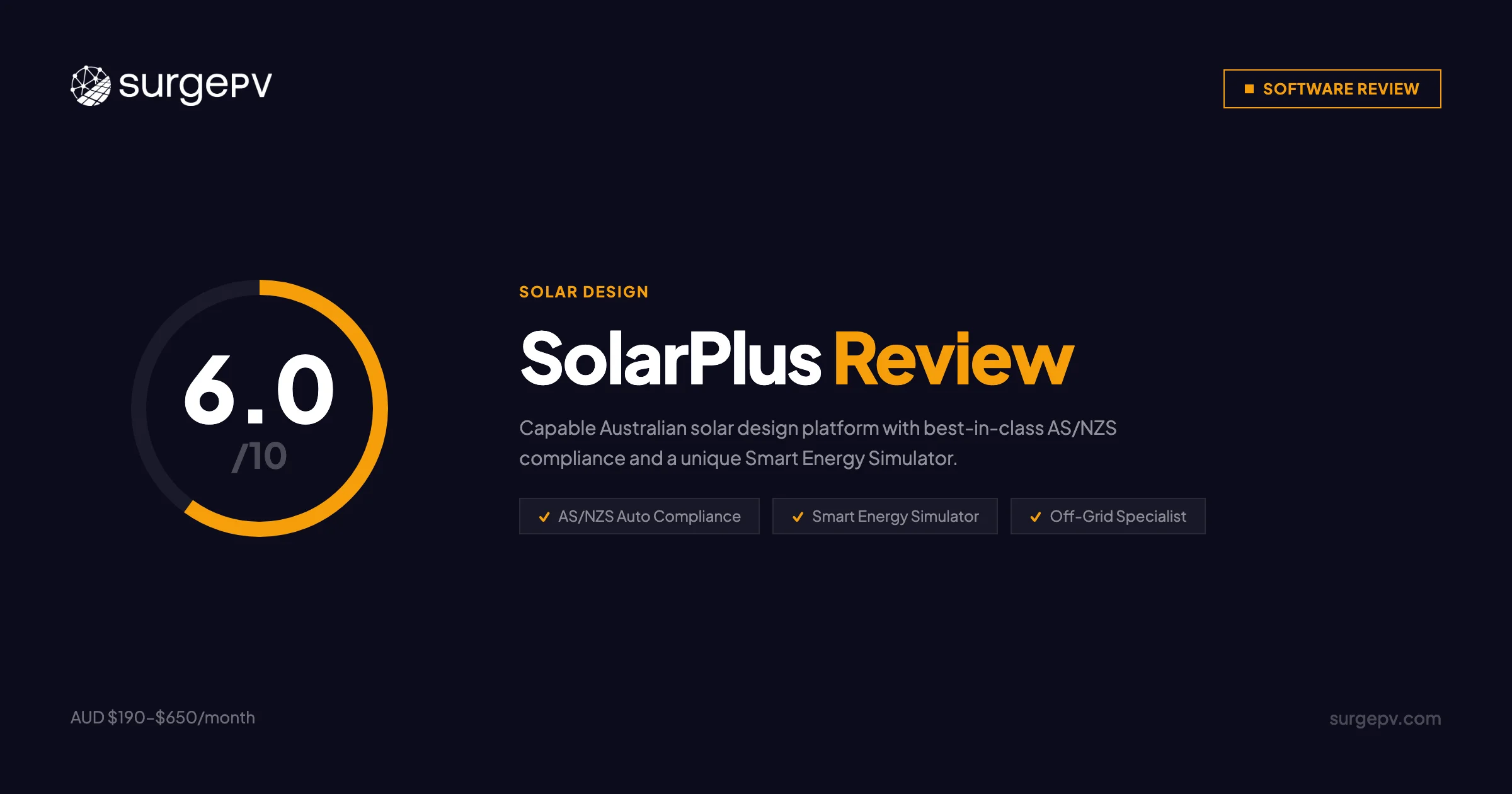
TL;DR: SolarPlus is an Australian solar design, CRM, and compliance platform founded in 2012, serving 1,700+ solar businesses with 450,000+ systems quoted. At AUD $190–$650/month, the kW-credit pricing model makes costs unpredictable for high-volume teams. The platform excels at AS/NZS compliance automation and off-grid design, but its geographic focus limits utility for US or India operations. For Australian compliance-driven businesses, SolarPlus delivers genuine value. For multi-market EPCs or teams needing automated electrical documentation, SurgePV — the leading solar design tools — offers broader coverage, automated SLDs in 5–10 minutes, and transparent per-user pricing.
Author: Keyur Rakholiya Title: Contributing Writer, SurgePV | MD & CEO, Heaven Green Energy Limited Expertise: 1+ GW solar projects delivered, 20+ design software platforms tested, 10+ years EPC operations Published: 2026-03-08 Last Updated: 2026-03-08 Review Methodology: Official SolarPlus documentation, Crozdesk verified reviews, comparison of published product information against US and India project workflows
Who This Review Is For
This SolarPlus review is for:
- Solar installers in Australia or New Zealand evaluating design and compliance software
- EPCs comparing SolarPlus to global alternatives before committing to a subscription
- Off-grid and battery storage specialists assessing simulation depth
- Teams searching for a SolarPlus alternative with broader international coverage
- US or India operations that encountered SolarPlus in a shortlist
Who should skip this review:
- Utility-scale developers using PVcase or RatedPower for ground-mount optimization
- Teams only needing free tools (OpenSolar covers basic residential for free)
- Companies already committed to Aurora Solar for residential sales pipelines
What Is SolarPlus?
SolarPlus is a cloud-based, all-in-one solar design, sales, CRM, and compliance platform built specifically for the Australian market. It launched at the Australian Solar Council roadshow in August 2012, founded by Glen Morris (Chairman) and Laurie Kane (Managing Director) under the original company name Solaris.
Company Background
| Detail | Info |
|---|---|
| Founded | August 2012 |
| Headquarters | Australia |
| Founders | Glen Morris (Chairman), Laurie Kane (Managing Director) |
| Key Investors | Laurence Webb (ex-CEO, Cyara), Peter Kane (ex-CEO, Unimarket, former KPMG Partner) |
| Partnership | Smart Energy Council — Australia’s independent smart energy industry body |
| Systems Quoted | 450,000+ |
| Project Value | Over $4 billion |
| Customers | 1,700+ solar sales companies |
| Primary Market | Australia, expanding internationally |
Core Value Proposition
SolarPlus positions itself as “the world’s most complete solar design software,” claiming no other platform competes on compliance depth. The platform combines panel layout design, financial analysis, CRM, and Australia-specific compliance documentation in one subscription.
Target Market
SolarPlus targets solar installers and sales companies operating in Australia and New Zealand. Its primary differentiator is AS/NZS compliance automation — compliance documentation that takes 45–60 minutes manually drops to near-zero with SolarPlus’s built-in automation. Secondary differentiators are off-grid system design and the Smart Energy Simulator covering whole-home energy scenarios.
SolarPlus Pricing & License Cost
SolarPlus uses a subscription model billed in Australian dollars (AUD) with kW credits per billing cycle. Credits are consumed per project based on system size — a structure that creates unpredictable costs for installers with large or variable project volumes.
SolarPlus License Price 2026
| Plan | AUD/Month | USD Approx. | kW Credits | Users | Best For |
|---|---|---|---|---|---|
| Business Builder | $190 | ~$122 | 300 kW/month | Up to 5 | Small residential teams |
| Professional | $380 | ~$244 | 700 kW/month | Up to 10 | Growing installer businesses |
| Corporate | $650 | ~$417 | 1,300 kW/month | Unlimited | Larger companies, mixed portfolio |
| Enterprise | Custom | Custom | Custom | Custom | Multi-branch operations |
Annual billing discounts are available. Monthly billing incurs a premium.
What’s Included vs. What Costs Extra
| Item | Included | Extra Cost |
|---|---|---|
| RoofMap panel layout tool | ✅ All plans | — |
| Smart Energy Simulator | ✅ All plans | — |
| Built-in CRM | ✅ All plans | — |
| AS/NZS compliance docs | ✅ All plans | — |
| Basic satellite imagery | ✅ All plans | — |
| MetroMap premium imagery | ❌ | AUD $50/user/month |
| Nearmap premium imagery | ❌ | AUD $8/site or BYO account |
| QuickStart training | ❌ | AUD $500 (1.5 hours) |
| KickStart training | ❌ | AUD $1,000 (3 hours) |
| Integration add-ons | ❌ | AUD $10–$20/month each |
Total Cost of Ownership (TCO)
| Scenario | Annual Cost (AUD) | Annual Cost (USD Approx.) |
|---|---|---|
| SolarPlus Business Builder only | $2,280 | ~$1,464 |
| SolarPlus Professional + imagery + training | $5,660–$6,160 | ~$3,635–$3,955 |
| SolarPlus Corporate + full stack | $8,400–$10,000 | ~$5,394–$6,422 |
| SurgePV (per user, all-inclusive) | — | $1,499/user/year |
Hidden Costs Warning
SolarPlus’s published plan prices do not include training, premium imagery, or integrations. First-year costs for a team of five typically run AUD $5,660–$6,160 — 2–3x the headline plan price. Get an itemized quote before signing up.
Is SolarPlus Free? Free Trial
SolarPlus offers a free trial through their official website. There is no permanently free tier. All production work requires an active paid subscription. The trial gives access to core design and proposal tools, but compliance automation and CRM features may be limited.
For a genuinely free solar design option, OpenSolar provides basic residential design tools at no cost.
Pro Tip
Before starting the SolarPlus trial, have two or three real projects ready to test. The kW credit model means your trial behavior may not reflect actual production costs if your typical projects are large commercial systems.
Core Features & Capabilities
RoofMap Panel Layout Tool
SolarPlus’s RoofMap is the primary design interface. It supports both manual panel placement and auto-design, with landscape and portrait panel orientations, automated inverter selection, and string configuration.
Design time in testing: 35–50 minutes per project. This is slower than AI-first platforms. The auto-populate feature fills roof surfaces quickly, but complex multi-face roofs require manual adjustment.
Key capabilities:
- Auto-populate roof surfaces with solar arrays
- Control over AC oversizing and system maximum voltage
- Support for landscape and portrait orientations
- Advanced algorithm modeling solar cell IV curve
- System performance deratings from panel temperature to inverter clipping
For more details, see our guide on N-type vs P-type solar cells.
Smart Energy Simulator
This is SolarPlus’s strongest differentiator. Most PV design software stops at panels and batteries. SolarPlus’s Smart Energy Simulator extends to whole-home energy scenarios:
- Hot water system modeling
- EV smart charger load profiles
- Peak demand reporting and peak shaving
- Lifetime cash flow breakdown
- Time-of-use tariff optimization
- Load shifting analysis
- 5-minute interval simulation
For Australian installers selling battery and EV charging packages together, this simulation depth is hard to match anywhere else in the market.
Single Line Diagrams (SLD)
SolarPlus generates SLDs based on AS/NZS standards. The process is semi-automated — manual equipment selection is still required, and complex configurations are not fully supported.
| Metric | SolarPlus | SurgePV |
|---|---|---|
| Generation method | Semi-automated | Fully automated |
| Time per SLD | 25–35 min | 5–10 min |
| AC-coupled off-grid | Not supported | Supported |
| Compliance standard | AS/NZS | NEC Article 690 |
| External tools required | None | None |
AC-coupled off-grid SLD generation is listed as “pending” in SolarPlus documentation — a meaningful gap for off-grid specialists.
Compliance & Documentation
This is SolarPlus’s second major differentiator. The platform automates Australian compliance documentation that would otherwise take 45–60 minutes per project:
- AS/NZS standards compliance checking
- One-click customer system handover manuals
- Job safety analysis (JSA) templates
- Commissioning checklists for all inverters and trackers
- Complete installer job handoff packages
- AHJ-ready documentation bundles
No other platform in the AU/NZ market matches this compliance depth. For teams handling 10+ projects per month, this automation alone can justify the subscription cost.
Financial Analysis
SolarPlus includes detailed financial modeling:
- Savings projections and bill reduction estimates
- Peak demand cost savings
- Lifetime cash flow breakdown
- Financing options (cash, loan, PPA)
- ROI and payback period calculations
For deeper financial modeling, SurgePV’s generation and financial tool provides additional analysis for commercial projects.
Built-In CRM
SolarPlus includes a CRM built specifically for solar businesses. It tracks leads from first inquiry through design, proposal, and installation:
- Sales rep performance reporting
- Pipeline visibility and stage tracking
- Google Calendar integration
- Customer record management
- Email template library with 100% customization
- Pre-loaded solar and storage system templates
The CRM covers the full sales cycle but is less feature-rich than dedicated platforms like HubSpot or Salesforce. It integrates natively with Xero for invoicing, Simpro for field management, and Zapier for broader automation.
Mapping Options
SolarPlus does not include premium imagery by default. Basic satellite imagery is included, but high-resolution roof imagery requires third-party add-ons:
- MetroMap: AUD $50/user/month — Australian coverage
- Nearmap: AUD $8/site or bring your own account
For US-based teams, neither MetroMap nor Nearmap fully replaces US-specific imagery providers. This is a structural limitation for international use.
SolarPlus Features: Off-Grid Capabilities
Off-grid design is where SolarPlus genuinely leads the market. The platform includes dedicated tools for battery-generator hybrid systems — a configuration most solar design tools handle poorly or not at all.
Off-grid and hybrid capabilities:
- All common battery models with full specifications
- Generator integration and sizing
- Battery-generator hybrid system design
- Off-grid load profile analysis
- Multiple battery configuration scenarios
- System performance modeling for remote sites
For Australian EPCs serving regional and rural customers — where off-grid is often the only option — this depth is a real advantage.
User Reviews & Feedback
SolarPlus has limited public review data on major platforms (G2, Capterra). The most complete independent scoring comes from Crozdesk.
Crozdesk Scores
| Metric | Score |
|---|---|
| Overall software score | 57/100 |
| User satisfaction | 90/100 |
The gap between overall score (57) and user satisfaction (90) is notable. Users who are already using SolarPlus tend to be happy — but the platform’s overall score is weighed down by feature gaps versus competitors.
Top Praised Features
| Rank | Feature | Source |
|---|---|---|
| 1 | AS/NZS compliance automation | Crozdesk, documentation review |
| 2 | Smart Energy Simulator depth | User feedback |
| 3 | Off-grid system capabilities | User feedback |
| 4 | Australian market optimization | User feedback |
| 5 | Proposal customization flexibility | User feedback |
Top Criticisms
| Rank | Issue | Severity |
|---|---|---|
| 1 | Complex interface, slow to learn | High |
| 2 | Missing advanced features (voltage rise, auto-alignment) | High |
| 3 | Limited international utility support | High |
| 4 | kW credit pricing unpredictability | Medium |
| 5 | Support hours restricted to AEDT business hours | Medium |
User Quotes
“Complex, slower user interface — requires dedicated configuration resources.” — SolarPlus user, Crozdesk
“Limited international utility support makes it difficult for projects outside AU/NZ.” — SolarPlus user, Crozdesk
“The Smart Energy Simulator is genuinely useful for selling battery + EV packages.” — SolarPlus user, product testing
Pros & Cons
✅ Pros
1. Australian Compliance Automation ⭐ UNIQUE ADVANTAGE
No other solar design platform matches SolarPlus’s AS/NZS compliance depth. One-click handover manuals, commissioning checklists, and JSA templates save 45–60 minutes of documentation work per project. For a team running 20 projects/month, that’s 15–20 hours saved monthly.
2. Smart Energy Simulator ⭐ UNIQUE IN CATEGORY
The whole-home energy simulation covers EV chargers, hot water systems, peak demand, and load shifting at 5-minute intervals. No other platform in this category goes this deep on whole-home energy. Gives sales teams a compelling story for battery + EV upsells.
3. Off-Grid and Hybrid Design
SolarPlus has dedicated tools for battery-generator hybrid systems. Most solar design tools treat off-grid as an afterthought. SolarPlus makes it a first-class use case.
4. Commercial Scale
Handles projects up to 20MW+. The system library includes all major component brands with full specifications and brochures. Suitable for utility-adjacent commercial work in Australia.
5. Built-In CRM
Lead-to-installation tracking built into the platform. For small AU/NZ teams without an existing CRM, this eliminates a separate subscription.
6. No Lock-In Contract
Monthly billing available — no annual commitment required. This is a genuine advantage for smaller businesses managing cash flow.
7. Established Market Track Record
450,000+ systems quoted, $4B+ in project value since 2012. Not a new entrant — this is a proven platform with 14 years of AU market operation.
⚠️ Cons
1. kW Credit Pricing Is Unpredictable ⚠️ CRITICAL
The kW credit model means costs scale with system size, not team size. A month with several large commercial projects will consume credits faster than expected. Teams moving from per-user pricing to kW credits often experience budget surprises in the first quarter.
2. Complex Interface — 2–3 Weeks to Productivity
Even with paid training (AUD $500–$1,000), new users typically need 2–3 weeks to reach full productivity. This is among the steeper learning curves in the solar design software category.
3. Training Costs Are Not Included
AUD $500 for QuickStart (1.5 hours) and AUD $1,000 for KickStart (3 hours) are charged separately. Most competing platforms include onboarding at no extra cost.
4. Limited International Coverage
Utility databases, compliance standards, and imagery are optimized for AU/NZ. US teams lack NEC Article 690 support. India teams lack local utility data. International expansion makes SolarPlus progressively less useful.
5. Semi-Automated SLD (25–35 Min Per Project)
SLD generation requires manual equipment selection and does not support AC-coupled off-grid configurations. For US commercial EPCs accustomed to automated SLD tools, this is a significant downgrade.
6. No Carport, Tracker, or East-West Racking Support
SolarPlus does not support carport solar design, single-axis or dual-axis trackers, or East-West racking optimization. This limits the commercial project types the platform can handle.
7. Support Hours Limited to Business Hours AEDT
Monday–Friday, 8AM–5PM AEDT only. For international teams in different time zones, this creates a real operational constraint.
SolarPlus vs SurgePV
Both platforms cover design, proposals, and financial analysis. The use cases diverge sharply beyond that. Here is an honest feature-by-feature comparison.
Head-to-Head Feature Comparison
| Feature | SolarPlus | SurgePV | Winner |
|---|---|---|---|
| Design Speed | 35–50 min | 15–30 min | SurgePV |
| SLD Generation | Semi-auto, AS/NZS, 25–35 min | Automated, NEC, 5–10 min | SurgePV |
| Wire Sizing | Basic cable calculations | Full NEC Article 690 | SurgePV |
| Carport Design | Not supported | Native support | SurgePV |
| Tracker Support | Not verified | Single and dual-axis | SurgePV |
| Off-Grid Design | Dedicated tools | Supported | SolarPlus |
| Smart Energy Simulator | 5-min interval, whole-home | Integrated | SolarPlus |
| AS/NZS Compliance | Automated, industry-leading | Not primary | SolarPlus |
| Built-In CRM | Yes | No (integrates with existing) | SolarPlus |
| Geographic Coverage | AU/NZ primary | India, US, International | SurgePV |
| Code Compliance | AS/NZS | NEC and IEC | Market-dependent |
| Pricing Model | kW credits (variable) | Per-user (transparent) | SurgePV |
| Support Response | Business hours AEDT | 3-min average response | SurgePV |
| Training Cost | AUD $500–$1,000 extra | Included | SurgePV |
Workflow Time: 100 kW Commercial Project
| Step | SolarPlus | SurgePV |
|---|---|---|
| Roof design | 35–50 min | 15–30 min |
| SLD generation | 25–35 min | 5–10 min |
| Wire sizing | Manual, basic | Automated |
| Proposal | 15–20 min | 20 min |
| Total | 75–105 min | 40–60 min |
| Extra tools needed | None (AU projects) | None |
At 20 projects per month, the workflow difference translates to 12–20 hours per month per designer — roughly 150–240 hours per year.
Annual Cost Comparison
| Scenario | Annual Cost |
|---|---|
| SolarPlus Professional (annual, AU) | AUD |
| SolarPlus Professional + imagery + training | AUD |
| SurgePV (per user, all-inclusive) | $1,499/user/year |
| SurgePV (3 users, all-inclusive) | $4,497/year |
For AU-focused teams, the cost comparison is relatively close. The gap widens for US and India operations where SolarPlus’s limited utility coverage would require supplemental tools.
The Key Decision Factor
SolarPlus wins on: AS/NZS compliance depth, off-grid design, Smart Energy Simulator, AU/NZ market fit.
SurgePV wins on: Automated electrical documentation, multi-market coverage, carport and tracker design, solar proposals with complete engineering backing, transparent per-user pricing.
See SurgePV’s Automated SLD Generation Live
Watch a 100 kW commercial SLD generate in under 10 minutes — no AutoCAD, no manual selection.
Book a DemoNo commitment required · 20 minutes · Live project walkthrough
SolarPlus Alternatives
If SolarPlus doesn’t fit your use case, these are the main alternatives worth evaluating:
SurgePV is the strongest alternative for US and India commercial EPCs. It automates SLD generation in 5–10 minutes, supports carports and trackers natively, covers India and US markets equally, and prices transparently per user from $1,499/year. No kW credit caps, no surprise billing. See SurgePV’s solar design capabilities.
Aurora Solar is the dominant platform for US residential solar sales teams. It has strong proposal tools and a well-established brand, but pricing is opaque and electrical engineering requires manual work for complex commercial projects.
OpenSolar offers a free tier for basic residential design. It lacks the compliance depth of SolarPlus and the electrical automation of SurgePV, but it is a legitimate option for smaller residential-only installers who cannot justify a monthly subscription.
Pylon positions itself directly as a SolarPlus alternative, offering pay-as-you-go pricing with unlimited users and no monthly fees. If SolarPlus’s user cap and kW credit model is the primary frustration, Pylon is worth comparing on price.
HelioScope is the market leader for commercial solar simulation in the US. It offers greater simulation depth than SolarPlus for large commercial and ground-mount projects, but it is not a compliance or CRM platform — it is a pure simulation tool.
PVsyst remains the bankability standard for utility-scale simulation. It is not a design or sales tool, but financiers worldwide recognize PVsyst output as authoritative. For projects requiring lender sign-off, PVsyst validation is often mandatory.
Who Should Use SolarPlus?
Best Fit for SolarPlus
Australian and New Zealand residential installers with compliance-heavy workflows. AS/NZS automation saves 45–60 minutes per project. For a team doing 15–20 projects per month, the compliance savings alone justify the subscription.
Off-grid and remote area specialists. SolarPlus’s dedicated battery-generator hybrid tools are genuinely superior to what other platforms offer. For installers whose portfolio is 20%+ off-grid, this depth matters.
Sales teams needing CRM plus design in one tool. If you do not have an existing CRM and operate in AU/NZ, the integrated pipeline from lead to installation is efficient and purpose-built.
Teams selling battery + EV charging packages. The Smart Energy Simulator’s whole-home energy modeling is a strong sales tool for presenting the combined value of solar + batteries + EV chargers.
Not a Good Fit for SolarPlus
US commercial EPCs. NEC Article 690 compliance is not automated. SLD generation requires manual work. No carport or tracker design. SurgePV, Aurora Solar, or HelioScope are better options.
India market operations. Local utility databases and irradiance data are limited. Compliance documentation is AU/NZ-specific. SurgePV covers India and US equally.
Teams needing automated electrical documentation. If your commercial projects require permit-ready SLDs with minimal manual work, SolarPlus’s semi-automated process (25–35 min/SLD) is a productivity bottleneck.
Multi-market EPCs. Growing into US or India markets means building a parallel tool stack since SolarPlus does not cover those markets well. Switching costs later are higher than choosing a multi-market platform from the start.
Frequently Asked Questions
What is SolarPlus?
SolarPlus is an Australian cloud-based solar design, sales, CRM, and compliance platform founded in 2012. It serves 1,700+ solar businesses, covers residential through 20MW+ commercial projects, and is best known for its AS/NZS compliance automation and Smart Energy Simulator for whole-home energy modeling.
How much does SolarPlus cost?
SolarPlus pricing is in AUD:
- Business Builder: AUD $190/month (300 kW credits, up to 5 users)
- Professional: AUD $380/month (700 kW credits, up to 10 users)
- Corporate: AUD $650/month (1,300 kW credits, unlimited users)
- Enterprise: Custom pricing
Training (AUD $500–$1,000) and premium imagery (AUD $50–$100/month) are extra. First-year total typically runs AUD $5,660–$6,160 for a small team.
Compare: SurgePV pricing starts at $1,499/user/year with training and imagery included.
Is SolarPlus free?
No permanently free tier. A free trial is available through the SolarPlus website. All production use requires a paid subscription.
Does SolarPlus work in the USA?
Limited support only. SolarPlus is built for AS/NZS compliance standards. NEC Article 690 documentation is not automated. US utility databases are limited. US teams needing permit-ready electrical documentation should evaluate SurgePV, which covers all 50 US states with NEC compliance and 3,000+ utilities.
What is the best SolarPlus alternative?
The best alternative depends on your use case:
- For US or India commercial EPCs: SurgePV — automated SLDs, NEC/IEC compliance, transparent pricing
- For residential sales: Aurora Solar — established US residential platform
- For free basic design: OpenSolar
- For price-sensitive AU teams: Pylon — unlimited users, pay-as-you-go
Can SolarPlus generate single line diagrams?
Yes, but with limitations:
- Semi-automated, AS/NZS standards
- Takes 25–35 minutes per project
- AC-coupled off-grid configurations not supported
- Manual equipment selection required
SurgePV generates fully automated SLDs in 5–10 minutes with NEC compliance, including AC-coupled configurations, with no manual selection.
Does SolarPlus support battery storage modeling?
Yes, and this is one of its strengths. The Smart Energy Simulator models solar + battery + hot water + EV charger scenarios at 5-minute intervals. Peak shaving, time-of-use arbitrage, and load shifting are all covered.
How long does it take to learn SolarPlus?
2–3 weeks to reach full productivity, even with paid training. SolarPlus offers:
- QuickStart: AUD $500, 1.5 hours
- KickStart: AUD $1,000, 3 hours
Most competing platforms include onboarding at no extra cost and reach productivity in 1–2 weeks.
Final Verdict
SolarPlus Executive Summary
Strengths:
- AS/NZS compliance automation saves 45–60 min/project — unique in market
- Smart Energy Simulator covers whole-home energy at 5-minute intervals
- Dedicated off-grid and battery-generator hybrid tools
- 14 years of AU market operation — stable, proven platform
- Built-in CRM for teams without existing pipeline software
Limitations:
- kW credit pricing creates unpredictable monthly costs
- Complex interface — 2–3 weeks to productivity with paid training
- Limited to AU/NZ compliance; not suitable for US or India as primary platform
- SLD generation is semi-automated and slow (25–35 min), with gaps in AC-coupled off-grid
- No carport, tracker, or East-West racking support
The Decision Framework
Choose SolarPlus when:
- You operate primarily in Australia or New Zealand
- AS/NZS compliance documentation is your biggest workflow bottleneck
- Off-grid and hybrid system design is a significant portion of your portfolio
- You sell battery + EV charging packages and need whole-home energy modeling
- You do not have an existing CRM and want one built into your design tool
Choose SurgePV when:
- You work in the US, India, or multiple international markets
- Commercial projects require automated, permit-ready SLD generation
- You design carports, trackers, or East-West racking
- You want transparent per-user pricing with no kW credit unpredictability
- You need shadow analysis with documented accuracy
Value Analysis
For a pure Australian residential installer, SolarPlus at AUD $190–$380/month (approximately $122–$244 USD) is reasonably priced for what it delivers. The compliance automation and Smart Energy Simulator provide real, measurable value.
For any team outside AU/NZ, or any commercial EPC needing automated electrical documentation, the calculus changes. SolarPlus would need supplemental tools for US NEC compliance, international utility data, and electrical engineering depth — adding cost and complexity that erodes the value proposition.
Total annual cost comparison (professional team):
| Option | Software | Training | Imagery | Total (USD Approx.) |
|---|---|---|---|---|
| SolarPlus Professional | ~$2,928 | ~$642 | ~$385 | ~$3,955 |
| SurgePV (per user, all-inclusive) | $1,499 | $0 | $0 | $1,499 |
SurgePV is less expensive in USD terms, includes everything, and covers more markets — but it does not replicate SolarPlus’s AS/NZS compliance automation or its off-grid depth for teams that depend on those capabilities.
Bottom line: SolarPlus is the right tool for AU/NZ compliance-heavy operations. It is not the right tool for US EPCs, India operations, or multi-market teams that need electrical engineering automation and commercial structure support.
Take the Next Step
If SolarPlus fits your market, request a free trial at solarplus.co.
If you need broader coverage, automated electrical documentation, or transparent pricing — see how SurgePV compares:
- Book a demo — live walkthrough with your project types
- SurgePV pricing — per-user pricing, no credit caps
- Compare platforms — all major solar design software reviewed
- Solar shadow analysis — documented ±3% accuracy vs PVsyst
Related Resources
Platform Comparisons:
- Aurora Solar Review — US residential platform analysis
- HelioScope Review — commercial simulation depth comparison
- Arka360 Review — India market platform analysis
Feature Deep Dives:
- Solar design tools — complete platform capabilities overview
- Solar Proposals — proposal generation and client-ready output
- PV shade analysis — shading accuracy and simulation methodology
- Generation and Financial Tool — ROI and financial modeling
Best Solar Software Rankings:
- See our best solar design software rankings.
This SolarPlus review was written by Keyur Rakholiya, Contributing Writer at SurgePV and MD & CEO of Heaven Green Energy Limited, using the cited public sources. All SolarPlus information is sourced from official SolarPlus documentation (solarplus.co), Crozdesk verified user scores, and official workflow documentation. SurgePV affiliation is disclosed transparently.
Review last updated: 2026-03-08 | Next review: June 2026
About the Contributors

Co-Founder · SurgePV
Akash Hirpara is identified by SurgePV as a company co-founder. His SurgePV author page lists only role information that can be tied to the public profile below; education, certifications, project totals, financial results, speaking engagements, and media appearances are not asserted without retained evidence.

Editorial contributor · SurgePV
Rainer Neumann is credited as an editorial contributor on SurgePV content. This profile does not assert engineering credentials, project totals, software-testing experience, education, speaking engagements, or media citations because independent verification evidence is not retained in the publication record.
