Pros
Cons
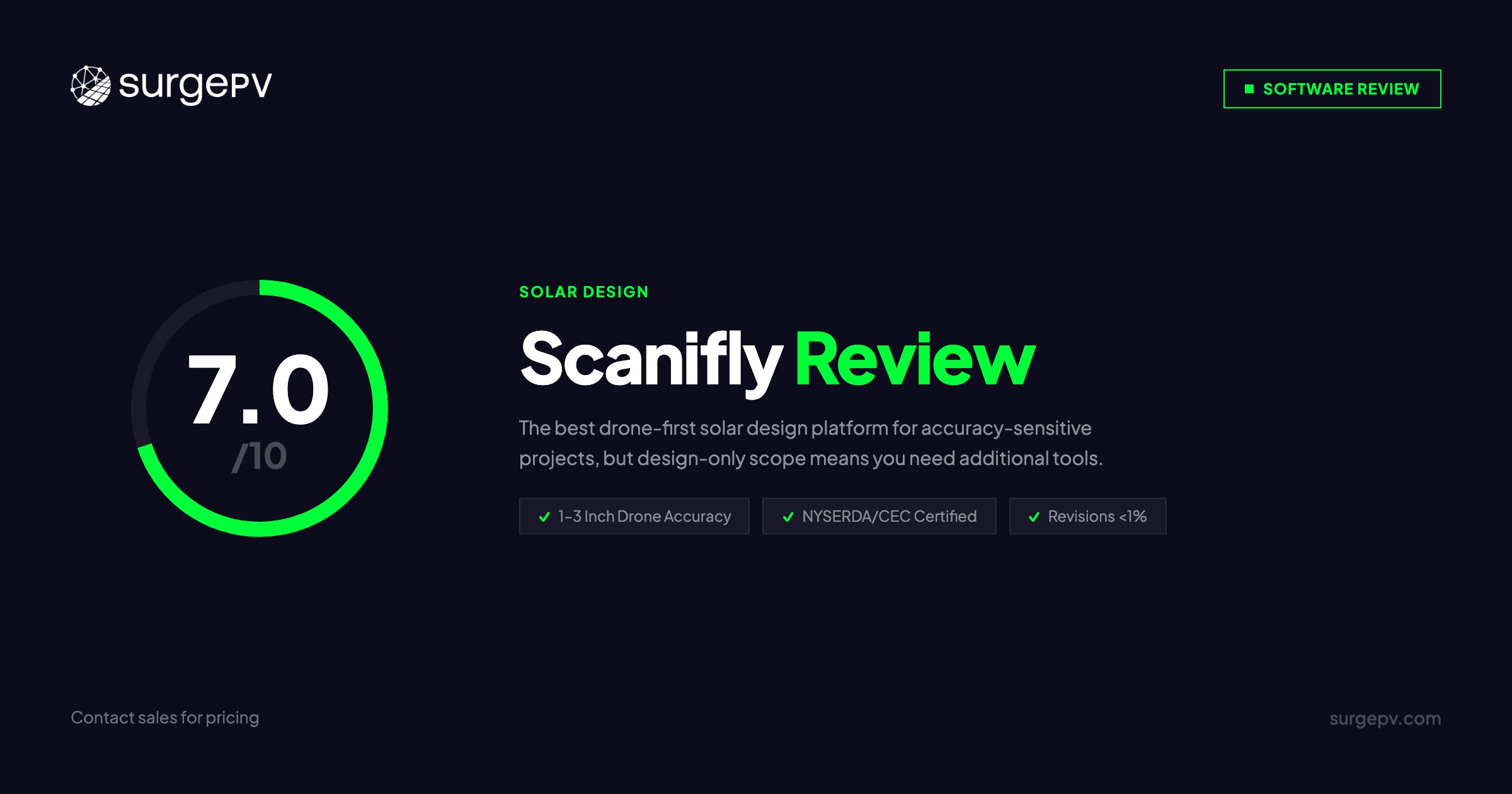
TL;DR: Scanifly is a drone-first solar design platform built by former solar contractors. It delivers 1–3 inch measurement accuracy via photogrammetry — the only drone-based shading tool approved by NYSERDA and MassCEC nationwide. Pricing is not disclosed publicly; total workflow cost reaches $10,000–12,000+/year when you add the tools Scanifly doesn’t include. For accuracy-sensitive commercial projects where revisions cost money, Scanifly justifies that investment. For teams needing design, proposals, financial modeling, and electrical documentation in one platform, SurgePV — a leading solar design platform — covers all of it from $1,499/user/year.
Author: Keyur Rakholiya Title: Contributing Writer, SurgePV | MD & CEO, Heaven Green Energy Limited Expertise: 1+ GW solar projects delivered, 20+ design software platforms tested, 10+ years EPC operations Published: 2026-03-08 Last Updated: 2026-03-08 Review Methodology: Official Scanifly documentation, verified customer case studies, comparison of published product information, and analysis of publicly available product information (no public G2/Capterra reviews available as of March 2026)
Who This Review Is For
This Scanifly review is written for:
- Solar installers evaluating drone-based design to reduce revision rates
- Commercial EPCs assessing whether Scanifly’s accuracy justifies the added cost and workflow complexity
- Teams already running drone programs who want to understand what Scanifly adds
- Anyone comparing Scanifly vs Nearmap, Scanifly vs Aurora Solar, or researching Scanifly alternatives
- Procurement teams doing total cost of ownership analysis before signing a contract
Who should skip this review:
- Pure utility-scale operations (Scanifly focuses on residential and C&I, not large-scale ground mount)
- Teams with zero drone capability and no plan to build one
- Installers needing a single platform that handles design through proposal
What Is Scanifly?
Scanifly is a drone-first solar design platform founded in 2015 by John Novak, Jason Steinberg, and Denis Kobozev — three former solar contractors who built the tool they wished existed. Headquartered in Brooklyn, New York, Scanifly operates in 30+ countries with 33 employees and $12.4M in total funding ($10M Series A from Runway Venture Partners in 2022).
The company’s mission is direct: “Building technology for solar installers to empower them to elevate and scale the quality of solar worldwide.”
What makes Scanifly different from every other design tool on this list is its photogrammetry engine. Instead of relying on satellite imagery or LIDAR datasets, Scanifly processes hundreds of overlapping drone photos into centimeter-accurate 3D roof models. The result is 1–3 inch measurement accuracy across X, Y, and Z planes — compared to 6–12 inch tolerance from satellite-based tools.
Company Background
| Detail | Info |
|---|---|
| Founded | 2015 |
| Founders | John Novak, Jason Steinberg, Denis Kobozev |
| Headquarters | Brooklyn, New York |
| Funding | $12.4M total ($10M Series A, March 2022) |
| Employees | ~33 |
| Global Reach | 30+ countries |
Two Core Products
Scanifly operates on a two-stage design philosophy that separates the sales phase from the engineering phase:
PrelimDesign handles the initial customer conversation. It uses satellite imagery from Google Maps, Bing, Mapbox, Nearmap, and USGS LiDAR to generate AI-powered layouts and system sizing quickly — no drone required. Sales teams can produce proposal-ready designs in minutes. Unlimited designs are included per subscription, with no per-project fees.
DroneDesign handles final engineering. After a sale is likely, a technician flies the site. Scanifly processes the imagery into a photorealistic 3D model with full shading analysis. The output is permit-ready with a 100% fitment guarantee — meaning no panel fit surprises on install day.
This two-stage approach is Scanifly’s answer to a real problem: satellite imagery is good enough for sales but not accurate enough for engineering on complex rooftops.
Scanifly Pricing & License Cost
Scanifly does not publish subscription pricing. To get a quote, you contact hello@scanifly.com.
This is a deliberate choice — pricing is likely seat-based and varies by team size and usage volume. For budgeting purposes, market estimates place the platform at $4,000–6,000/year for the software alone.
Scanifly License Price 2026
| Service | Credits |
|---|---|
| Residential Site Modeling | 15 credits |
| Residential Max Fill | 18 credits |
| Residential Plan Set | 70 credits |
| Commercial Site Modeling | 100 credits |
| Commercial Max Fill | 120 credits |
| Commercial Plan Set | Custom pricing |
| Expedited Surcharge | 5–30 credits |
Credit packs are purchased separately. The exact credit-to-dollar conversion is not disclosed, but the system allows you to pay for what you use rather than a flat monthly fee per project.
Total Cost of Ownership: Scanifly vs Full Workflow
Here is where Scanifly’s pricing becomes more complex. The platform covers design only. A complete solar workflow requires additional tools:
| Tool | Annual Cost |
|---|---|
| Scanifly (estimated) | $4,000–6,000 |
| Drone + insurance | ~$1,600 |
| Energy Toolbase (financial modeling) | $2,388 |
| AutoCAD (electrical SLDs) | $2,000 |
| CRM | ~$1,200 |
| Total | $11,188–13,188/year |
Compare that to an all-in-one platform:
| Workflow | Annual Cost |
|---|---|
| Scanifly + required stack | $11,000–13,000+/year |
| SurgePV (all-in-one) | From $1,499/user/year |
Hidden Costs to Verify
Scanifly’s contact-sales pricing model means you cannot compare plans without a sales conversation. Ask about: per-seat vs per-project pricing, credit pack costs and expiration, volume discounts for 50+ projects/month, and onboarding or training fees. Also factor in FAA Part 107 certification costs if your team doesn’t already hold drone licenses.
Is Scanifly Free? Free Trial
Scanifly is not free. No free trial is publicly advertised.
The Scanifly Mobile app is free with any active subscription — it includes digital checklists, photo annotation, team collaboration, and drone image submission.
Scanifly Academy is also free: instructor-led and self-paced training, including a Surveyor Associate Certificate program.
If you want to evaluate the platform before committing, request a demo directly at scanifly.com. The sales team can walk you through PrelimDesign and DroneDesign with your own project scenarios.
Core Features & Capabilities
PrelimDesign: Sales-Phase Design
PrelimDesign is the entry point for most Scanifly workflows. It handles everything before a drone flight is justified.
What it does:
- Pulls satellite imagery from Google Maps, Bing, Mapbox, Nearmap, and USGS LiDAR
- Generates AI-powered panel layouts and system sizing
- Calculates offset and production estimates
- Produces proposal-ready outputs within minutes
- Unlimited designs per subscription (no per-project credits consumed)
Two design environments:
- SimpleDesign: Streamlined for non-technical salespeople. AI-generated layouts, clean interface, fast output.
- Pro Design: Full customization for engineers. Fire setbacks, per-module control, CAD export, racking integration.
Integrations: Energy Toolbase, SubcontractorHub, Enerflo for downstream proposal and financial steps.
PrelimDesign is competitive with Aurora Solar’s satellite-based workflows, with one advantage: Scanifly’s subscription includes unlimited preliminary designs, while Aurora typically charges per-project credits.
Scanifly Drone Survey: DroneDesign
DroneDesign is Scanifly’s core differentiator. No other solar design platform processes drone imagery natively and converts it into engineering-grade 3D models.
How it works:
- A technician flies the site with a compatible drone (geo-tagged imagery, GPS)
- Images are uploaded to Scanifly
- Photogrammetry engine processes overlapping photos into a 3D model
- Roof dimensions, obstructions, and shading data are extracted with 1–3 inch accuracy
- Output feeds directly into design, shading analysis, and plan set generation
Accuracy specifications:
- 1–3 inch measurement accuracy across X, Y, and Z planes
- Satellite imagery comparison: 6–12 inch tolerance
- 100% fitment guarantee on install day
Regulatory approvals (verified):
Scanifly is the first and only drone-based shading tool approved nationwide by:
- NYSERDA (New York)
- MassCEC (Massachusetts)
- California Energy Commission (CEC)
- Austin Energy
- Commerce RI
- Energy Trust of Oregon
- Lender approvals: LightReach, EverBrite, Sunlight
This matters for financed projects. If a lender or state program requires certified shading data, Scanifly’s approvals satisfy that requirement in a way no satellite-based tool currently can.
Drone compatibility:
Compatible with any drone that captures geo-tagged imagery with GPS. Recommended models:
- General: Autel EVO II Pro 6k
- Thermal (under $5k): Autel EVO II Pro 640T
- Thermal (above $5k): DJI Mavic 3 Thermal
Incompatible drones: DJI Mavic Mini, Spark, Air, Air 2, Inspire 1, Phantom 3, Autel Evo Lite/Lite+/Nano/Nano+, EXO X7 Ranger+.
Scanifly Mobile App
Free with any active subscription on iOS and Android.
The app covers field operations that other design tools ignore entirely:
- Customizable digital checklists for site surveys
- Photo annotation with stickers, text, and drawings
- Upload photos, videos, and structural/electrical data directly from the field
- Album organization by project
- Team collaboration via comments and tagging
- Direct drone image submission to DroneDesign
Scanifly positions this as “like SiteCapture and CompanyCam — but purpose-built for solar field ops.” For teams currently paying for SiteCapture or CompanyCam, this is a genuine cost offset.
Design Services
For teams without drone pilots or bandwidth to process imagery internally, Scanifly offers outsourced design services on a credit basis. Turnaround is typically within 48 hours for residential projects.
This option lowers the barrier to entry — you can access DroneDesign-quality outputs without hiring or training a drone team immediately.
Integrations
Scanifly’s integration catalog is meaningful for a specialist platform:
| Category | Partners |
|---|---|
| Racking | IronRidge (Jan 2026 API, saves 1–3 hrs/project), K2 Systems, SnapNrack, Pegasus, Unirac |
| Proposal/Finance | Energy Toolbase, SubcontractorHub, Enerflo |
| Automation | Zapier (5,000+ apps, no-code) |
| Export | CAD files, shade reports, BOM, engineering plan sets |
| Custom | API available (contact integration@scanifly.com) |
The IronRidge integration (January 2026) is new and notable — it pulls BOM directly from design into racking orders, cutting 1–3 hours per project for teams using IronRidge hardware.
Verified Performance Data
Scanifly has no public G2, Capterra, or TrustRadius reviews as of March 2026. All performance data comes from verified company case studies.
Time Savings
| Company | Metric | Result |
|---|---|---|
| Hammond Energy | Survey time | 16 hours → 2.5 hours (84% reduction) |
| Solar Energy Services | Survey to plan set | 3 weeks → 3 days |
| Resonant Energy | 22-roof, 650 kW project | Days → hours |
| Lightwave Solar | Per-project savings | 45 minutes saved |
| CalSolar | Survey acceleration | 200% faster |
| EmPower Solar | Design time | Cut in half |
Accuracy & Quality
| Company | Metric | Result |
|---|---|---|
| Namaste Solar | Revision rate | 25% → under 1% |
| Dynamic SLR | Panel fitment | Zero fit errors since switching |
| Hammond Energy | Accuracy | Perfect on 1.8 MW commercial |
| Solar Energy Services / NYSSF | Revisions | Zero revisions |
Financial Impact
| Company | Metric | Result |
|---|---|---|
| EmPower Solar | Software cost vs Aurora | 53% reduction |
| Multiple customers | Per-project savings | $100–$300 |
| Multiple customers | Break-even timeline | Within first month |
How to Evaluate These Numbers
These are company-published case studies, not independent audits. They represent Scanifly’s best outcomes, not typical results. Before relying on them for ROI calculations, ask Scanifly for references from companies similar to yours in project type and volume.
Pros & Cons
Pros
1. Measurement Accuracy That Satellite Cannot Match
Drone photogrammetry delivers 1–3 inch accuracy across three dimensions. Satellite imagery gives you 6–12 inches. For complex commercial rooftops with multiple penetrations, HVAC units, and irregular geometry, that gap directly translates to revision rates. Namaste Solar’s documented drop from 25% to under 1% revision rate is the clearest proof of this.
2. Regulatory Approvals That Unlock Financed Projects
No other drone design tool holds simultaneous NYSERDA, MassCEC, and CEC approvals. For installers working in New York and Massachusetts — where incentive programs require certified shading data — Scanifly is the only drone-based option that qualifies. This is not a marketing claim; it is a procurement requirement.
3. Two-Stage Workflow Covers the Whole Pre-Sale Journey
PrelimDesign for sales, DroneDesign for engineering. The handoff between stages is seamless — designs built in PrelimDesign carry forward into DroneDesign without recreation. This is better than tools that force you to rebuild the project at each stage.
4. Unlimited Preliminary Designs Per Subscription
Aurora Solar and some competitors charge per-project credits for satellite designs. Scanifly’s PrelimDesign is unlimited. For high-volume sales teams running 30–50 preliminary designs per month, this pricing structure is more predictable.
5. Free Field Operations App
SiteCapture costs $49/user/month. CompanyCam costs $36/user/month. Scanifly Mobile replaces both for solar-specific field work at no extra cost. For teams with 5 field technicians, that is $2,100–$2,940/year in avoided software spend.
6. EmPower Solar’s 53% Cost Reduction vs Aurora
This is the single strongest financial data point Scanifly has. EmPower Solar documented a 53% reduction in software costs after switching from Aurora to Scanifly. If your current Aurora bill is $8,000/year, the math is meaningful — though verify whether your workflow complexity matches EmPower Solar’s.
Cons
1. Design-Only Platform Requires 3–4 Additional Tools
Scanifly produces designs. It does not produce proposals, financial models, SLDs, or anything a customer or lender sees at the end of the workflow. You need Energy Toolbase (or equivalent) for financials, a proposal tool, and AutoCAD or similar for electrical documentation. Each adds cost and context-switching.
2. Drone Requirement Adds Operational Complexity
DroneDesign requires a compatible commercial drone ($1,700–$3,000), FAA Part 107 certification for each pilot, and business drone insurance. That is not a one-time cost — insurance renews annually, pilots need to maintain certifications, and drones need maintenance. Teams without existing drone programs are adding 60–90 days of setup time before they can use Scanifly’s core product.
3. No Public Pricing
Contact-sales pricing introduces friction and makes budget comparison harder. You cannot evaluate Scanifly’s cost without a sales conversation, which means procurement teams must invest time before knowing if the platform fits the budget.
4. Total Cost of Ownership Is High
The design-only scope pushes total annual cost to $11,000–13,000+ when you add the surrounding tools. For small installers doing under 20 projects per month, that TCO is difficult to justify compared to an all-in-one platform at $1,499–2,000/user/year.
5. No Public Third-Party Reviews
As of March 2026, Scanifly has no verified reviews on G2, Capterra, TrustRadius, or SourceForge. All user evidence comes from company-curated case studies. This makes independent validation impossible.
6. Drone Limitations in Adverse Conditions
Image quality is affected by glare, overexposure, blur, and cloud coverage. In regions with frequent overcast or rainy weather, drone flight windows are limited, which can delay project timelines.
Need Design, Proposals, and Financials in One Platform?
SurgePV covers the full workflow — from 3D design and shading analysis to automated SLDs, proposals, and financial modeling — at a fraction of Scanifly’s total stack cost.
Book a DemoNo commitment required · 20 minutes · Live project walkthrough
Scanifly vs SurgePV
Scanifly and SurgePV serve different segments of the solar design market. The comparison is not really “which is better” — it is “which problem are you solving.”
Head-to-Head Feature Comparison
| Feature | Scanifly | SurgePV | Winner |
|---|---|---|---|
| Measurement Accuracy | 1–3 inch (drone) | Standard satellite/LIDAR | Scanifly |
| Drone-Based Shading | Yes (NYSERDA/MassCEC approved) | No | Scanifly |
| SLD Generation | No | Yes (5–10 min automated) | SurgePV |
| Financial Modeling | No | Yes (included) | SurgePV |
| Proposal Generation | No | Yes (included) | SurgePV |
| CRM | No | Integrates with existing CRM | SurgePV |
| Cloud-Based | Yes | Yes | Tie |
| Mobile Field App | Yes (free) | No dedicated field app | Scanifly |
| Transparent Pricing | No (contact sales) | Yes ($1,499/user/year) | SurgePV |
| All-in-One Workflow | No (3–4 tools needed) | Yes (single platform) | SurgePV |
| Regulatory Approvals | NYSERDA, MassCEC, CEC | Standard | Scanifly |
Workflow Time: 100 kW Commercial Project
| Step | Scanifly Stack | SurgePV |
|---|---|---|
| Sales-phase design | 15–30 min (PrelimDesign) | 15–30 min |
| Drone survey + processing | 3–4 hours | Not required |
| Shading simulation | Included in DroneDesign | Included |
| SLD generation | 2–3 hours (AutoCAD, manual) | 5–10 min (automated) |
| Financial model | 1–2 hours (Energy Toolbase) | Included |
| Proposal | 1–2 hours (separate tool) | 15–20 min |
| Total | 7–11 hours | 45–60 min |
Annual Cost Comparison
| Scenario | Annual Cost |
|---|---|
| Scanifly + full required stack | $11,000–13,000+/year |
| SurgePV (3 users, all-inclusive) | $4,497/year ($1,499/user) |
| Aurora + AutoCAD | ~$8,000/year |
Net annual savings: SurgePV vs Scanifly full stack: $6,500–8,500+/year per team
Where Scanifly Beats SurgePV
On accuracy and regulatory compliance, Scanifly wins outright. If your workflow requires:
- NYSERDA or MassCEC-certified shading data for state incentive programs
- Sub-3-inch roof measurement for complex C&I installs
- Documented revision rates approaching zero for premium project types
Then Scanifly’s DroneDesign provides something SurgePV’s satellite-based approach cannot replicate.
Where SurgePV Beats Scanifly
For any workflow step beyond design capture, SurgePV covers ground Scanifly does not touch. Automated SLDs, integrated solar proposals, and built-in financial modeling via the generation and financial tool eliminate the need for a four-tool stack. For teams doing 20+ projects per month who don’t have documented revision problems, that consolidation saves $6,000–8,000/year and significant coordination overhead.
Scanifly Alternatives
Aurora Solar
Aurora Solar is Scanifly’s most direct competitor for residential design. Aurora uses satellite imagery with AI-powered shading analysis and covers the full sales workflow including proposals. It lacks drone integration natively. Best for residential-focused sales teams who need proposals built in. Read the Aurora Solar review.
HelioScope
HelioScope from Folsom Labs is an engineering-grade simulation platform acquired by PowerClerk. It focuses on accurate energy production modeling rather than field surveying. Best for commercial designers who need bankable energy estimates but don’t need drone capture. Read the HelioScope review.
Arka360
Arka360 is an all-in-one platform covering CRM, design, proposals, and permit packages. It is satellite-based rather than drone-based. Best for India-focused teams and small installers needing an integrated CRM without separate software investments. Read the Arka360 review.
PVsyst
PVsyst is the simulation standard for bankable energy yield studies. It handles detailed array modeling and loss analysis but is not a field design or proposal tool. Best for EPCs who need financier-grade simulation output as a standalone deliverable alongside other tools. Read the PVsyst review.
OpenSolar
OpenSolar is a free-to-use solar design and proposal platform with coverage in 100+ countries. It covers the full sales workflow with satellite imagery. Best for cost-sensitive installers who want a complete platform without per-user fees.
SurgePV
SurgePV is the all-in-one alternative for teams that need design, PV shade analysis, automated SLDs, proposals, and financial modeling in a single platform. Starting at $1,499/user/year, it eliminates the 3–4 tool stack Scanifly requires and covers both residential and commercial workflows. Best for EPCs doing 15+ projects per month who need consistent output without tool fragmentation.
Who Should Use Scanifly?
Use Scanifly When:
You operate in New York or Massachusetts and need state-approved shading data. NYSERDA and MassCEC require certified shading analysis for incentive applications. Scanifly is the only drone-based tool that satisfies this requirement. If your business depends on NY-Sun or Mass Solar Loan projects, this approval is a procurement decision, not a preference.
Your revision rate is above 5% and costing you money. Namaste Solar documented a drop from 25% to under 1% revision rate. If you are paying roofers to come back, losing install days to fit errors, or eating the cost of reorders, Scanifly’s accuracy addresses the root cause directly.
You already operate or plan to build a drone program. The operational overhead of drone compliance (FAA Part 107, insurance, maintenance) only makes sense if you use it at volume. If your team is already flying drones for site assessment, adding Scanifly is low-friction.
You are working on complex C&I rooftops where satellite imagery falls short. Multi-level roofs, rooftops covered with HVAC units, and buildings with irregular geometry are where 6–12 inch satellite tolerance creates real engineering risk. DroneDesign was built for exactly these projects.
You need lender-acceptable shading reports. LightReach, EverBrite, and Sunlight accept Scanifly’s Viewshed technology. If your financing partners require certified shading data, Scanifly is the path of least resistance.
Do Not Use Scanifly When:
You need a complete workflow in one platform. Scanifly produces designs. Everything else — proposals, financial models, SLDs, CRM — requires separate tools. If your team cannot absorb 3–4 integrations and the coordination they create, an all-in-one platform like SurgePV is a better fit.
You do high-volume residential with standardized rooftops. Flying a drone for every residential install on a standard shingle roof adds cost and time that satellite-based design handles adequately. Scanifly’s accuracy advantage pays off on complexity, not volume.
You cannot support drone operations. No drone program, no FAA Part 107 pilot, no insurance means no DroneDesign. PrelimDesign works without a drone, but so does every competitor.
You need design-to-proposal in under an hour. Scanifly’s drone-based workflow takes 3–4 hours of survey and processing. For fast-turn proposals on straightforward residential jobs, that cycle time is too slow.
Compare Scanifly
See our best solar design software rankings.
Frequently Asked Questions
What is Scanifly?
Scanifly is a drone-first solar design platform. It uses photogrammetry — the process of converting overlapping drone photos into 3D models — to produce inch-accurate roof measurements for solar design. Founded in 2015 in Brooklyn, it operates in 30+ countries and holds nationwide approvals from NYSERDA, MassCEC, and CEC for its drone-based shading analysis.
How much does Scanifly cost?
Scanifly does not publish pricing. Contact hello@scanifly.com for a subscription quote. For design services, Scanifly uses a credit-based system:
- Residential site modeling: 15 credits
- Residential plan set: 70 credits
- Commercial site modeling: 100 credits
Estimated annual software cost is $4,000–6,000/year. Total workflow cost including supporting tools reaches $11,000–13,000+/year.
Total cost comparison:
| Platform | Annual Cost |
|---|---|
| Scanifly + full required stack | $11,000–13,000+ |
| SurgePV (3 users, all-inclusive) | $4,497 |
| Aurora + AutoCAD | ~$8,000 |
Does Scanifly require a drone?
DroneDesign requires a compatible drone with GPS and geo-tagged imagery capability. PrelimDesign does not — it uses satellite imagery. However, without a drone, you lose the accuracy advantage (1–3 inch vs 6–12 inch) that justifies choosing Scanifly over alternatives.
Compatible drones include the Autel EVO II Pro 6k (recommended). Incompatible models include DJI Mavic Mini, Spark, Air, Air 2, Phantom 3, and several Autel Nano/Lite models.
What is the best Scanifly alternative?
The right alternative depends on what you need beyond design:
- All-in-one (design + proposals + financials + SLDs): SurgePV — $1,499/user/year
- Residential sales workflow: Aurora Solar — satellite-based, proposals built in
- Bankable simulation: HelioScope — engineering-grade energy modeling
- Budget-conscious all-in-one: OpenSolar — free tier available
None of these alternatives replicate Scanifly’s drone accuracy or its NYSERDA/MassCEC regulatory approvals.
How does Scanifly compare to Nearmap?
Nearmap is an aerial imagery provider. Scanifly is a design platform that can use Nearmap imagery as one of its data sources for PrelimDesign. They are not direct competitors. Nearmap provides high-resolution satellite-style imagery; Scanifly’s DroneDesign provides 1–3 inch drone photogrammetry. You can use both together — Nearmap for preliminary sales designs inside Scanifly, DroneDesign for final engineering.
Does Scanifly generate proposals or SLDs?
No. Scanifly produces designs and shading reports. It does not generate customer proposals, single line diagrams, or financial models. To run a complete workflow, Scanifly users typically pair it with Energy Toolbase (financials), a proposal tool, and AutoCAD for electrical documentation.
If proposals and SLDs matter, consider SurgePV’s solar proposal software and automated SLD generation instead.
Is Scanifly free?
No. Scanifly is not free and does not offer a publicly advertised free trial. The Scanifly Mobile app and Scanifly Academy training are free with a subscription. Contact scanifly.com to request a demo before purchasing.
Final Verdict
Scanifly Executive Summary
Strengths:
- Best-in-class drone photogrammetry accuracy (1–3 inch) — no satellite tool matches this
- Only drone shading platform with NYSERDA, MassCEC, CEC, and major lender approvals
- Two-stage workflow (PrelimDesign + DroneDesign) handles sales through engineering without recreation
- Documented results: 96% revision reduction, 84% survey time reduction, 53% cost reduction vs Aurora
- IronRidge API integration (Jan 2026) cuts BOM workflow by 1–3 hours per project
- Free mobile field app replaces SiteCapture/CompanyCam for solar-specific ops
Limitations:
- Design-only — no proposals, SLDs, financials, or CRM built in
- No public pricing; contact-sales model adds procurement friction
- Total workflow cost reaches $11,000–13,000+/year with required tools
- No public third-party reviews (G2, Capterra) — all evidence is company-published
- Drone operations require FAA licensing, insurance, and hardware investment
- Desktop workstation required; not mobile-workstation compatible
The Decision Framework
Choose Scanifly when:
- Operating in NY/MA where NYSERDA or MassCEC approval is a requirement
- Current revision rate exceeds 5% and each revision costs money
- Already running a drone program or committing to build one
- Working on complex C&I rooftops where satellite imagery produces fit errors
- Using lenders (LightReach, EverBrite, Sunlight) that require certified shading reports
Choose SurgePV when:
- You need one platform for design, proposals, financials, and electrical documentation
- You do not have drone operations and don’t plan to start
- Total workflow cost matters — SurgePV’s all-in-one approach saves $6,500–8,500+/year vs Scanifly’s full stack
- Volume is your constraint, not accuracy — satellite-based design is sufficient for standard residential rooftops
Value Analysis
Scanifly’s business case is specific. It solves the accuracy problem for teams where revisions are frequent, costly, or where state programs require certified drone data. In those situations, the investment pays back quickly — EmPower Solar documented break-even within the first month.
Outside that specific context, Scanifly’s design-only scope creates workflow fragmentation that accumulates in annual cost and coordination overhead. For most installers running under 20 complex projects per month, an all-in-one platform delivers more value per dollar.
Take the Next Step
See how SurgePV’s complete platform compares to Scanifly’s specialist approach.
- Book a demo — See SurgePV’s design, proposal, and electrical tools with your project types
- Compare platforms — Full platform comparisons
- Pricing details — Transparent per-user pricing with no hidden fees
- Shadow analysis software — How SurgePV handles shading without a drone
Considering Scanifly but need proposals? SurgePV integrates with existing design data and covers everything Scanifly leaves out.
Related Resources
Platform Comparisons:
- Aurora Solar Review — How Aurora Solar compares for residential design
- HelioScope Review — Engineering-grade simulation platform analysis
- Arka360 Review — All-in-one platform with built-in CRM
Feature Deep Dives:
- Solar Designing — Full design capabilities overview
- Shadow Analysis Software — Shading analysis without drone requirements
- Solar Proposal Software — Proposal generation built into the design workflow
- Generation and Financial Tool — ROI and financial modeling
This Scanifly review was written by Keyur Rakholiya, Contributing Writer at SurgePV and MD & CEO of Heaven Green Energy Limited, using the cited public sources. All Scanifly information is sourced from official Scanifly documentation, verified customer case studies published by Scanifly, and publicly available product information. No independent G2 or Capterra reviews were available as of March 2026. We disclose that SurgePV publishes this review and disclose our company affiliation transparently.
Review last updated: March 8, 2026 | Next review: June 2026
About the Contributors

Editorial contributor · SurgePV
Rainer Neumann is credited as an editorial contributor on SurgePV content. This profile does not assert engineering credentials, project totals, software-testing experience, education, speaking engagements, or media citations because independent verification evidence is not retained in the publication record.

CEO & Co-Founder · SurgePV
Keyur Rakholiya is identified by SurgePV as its CEO and a company co-founder. His SurgePV author page lists only role information that can be tied to the public profile below; credentials, project totals, testing claims, media appearances, and speaking engagements are not asserted without retained evidence.
