Pros
Cons
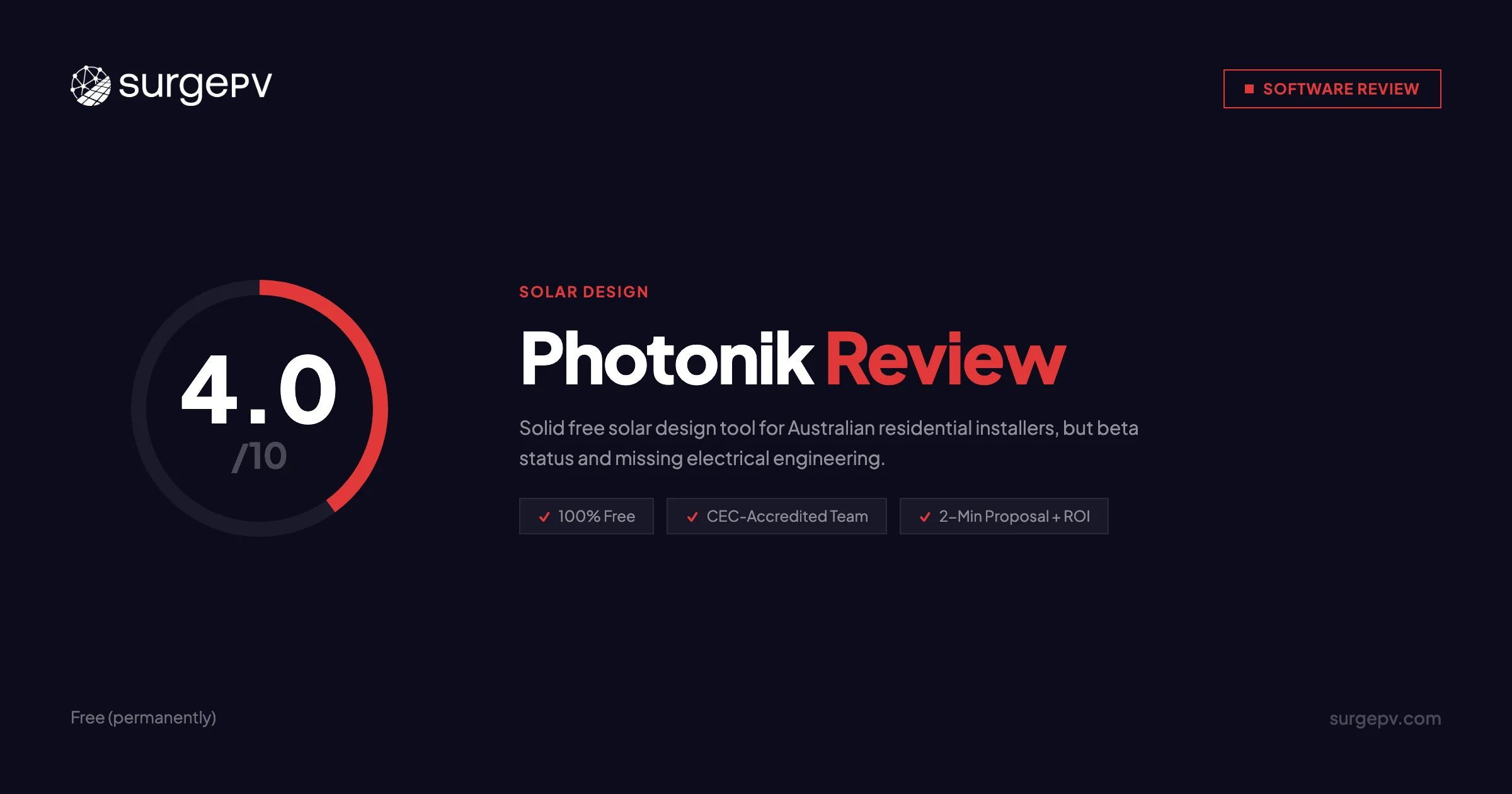
TL;DR: Photonik is a free, browser-based solar design tool built by the Clean Energy Reviews team in Australia. It covers drag-and-drop layout, basic shading analysis, proposal generation, and battery storage modeling at no cost. It has no G2 or Capterra reviews and remains in beta as of 2026. For Australian residential installers on a tight budget, Photonik works well for simple rooftop projects. For commercial EPCs needing SLD generation, wire sizing, and bankable shading analysis, SurgePV — the leading solar design software for commercial teams — covers the full engineering workflow Photonik cannot.
Author: Keyur Rakholiya Title: Contributing Writer, SurgePV | MD & CEO, Heaven Green Energy Limited Expertise: 1+ GW solar projects delivered, 20+ design software platforms tested, 10+ years EPC operations Published: 2026-03-08 Last Updated: 2026-03-08 Review Methodology: Official Photonik documentation, Clean Energy Reviews forum feedback, competitive testing against commercial-grade platforms
Who This Review Is For
This Photonik review is written for:
- Solar installers comparing free tools against paid platforms
- Australian residential teams evaluating budget-friendly design software
- Commercial EPCs considering Photonik before realizing its scope limitations
- Teams searching for a Photonik alternative for larger projects
Skip this review if you already know you need commercial-scale electrical engineering — Photonik is not built for that use case.
What Is Photonik?
Photonik is a free, web-based solar design and proposal platform developed by Clean Energy Reviews, an Australia-based solar media and review company. The tool was built by a four-person team: Jason Svarc (CEC-accredited solar specialist and former Swinburne University instructor), Bruce (IT and renewables), Mo (PhD engineer), and Marty (solar operations).
The product is operated by Photonik Pty. Ltd. and targets two distinct groups: solar installers creating proposals for clients, and homeowners planning residential solar without professional help. This dual audience shapes the design philosophy — simplicity and accessibility over depth and engineering rigor.
Company Background
| Detail | Info |
|---|---|
| Developer | Photonik Pty. Ltd. / Clean Energy Reviews (Australia) |
| Founded by | Jason Svarc (CEC-accredited, 10+ years solar) |
| Deployment | Web-based SaaS — no download required |
| Pricing | Permanently free |
| Development Stage | Beta (as of 2026) |
| Primary Market | Australia (residential) |
| Secondary Market | US and international (limited) |
| G2 / Capterra Rating | Not listed on either platform |
Core Value Proposition
Photonik’s mission is energy democratization — removing the cost and complexity barrier to solar design tools. Where platforms like Aurora Solar or HelioScope charge hundreds of dollars per month, Photonik offers free access to layout, shading, and proposal tools. That’s a genuine differentiator, especially for small installers and homeowners.
The trade-off is scope. Photonik does not attempt to replace commercial-grade solar design software. It aims to serve the lower end of the market well, rather than the full stack.
Photonik Pricing & License Cost
Photonik Pricing 2026
Photonik has one pricing tier: free.
| Plan | Price | Features | Who It’s For |
|---|---|---|---|
| Free | $0/month | All core features included | Residential installers, homeowners |
There is no credit card required, no trial period, and no feature gating. The company has publicly committed to keeping Photonik “free or very affordable” long-term.
No paid tiers with disclosed pricing currently exist. If paid plans are introduced, they have not been announced through official channels.
Is Photonik Free? Free Trial
Photonik is permanently free — there is no trial period because the full tool is available at no cost. This applies to design, shading analysis, proposal generation, and all calculators. There is no freemium model restricting key features behind a paywall.
What “Free” Actually Means
Photonik’s free model covers the full feature set. You do not need to upgrade to access proposals, battery storage modeling, or the STC calculator. The only cost you might encounter is if you need electrical documentation (SLD, wire sizing) — those require a separate paid tool since Photonik does not provide them.
Total Cost of Ownership
The “free” label requires context. If your workflow needs SLD generation and wire sizing — which most commercial and permit-required residential jobs do — you still need AutoCAD or an equivalent.
| Workflow | Annual Cost |
|---|---|
| Photonik alone (residential, no electrical docs) | $0/year |
| Photonik + AutoCAD (if SLD needed) | approx. $2,000/year |
| SurgePV (all-in-one, SLD included, 3 users) | From $1,499/user/year |
For residential jobs where electrical documentation is handled separately or outsourced, Photonik’s $0 cost is real. For teams that need permit-ready packages in-house, the cost calculation changes.
Pro Tip
Before choosing Photonik for a new project, check your local permit requirements. Many Australian states and most US jurisdictions require an SLD for grid connection applications. If your jurisdiction requires one, budget for AutoCAD or consider a platform that includes SLD generation.
Photonik Solar Design Features & Capabilities
Design Tools
Photonik’s design interface is built around a drag-and-drop layout on HD satellite imagery. The workflow is:
- Enter the site address to load aerial imagery
- Draw roof segments and place panels with drag-and-drop
- Configure string layout, inverter selection, and MPPT matching
- Review array optimization and kWh/day estimates by section
- Generate a proposal
The tool includes:
- Solar panel layout with automatic DC cable path drawing
- String voltage calculator for inverter MPPT matching
- Array section overview with generation estimates
- Efficiency comparison vs. ideal panel orientation
- Panel placement optimizer
The UI is designed for speed. The company claims proposals can be created in under 2 minutes, which is plausible for a simple residential rooftop.
Shading Analysis
Photonik includes basic shading analysis as part of the array optimization workflow. The tool provides kWh/day estimates per array section, accounting for orientation and obstruction.
What it does not include:
- LIDAR-based 3D obstruction mapping
- 8760-hour annual shading simulation
- Documented accuracy vs. PVSyst or any industry-standard baseline
For residential projects where shading accuracy is not critical for financing, this is adequate. For bankable projects where a financier needs documented production estimates, it is not sufficient.
| Platform | Shading Method | Documented Accuracy |
|---|---|---|
| Photonik | Basic (orientation + basic obstructions) | Not published |
| SurgePV | 8760-hour LIDAR-based | ±3% vs PVSyst (documented) |
| HelioScope | 8760-hour simulation | Published |
Electrical Engineering ⚠️ NOT AVAILABLE
This is the most important gap in Photonik’s feature set for professional use.
Photonik does not include:
- SLD (Single-Line Diagram) generation
- Wire sizing automation
- Voltage drop calculations
- Conduit fill calculations
- NEC Article 690 or equivalent compliance output
For residential projects in Australia where a separate electrician handles the documentation, this may not matter. For US installers or EPCs that produce their own permit packages, this is a blocker.
SurgePV comparison at this point: solar design software that automates the full electrical stack — SLD in 5–10 minutes, wire sizing, voltage drop, NEC-compliant output — with no AutoCAD required.
Additional Calculators
Photonik ships with several standalone tools that add value beyond basic design:
| Calculator | Description |
|---|---|
| Off-Grid Load Calculator | Sizes off-grid systems based on energy consumption |
| STC Calculator | Calculates Australian small-scale technology certificates (rebates) |
| Electrification Calculator | Models electrification scenarios |
| V2G Tool | Vehicle-to-Grid modeling |
The STC calculator is particularly useful for Australian installers quoting government rebates. It is not relevant for the US or most international markets.
Proposals & Financial Modeling
Photonik generates professional proposals with:
- System configuration summary
- ROI and payback period estimates
- Financial modeling with margins and rebates
- Battery storage integration
The 2-minute proposal claim is specific to simple residential systems. The output is described by forum users as “simple, easy-to-read” — appropriate for homeowner-facing proposals, less suited to developer or commercial investor presentations.
PDF Export Status
As of 2026, PDF export is a pending feature request in the Photonik forum. Users have asked for downloadable PDF proposals and direct email capability. This is expected to improve, but not yet confirmed as released.
Battery Storage
Photonik includes battery storage modeling as part of its feature set. This covers:
- Energy storage system configuration
- Storage performance estimates in proposals
The depth of this modeling (cycle simulation, dispatch logic, financial battery payback) is not documented in detail. For homeowners comparing solar-plus-storage options, it provides useful estimates. For commercial energy storage projects, independent modeling tools are more appropriate.
Hardware Database
Photonik’s hardware database covers common panels and inverters but has known gaps. Community-requested additions that were not yet in the database as of early 2026 include:
- Enphase IQ7A and IQ8 series microinverters
- Sol-Ark 15K Limitless hybrid inverters
- Solax X3 hybrid converters
- SAJ R5-5K-S2 inverter
For more details, see our guide on hybrid inverter guide.
For installers using mainstream hardware (Fronius, SMA, standard Tier 1 panels), the database should be adequate. For installers who regularly specify less common or newer hardware, check the database before committing.
User Reviews & Feedback
Photonik is not listed on G2, Capterra, or TrustRadius. All user feedback comes from the Clean Energy Reviews forum, which is moderated by the same team that built Photonik.
This is a meaningful limitation for a professional software evaluation. Third-party review platforms provide independent verification that forum feedback cannot. The absence from G2 and Capterra means there is no standardized rating, no verified reviewer count, and no category benchmark comparison.
Forum Feedback Summary
What users say positively:
- “Quite useful and easy to use”
- “High resolution aerial photos”
- “Easy step for all relevant data configuration”
- Developer responsiveness and willingness to add features praised
- No training required to get started
What users are requesting:
| Request | Type |
|---|---|
| PDF export | Missing feature |
| Direct email for proposals | Missing feature |
| Product datasheet links in proposals | Enhancement |
| Multiple parallel inverter support | Engineering gap |
| Expanded hardware database | Data gap |
Overall sentiment: Positive for what the tool does. The criticism is largely about what is missing, not what is broken.
The Validation Gap
For a platform targeting professional solar installers, the absence of third-party review validation is a real consideration. When evaluating software for business use, G2 reviews provide:
- Independent, verified user feedback
- Competitor benchmarks on the same scoring scale
- Aggregated data on support quality, ease of use, ROI
Photonik has none of this. Decisions about deploying it for professional use should factor in this gap.
Need a Photonik Alternative for Commercial Projects?
SurgePV handles the full engineering workflow: automated SLD, wire sizing, 8760-hour shading, and permit-ready proposals in under an hour.
Book a DemoNo commitment required · 20 minutes · Live project walkthrough
Pros & Cons
✅ Pros
1. Completely Free ⭐ UNIQUE ADVANTAGE
Photonik is the only solar design tool in the market offering a full feature set at $0 with no credit card, no freemium gate, and a public commitment to remain free or very affordable. For a solo installer or startup, this eliminates software cost entirely for residential design work.
2. Built by Credible Solar Professionals
Clean Energy Reviews is a well-regarded Australian solar media brand. Jason Svarc’s CEC accreditation and 10+ years of hands-on experience provide more domain credibility than typical venture-backed SaaS tools built primarily by software engineers.
3. Fast Proposal Generation
The 2-minute proposal workflow is practical for residential sales contexts. Installers can generate client-facing proposals during or immediately after a site visit, which improves close rates for straightforward rooftop jobs.
4. Useful Australian-Specific Calculators
The STC calculator is genuinely useful for Australian installers quoting government rebates. The off-grid load calculator and V2G tool add scope beyond basic grid-tie design.
5. Active Development Based on User Feedback
The Photonik team engages directly with forum feedback and adds features based on user requests. For a free tool in beta, the responsiveness is above average.
6. No Download Required
Web-based access works on any modern browser. No IT setup, no license management, no version compatibility issues.
⚠️ Cons
1. Beta Status ⚠️ CRITICAL
Photonik is still in active beta development as of 2026. The feature roadmap is not fully published, and several commonly requested features (PDF export, multi-inverter wiring) are pending. Using beta software for client-facing commercial work carries risk.
2. No SLD Generation ⚠️ CRITICAL
Missing SLD generation is the most significant limitation for professional use. Grid connection applications in Australia, the US, and most markets require a single-line diagram. Without it, Photonik’s workflow stops before permit submission.
3. No Wire Sizing Automation
Manual wire sizing is time-consuming and error-prone. Photonik provides string voltage guidance but not automated wire sizing with NEC or AS/NZS compliance output.
4. Zero Third-Party Review Validation
Not listed on G2, Capterra, or TrustRadius. All user feedback is on a forum run by the same company. This makes independent assessment difficult and limits trust for enterprise procurement decisions.
5. Limited Hardware Database
Popular hardware from Enphase, Sol-Ark, and Solax is missing from the database as of early 2026. Installers who regularly specify newer or less-common products will hit this constraint.
6. Australia-Primary Scope
The tool was built for the Australian market. US coverage exists but lacks the utility database depth, NEC compliance tools, and hardware breadth that US installers expect from professional software.
7. No Team Features
No API, no CRM integration, no multi-user collaboration workflow. Photonik is a single-user tool. Teams need to share access individually.
Photonik vs SurgePV
Both platforms serve solar design, but they target fundamentally different users. Photonik serves Australian residential installers and homeowners. SurgePV serves commercial EPCs and professional teams designing at scale.
Feature Comparison
| Feature | Photonik | SurgePV | Winner |
|---|---|---|---|
| Pricing | Free | From $1,499/user/year | Photonik |
| SLD Generation | Not available | Automated (5–10 min) | SurgePV |
| Wire Sizing | Not available | Automated | SurgePV |
| Shading Analysis | Basic | 8760-hour, ±3% vs PVSyst | SurgePV |
| Carport Design | Not available | Native support | SurgePV |
| Tracker Support | Not available | Single/dual-axis | SurgePV |
| US Market Coverage | Limited | 3,000+ utilities, all 50 states | SurgePV |
| India Market | Not supported | Full support | SurgePV |
| Battery Storage | Basic modeling | Advanced simulation | SurgePV |
| Commercial Scale | Residential only | Up to 10 MW | SurgePV |
| Development Stage | Beta | Production-ready | SurgePV |
| API / Integrations | None | Available | SurgePV |
| Ease of Use | Very easy | Easy (2–3 week onboarding) | Photonik |
| G2 Reviews | Not listed | Verified reviews | SurgePV |
Workflow Time Comparison (200 kW Commercial Project)
| Step | Photonik Stack | SurgePV |
|---|---|---|
| Roof design | 15–30 min | 15–30 min |
| Shading analysis | Basic (included) | 8760-hour (1 min automated) |
| SLD generation | 2–3 hours (AutoCAD, manual) | 5–10 min (automated) |
| Wire sizing | 30–60 min (manual spreadsheet) | Instant (automated) |
| Proposal | 15–20 min | 15–20 min |
| Total | 3–4.5 hours | 40–60 minutes |
| Annual software cost | approx. $2,000 (AutoCAD) | $1,499/user/year (all-in) |
For 20 commercial projects per month, that time difference translates to 40–70 hours of labor savings monthly, or approximately $3,000–$5,250 in labor value at $75/hour.
Annual Cost Comparison
| Scenario | Annual Cost |
|---|---|
| Photonik alone (residential, no electrical docs) | $0 |
| Photonik + AutoCAD (if SLD needed) | approx. $2,000/year |
| SurgePV (3 users, all-in-one) | From $1,499/user/year |
| Aurora Solar (estimated) | $4,800–$6,000+/year |
Photonik Alternatives
SurgePV
The strongest alternative for commercial EPCs. SurgePV provides the full engineering workflow Photonik lacks — automated SLD, 8760-hour shading analysis, wire sizing, carport and tracker design, and multi-market coverage (India, US, Europe). At $1,499/user/year, it costs less than Photonik plus AutoCAD for teams needing permit documentation. See SurgePV pricing.
Aurora Solar
Aurora targets residential sales teams with a polished proposal workflow and AI-driven LIDAR shading. Pricing runs approximately $400+/month. Aurora is stronger than Photonik on shading depth and US market coverage but still lacks native SLD generation and electrical engineering. Best for residential sales-focused teams with budget. See the Aurora Solar review.
OpenSolar
OpenSolar is another free (for residential) platform with broader market coverage than Photonik. It offers proposal generation and basic electrical output in some tiers. Stronger international reach than Photonik, though depth of engineering features varies. A reasonable comparison point if Photonik’s Australian focus is the primary concern.
Arka360
Arka360 is a paid platform ($199/month) targeting India and US markets with built-in CRM, SLD generation, and proposal capabilities. It is substantially more capable than Photonik for professional use but costs money. Best for small to mid-size EPCs in India or the US who want an all-in-one tool. See the Arka360 review.
HelioScope
HelioScope (by Folsom Labs) is a simulation-focused platform used by commercial project developers. It provides detailed 8760-hour performance modeling and bankable output but requires more expertise than Photonik. Not a direct replacement — targets a more technical audience. See the HelioScope review.
PVsyst
PVsyst is the industry standard for bankable energy yield simulations. It is a desktop application (Windows), not web-based. Used by independent engineers for utility-scale and commercial project verification. Not a design-and-proposal tool like Photonik — a completely different use case. See the PVsyst review.
Who Should Use Photonik?
Photonik Is the Right Choice When:
1. You are an Australian residential installer with simple rooftop projects. Photonik is built for this use case. 5–20 kW rooftop systems with no complex electrical documentation are exactly what the tool handles well. The STC calculator adds direct value for the Australian market.
2. You are a homeowner planning solar without a professional. Photonik’s “no training required” interface and homeowner-friendly proposal output make it one of the most accessible design tools available. There is no cost barrier, and the learning curve is minimal.
3. You are a startup or solo installer with no software budget. If you cannot spend $1,500–$2,000/year on solar design software and your projects do not require in-house electrical documentation, Photonik gets you started at zero cost.
4. You outsource all electrical documentation. If a third-party electrical engineer handles all SLD and permit work, Photonik covers the design and proposal side of the workflow at no cost.
Photonik Is Not the Right Choice When:
1. You design commercial projects above 100 kW. Photonik has no commercial engineering features. You will hit limitations immediately — no SLD, no wire sizing, no carport or tracker support.
2. You need permit-ready electrical documentation in-house. Without SLD generation, Photonik cannot complete a permit package. You need either AutoCAD separately or a platform that includes it.
3. You operate in the US market professionally. US installers need utility-specific interconnection data, NEC compliance output, and hardware databases that include common US hardware. Photonik’s US coverage is limited.
4. You need bankable production estimates. Financiers and investors require documented shading methodology and accuracy benchmarks. Photonik does not publish accuracy data or use LIDAR-based 8760-hour simulation.
5. You need team collaboration, API access, or CRM integration. Photonik is a single-user, standalone tool with no integration layer.
Frequently Asked Questions
What is Photonik solar design software?
Photonik is a free, web-based solar design tool built by Clean Energy Reviews (Australia). It provides drag-and-drop panel layout, basic shading analysis, proposal generation, battery storage modeling, and an Australian STC rebate calculator. The tool is in beta as of 2026 and targets residential installers and homeowners.
How much does Photonik solar software cost?
Photonik is completely free. All core features are included at no cost, with no credit card required and no freemium limitations. The company has committed to keeping Photonik “free or very affordable” long-term.
If you need SLD generation or wire sizing for permit documentation, you will need a separate tool — AutoCAD costs approximately $2,000/year. SurgePV provides all-in-one design, SLD, and proposal capabilities starting from $1,499/user/year.
Does Photonik have a free trial?
Photonik does not have a trial period because the full product is permanently free. Sign up directly at app.photonik.solar and use it without any time limit or feature restriction.
What are the main Photonik features?
Photonik’s features include: drag-and-drop solar layout on HD satellite imagery, string voltage and MPPT calculator, DC cable path drawing, array generation estimates (kWh/day), proposal generation with ROI/payback modeling, battery storage configuration, off-grid load calculator, STC calculator (Australia), electrification calculator, and a V2G tool.
It does not include SLD generation, wire sizing automation, LIDAR-based 8760-hour shading analysis, carport or tracker design, or US utility database coverage.
Is Photonik good for commercial solar design?
No. Photonik is a residential-focused tool. It lacks the SLD generation, wire sizing, commercial structure support (carports, trackers), and bankable shading analysis that commercial projects require. Commercial EPCs should evaluate SurgePV, HelioScope, or Aurora Solar instead.
What is the best Photonik alternative?
For commercial EPCs: SurgePV provides the complete engineering workflow Photonik lacks — automated SLD, 8760-hour shading, wire sizing, carport/tracker design, and full US + India market coverage. For residential teams wanting more shading depth and US coverage: Aurora Solar. For teams wanting free with more international reach: OpenSolar.
Does Photonik work in the United States?
Partially. Photonik has US-facing features, but the tool is built for the Australian market. It lacks the US utility database coverage, NEC compliance output, and hardware breadth that US installers need for professional permit submissions. Teams doing commercial work in the US will find significant gaps.
Final Verdict
Photonik Summary
Strengths:
- Free pricing — no other full-feature solar design tool matches $0/year
- Credible team (Clean Energy Reviews, CEC-accredited founder)
- Simple interface — minimal training needed
- Australian STC calculator and off-grid tools
- Battery storage modeling included
- Active development with user feedback incorporated
Limitations:
- Beta status — incomplete features, unpublished roadmap
- No SLD generation — permit packages require AutoCAD
- No wire sizing automation
- No G2/Capterra reviews — no independent validation
- Limited hardware database
- Australia-primary scope — weak US coverage
- No team, API, or CRM features
Decision Framework
Choose Photonik when:
- Australian residential projects (5–20 kW rooftop)
- No budget for paid software
- Electrical documentation is outsourced or not required
- Simple homeowner-facing proposals
Choose SurgePV when:
- Commercial projects (100 kW+) requiring electrical documentation
- US or India market operations needing full utility coverage
- In-house permit package production (SLD, wire sizing, NEC compliance)
- Bankable production estimates required by financiers
- Team collaboration and workflow integration needed
Value Analysis
Photonik’s $0 price is its strongest competitive position. For the specific use case it serves well — Australian residential installers on a budget with simple rooftop projects — it delivers real value. The free price is not a trick. The team built it to democratize solar design, and it does that within its scope.
The scope is the constraint. Once a project requires permit-ready electrical documentation, commercial structures, or non-Australian market coverage, Photonik stops being adequate. At that point, the “free” tool costs time and requires additional paid software anyway.
For teams that have reached that boundary, SurgePV covers the complete engineering workflow at $1,499/user/year — which is less than Photonik plus AutoCAD while eliminating 2–3 hours of manual work per project.
Take the Next Step
If you are considering Photonik for commercial work or hitting its scope limitations:
- Book a SurgePV demo — See automated SLD, shading analysis, and proposals for a live project
- View SurgePV pricing — Compare against your current software stack
- Solar design software guide — Complete platform comparison for commercial EPCs
Related Resources
Platform Comparisons:
- Arka360 Review — Affordable paid platform with built-in CRM
- HelioScope Review — Simulation-focused commercial platform
- PVsyst Review — Bankable yield simulation standard
Feature Deep Dives:
- Solar Design Software — Commercial EPC platform guide
- Shadow Analysis Software — LIDAR-based shading tools compared
- Solar Proposal Software — Proposal platform comparison
- Generation & Financial Tool — ROI and payback modeling
This Photonik review was written by Keyur Rakholiya, Contributing Writer at SurgePV and MD & CEO of Heaven Green Energy Limited, with 1+ GW of solar project experience and hands-on testing of 20+ design software platforms. All Photonik information is sourced from official documentation (photonik.solar) and the Clean Energy Reviews community forum. We maintain editorial independence and disclose our company affiliation transparently.
Review published: 2026-03-08 | Next review: June 2026
About the Contributors

Content Head · SurgePV
Rainer Neumann is Content Head at SurgePV and a solar PV engineer with 10+ years of experience designing commercial and utility-scale systems across Europe and MENA. He has delivered 500+ installations, tested 15+ solar design software platforms firsthand, and specialises in shading analysis, string sizing, and international electrical code compliance.

CEO & Co-Founder · SurgePV
Keyur Rakholiya is CEO & Co-Founder of SurgePV and Founder of Heaven Green Energy Limited, where he has delivered over 1 GW of solar projects across commercial, utility, and rooftop sectors in India. With 10+ years in the solar industry, he has managed 800+ project deliveries, evaluated 20+ solar design platforms firsthand, and led engineering teams of 50+ people.
