Pros
Cons
TL;DR: HOMER Energy (now HOMER Microgrid Software by UL) is the industry-standard simulation platform for microgrid and hybrid renewable energy system design, used by 250,000+ professionals in 190+ countries. HOMER Pro starts at $125/month. Based on Capterra reviews, users rate it 4.4/5 overall — praising its simulation depth and global database coverage, but noting a steep learning curve and the Windows-only limitation. For off-grid and microgrid engineering, HOMER Pro delivers unmatched analytical rigor. For solar EPCs and installers needing integrated design, financial modeling, and proposals in a single workflow, SurgePV — the leading solar design software — handles the full project lifecycle from layout to signed proposal.
Author: Keyur Rakholiya Title: Contributing Writer, SurgePV | MD & CEO, Heaven Green Energy Limited Expertise: 1+ GW solar projects delivered, 20+ design software platforms tested, 10+ years EPC operations Published: 2026-03-08 Last Updated: 2026-03-08 Review Methodology: Official HOMER Energy documentation (homerenergy.com), Capterra verified reviews, comparison of published product information, engineering project experience
Who This Review Is For
This Homer Energy review helps:
- Engineers and consultants evaluating HOMER Pro for microgrid or off-grid projects
- Researchers and academics modeling hybrid renewable systems
- Energy developers assessing feasibility for remote power, mining, or island grid projects
- Teams comparing HOMER Pro vs SAM, Xendee, or Energy Toolbase for optimization workflows
- Solar EPCs wondering whether HOMER fits their design-to-proposal workflow
Who should skip this review:
- Residential solar installers (HOMER has no design, CRM, or proposal tools)
- Commercial rooftop EPCs needing permit-ready electrical documentation
- Teams looking for a cloud-based, browser-accessible design platform
What Is Homer Energy?
HOMER Energy is a simulation and economic optimization platform for microgrid and distributed generation systems. The software originated at the National Renewable Energy Laboratory (NREL) in 1993 under the name HOMER (Hybrid Optimization of Multiple Energy Resources). UL Solutions subsequently acquired the company, and the product is now marketed as HOMER Microgrid Software by UL.
The platform’s core function is to help engineers determine the least-cost combination of generation and storage technologies for a given load and location. It simulates how a system would operate hour-by-hour — or minute-by-minute — across an entire year, then compares thousands of possible configurations to find the optimal design.
Company Overview
| Detail | Info |
|---|---|
| Founded | 1993 (at NREL) |
| Current Owner | UL Solutions |
| Headquarters | Boulder, Colorado |
| Users | 250,000+ globally |
| Countries | 190+ |
| Market Position | Industry-standard microgrid optimization software |
Product Suite
HOMER Energy offers three products targeting different use cases:
| Product | Use Case | Pricing |
|---|---|---|
| HOMER Pro | Full microgrid and hybrid system optimization | From $125/month |
| HOMER Grid | Behind-the-meter solar + storage optimization | Contact for quote |
| HOMER QuickStart | Simplified tool for small off-grid systems | Free |
Core Value Proposition
HOMER’s primary value is simulation rigor. Where most solar design platforms calculate annual energy yield, HOMER models every hour of system operation — tracking battery state of charge, generator runtime, grid interactions, and surplus energy disposal across 8,760 hours per year. This level of detail is what engineers need for bankable feasibility studies on remote or hybrid systems.
Important Distinction
HOMER Energy is an engineering analysis tool, not a solar design platform. It does not generate 3D roof layouts, SLDs, or customer proposals. Teams using HOMER for simulation typically pair it with a separate design tool like SurgePV for the layout and proposal workflow.
Homer Energy Pricing & Cost
Homer Energy Software Cost 2026
HOMER Pro uses a subscription licensing model with a base rate and optional add-on modules.
| Component | Price |
|---|---|
| HOMER Pro base license | $125/month |
| Add-on modules | $6–15/month each |
| HOMER Grid | Contact for project-specific quote |
| HOMER QuickStart | Free |
| Academic/Student pricing | Discounted — contact directly |
The base HOMER Pro license covers the core simulation engine, HOMER Optimizer, sensitivity analysis, and NASA database access. Each add-on module unlocks a specific capability:
| Add-On Module | What It Unlocks |
|---|---|
| Advanced Load | AC/DC loads, deferrable loads |
| Advanced Grid | Grid connectivity modeling |
| Combined Heat & Power | CHP system simulation |
| Run of River Hydro | Hydroelectric resource modeling |
| Biomass | Biomass generation modeling |
| Hydrogen | H2 generation, storage, consumption |
| Advanced Storage | Modified Kinetic Battery Model + temperature effects |
| Multi-year | Long-term system degradation analysis |
| MATLAB Link | MATLAB integration for custom analysis |
Homer Energy Cost vs Alternatives
| Platform | Annual Cost | Best For |
|---|---|---|
| HOMER Pro (base) | $1,500/year | Microgrid and off-grid optimization |
| HOMER Pro + 3 add-ons | ~$1,800–2,040/year | Full hybrid system analysis |
| SAM (NREL) | Free | Utility-scale simulation (limited microgrid depth) |
| Xendee | Contact for quote | Cloud-based microgrid platform |
| Energy Toolbase | Contact for quote | Commercial behind-the-meter storage |
| SurgePV (all-in-one) | From $1,499/user/year | Design + simulation + proposals for EPCs |
License Terms
HOMER Pro is a single-user desktop license activatable on up to two computers for non-simultaneous use. The license can be transferred once if a user leaves an organization. No team or concurrent-user licensing is available in the standard offering.
Hidden Cost: Design Software
HOMER Pro has no native design or CAD capabilities. Teams using HOMER for simulation still need a separate design platform for roof layouts, shading analysis, and panel placement. This adds software cost and workflow friction that all-in-one platforms like SurgePV avoid.
Is Homer Energy Free? Free Trial
HOMER QuickStart is free. It is a simplified online tool for basic off-grid system sizing — useful for quick feasibility checks but lacking the depth of HOMER Pro.
HOMER Pro is not free. Based on publicly available information, no standard free trial is advertised, though educational institutions receive discounted academic pricing. Contact HOMER Energy directly at homerenergy.com to confirm whether a trial period is currently available.
Academic Users
Universities and research institutions can access HOMER Pro at reduced rates. If you are modeling a system for research or coursework, contact the HOMER sales team about academic licensing before paying the commercial rate.
Core Features & Capabilities
Chronological Simulation Engine
HOMER Pro’s defining technical feature is its chronological simulation approach. Rather than using monthly averages or simplified load profiles, HOMER simulates system operation in time steps ranging from 1 minute to 1 hour across a full year.
This matters for hybrid systems where the interaction between intermittent resources (solar, wind) and storage or backup generation is critical. An hour-by-hour simulation catches edge cases — overnight battery depletion, multi-day low-wind periods, summer peak demand spikes — that annual energy calculations miss.
What this means in practice:
- Battery state-of-charge tracks across every hour of the year
- Generator fuel consumption calculated against actual load and renewable output
- Grid interaction modeled for every pricing interval
- System reliability assessed against actual load variability
HOMER Optimizer
The HOMER Optimizer is a proprietary derivative-free optimization algorithm. Given a set of technology options and size ranges (e.g., solar PV from 10 kW to 500 kW in 10 kW increments, battery capacity from 50 kWh to 1 MWh), it tests thousands of combinations and identifies the configuration with the lowest net present cost (NPC).
This is not a simple parametric sweep — the algorithm intelligently searches the solution space, making it practical to optimize systems with multiple variables simultaneously.
Sensitivity Analysis
HOMER’s sensitivity analysis allows engineers to model uncertainty. Variables like fuel price, load growth rate, solar irradiance, and interest rate can be assigned ranges rather than fixed values. HOMER then runs the optimization across each combination of variables, producing a matrix of results showing how the optimal design changes under different assumptions.
This is a standard requirement for feasibility studies where project economics depend on uncertain future inputs.
Multi-Technology Support
| Technology | HOMER Pro Support |
|---|---|
| Solar PV | Yes |
| Wind turbines | Yes |
| Battery storage | Yes |
| Diesel/gas generators | Yes |
| Run-of-river hydro | Yes (add-on) |
| Biomass | Yes (add-on) |
| Combined Heat & Power | Yes (add-on) |
| Hydrogen | Yes (add-on) |
| Grid connection | Yes (add-on) |
Few platforms match this breadth. SAM covers solar and wind well but lacks the microgrid-specific dispatch modeling HOMER provides for hybrid systems with generators and storage.
NASA Database Integration
HOMER Pro connects to NASA’s climate, solar radiation, and wind velocity databases for any location on Earth. Engineers can pull irradiance and wind data for remote project sites — mining operations in Sub-Saharan Africa, telecom towers in Southeast Asia, island utilities in the Pacific — without sourcing separate meteorological datasets.
This global coverage is a core reason HOMER is used in 190+ countries.
Financial Analysis
HOMER calculates a full set of economic metrics for each simulated system configuration:
| Metric | Description |
|---|---|
| Net Present Cost (NPC) | Total lifecycle cost in present value terms |
| Levelized Cost of Energy (LCOE) | Cost per kWh delivered over project life |
| IRR | Internal rate of return |
| Simple payback period | Years to recover initial investment |
| NPV | Net present value of the investment |
| Operating cost | Annual cash operating expenditure |
For generation and financial analysis, HOMER’s output is detailed enough to support investor-grade feasibility reports on off-grid and microgrid projects.
HOMER Grid: Behind-the-Meter Optimization
HOMER Grid is a separate product targeting commercial, industrial, and institutional customers with grid-connected solar and storage. Key capabilities include:
- Solar + storage optimization for behind-the-meter applications
- Complex utility tariff modeling (demand charges, time-of-use rates, export tariffs)
- EV charging infrastructure planning (single/multiple chargers, Level 2 or DC fast charging)
- Grid resilience and backup power modeling
- Thousands of graphical results for system operation visualization
HOMER Grid pricing is project-specific — contact HOMER Energy directly for a quote.
Need Design + Financial Analysis in One Platform?
SurgePV combines 3D solar design, shading simulation, and financial modeling — no separate optimization tool required.
Book a DemoNo commitment required · 20 minutes · Live project walkthrough
User Reviews & Feedback
HOMER Pro has 9 verified reviews on Capterra with an overall rating of 4.4/5.
Capterra Rating Breakdown
| Category | Score |
|---|---|
| Overall | 4.4/5 |
| Features | 4.4/5 |
| Value for Money | 4.1/5 |
| Ease of Use | 4.0/5 |
| Customer Service | 4.0/5 |
The rating pattern is consistent: users rate features higher than ease of use. This reflects a tool that delivers on its technical promises but requires investment to learn.
What Users Say
Positive feedback from Capterra:
- “Very complete software with minor cons that gives great value results” — Capterra reviewer
- “Best tool for analysts in the energy sector which helps optimize energy resources” — Capterra reviewer
- “User friendly software for designing renewable energy systems and energy optimization” — Capterra reviewer
Users specifically call out the NASA database integration as a practical advantage for global projects, and the MATLAB export as valuable for custom post-processing.
Areas of criticism:
- Priced higher compared to some competing optimization programs
- Interface requires effort to understand initially — the learning curve is real
- Users request more frequent database updates for current regional irradiance and climate data
Honest Assessment
With only 9 Capterra reviews, the sample size is small. The 4.4/5 score reflects genuine satisfaction among engineers who understand what HOMER is designed to do. Users who give it lower marks typically cite the learning curve and Windows-only limitation — both valid and consistent criticisms.
Review Sample Size
HOMER Pro has fewer public reviews than platforms like Aurora Solar or SurgePV. This is partly because its user base — engineers, researchers, consultants — tends not to leave software reviews on consumer-facing platforms. The 250,000+ user count and 190+ country presence are more meaningful market signals than the review count.
Pros & Cons
Pros
1. Industry-Standard Simulation Rigor
HOMER’s chronological simulation approach is used by universities, development banks, government agencies, and engineering firms worldwide as the reference methodology for microgrid feasibility. A HOMER Pro analysis carries professional weight in investor reports and project documentation.
2. NREL Origins and Academic Credibility
The software’s roots at the National Renewable Energy Laboratory give it a level of technical credibility few commercial tools match. Researchers publishing in peer-reviewed journals regularly cite HOMER simulations. This matters when your analysis needs to withstand expert scrutiny.
3. Global Coverage via NASA Database
NASA climate, solar radiation, and wind velocity data for any point on Earth — no separate data purchase required. This is a practical advantage for projects in remote or data-sparse locations where ground measurements do not exist.
4. HOMER Optimizer Power
The proprietary optimization algorithm tests thousands of system configurations, not just a fixed set of options. For complex hybrid systems with multiple technology choices, this produces more reliable least-cost results than manual sensitivity analysis.
5. Multi-Technology Breadth
Solar, wind, batteries, generators, hydro, biomass, CHP, and hydrogen — all in one platform. No other widely-used tool handles this range of technologies in a single optimization framework.
6. Modular Add-On Architecture
Pay only for the capabilities your project needs. A team doing basic solar + storage + generator optimization does not pay for hydrogen or MATLAB integration. This keeps the base cost reasonable.
7. UL Solutions Backing
Acquisition by UL Solutions provides long-term platform stability. UL’s global presence in safety science and energy testing gives HOMER credibility with utility and institutional clients that care about vendor stability.
8. Sensitivity Analysis Depth
The ability to model uncertain variables — not just run a single scenario — is what separates a preliminary estimate from a bankable feasibility study. HOMER’s sensitivity framework is one of the most developed in any commercial energy software.
Cons
1. Windows-Only Desktop App
No Mac support, no Linux, no browser access, no mobile. In 2026, a major engineering platform being Windows-only is a meaningful constraint. Mac-using engineers need a Windows VM or a separate machine.
2. No Native Design Tools
HOMER has no 3D modeling, no LIDAR processing, no panel layout engine, and no shading analysis tied to a specific site geometry. Teams use HOMER for the optimization layer and a separate cloud solar design software for the design layer. This two-tool workflow adds cost and friction.
3. Steep Learning Curve
The simulation setup — defining load profiles, technology components, dispatch strategies, and sensitivity variables — takes time to learn. Users consistently mention this as a barrier. HOMER includes 2.5 hours of instructor-led training, which is a start but not enough for complex project types.
4. Single-User License Constraint
Non-simultaneous use on two computers only. No team licensing, no concurrent users. For engineering firms with multiple staff modeling projects, this creates bottlenecks or requires purchasing multiple separate licenses.
5. Higher Price Relative to Some Alternatives
SAM (System Advisor Model) from NREL is free and covers many of the same use cases for solar and wind. HOMER’s price premium is justified by its microgrid-specific dispatch modeling and optimization sophistication — but for simpler project types, SAM offers comparable results at no cost.
6. No Proposals, CRM, or Project Management
HOMER is purely an analysis tool. There is no proposal generation, no customer-facing output, no project tracking, and no CRM integration. For organizations that need to turn a feasibility study into a client deliverable, HOMER output must be reformatted in a separate tool.
7. No Real-Time Dispatch
HOMER Grid optimizes system design and operation strategy — it does not provide live energy management or dispatch control. Real-time energy management systems (EMS) are a separate product category.
Homer Energy vs SurgePV
HOMER and SurgePV serve different core functions. Direct comparison is useful for teams evaluating which tool fits their workflow — or whether they need both.
Head-to-Head Comparison
| Feature | HOMER Pro | SurgePV | Notes |
|---|---|---|---|
| Microgrid optimization | Yes — industry-leading | Limited | HOMER is purpose-built for this |
| Multi-technology (wind, hydro, biomass) | Yes — comprehensive | Solar + storage only | HOMER covers far more technology types |
| Chronological simulation | Yes — 1-min to 1-hr timesteps | Annual yield focus | HOMER depth is greater for hybrid systems |
| Sensitivity analysis | Yes — full scenario matrix | Basic | HOMER is stronger here |
| Solar PV design (3D) | No design tools | Yes — full 3D design | SurgePV is purpose-built for this |
| Shading analysis | Not available | Yes — full shading simulation | SurgePV handles site-specific shading |
| SLD generation | Not available | Yes — automated | SurgePV generates permit-ready SLDs |
| Proposal generation | No proposals | Yes — full proposals | SurgePV is a complete sales tool |
| Platform | Windows desktop only | Cloud-based | SurgePV accessible anywhere |
| Mac/Linux support | No | Yes | SurgePV browser-based |
| Pricing | From $125/month | From $1,499/user/year | Different target workflows |
| Best for | Engineers, researchers, consultants | EPCs, installers, commercial designers | Different core users |
When You Need Both
Complex off-grid or microgrid projects often require both tools:
- HOMER Pro — Determine optimal system size (kW solar, kWh storage, generator size) for a given site and load
- SurgePV — Design the actual panel layout for that site, generate shading analysis, produce SLD and customer proposal
The tools are complementary, not competitive, for this workflow. HOMER tells you what system to build. SurgePV helps you design and sell it.
When SurgePV Replaces HOMER
For standard commercial and residential solar projects — grid-connected systems with solar + storage where utility tariff optimization is not the primary design driver — SurgePV’s generation and financial tool covers the financial modeling most EPCs need. Running a full HOMER simulation for a standard grid-tied commercial rooftop is more analysis than the project requires.
When HOMER Has No Substitute
For off-grid remote power systems, island microgrids, hybrid systems combining four or more technology types, or projects requiring a sensitivity analysis across uncertain fuel prices and irradiance variability — HOMER Pro is the right tool, and there is no practical alternative at the same level of rigor.
Homer Energy Alternatives
SAM (System Advisor Model)
Best for: Utility-scale solar, wind, and geothermal simulation Pricing: Free (open-source, maintained by NREL) Key difference: SAM is stronger for single-technology utility-scale analysis. HOMER is stronger for multi-technology hybrid and off-grid optimization. SAM is free; HOMER costs from $125/month.
Xendee
Best for: Cloud-based microgrid design and optimization Pricing: Contact for quote Key difference: Xendee is a newer, cloud-native platform — accessible on any OS without a Windows desktop. HOMER has a longer track record and larger user base.
Energy Toolbase
Best for: Commercial and industrial behind-the-meter battery storage and DER optimization Pricing: Contact for quote Key difference: Energy Toolbase is more focused on commercial financial optimization (demand charge reduction, arbitrage) than on engineering-level hybrid system design. HOMER goes deeper on the simulation side.
SAMA (Open-Source)
Best for: Teams that need basic off-grid modeling at no cost Pricing: Free Key difference: SAMA covers basic microgrid optimization without HOMER’s commercial support, database integrations, or optimization depth.
SurgePV
Best for: Solar EPCs and installers needing design + simulation + proposals in one platform Pricing: From $1,499/user/year Key difference: SurgePV is not a microgrid optimization tool — it is a complete solar software suite platform for the design-to-signed-proposal workflow. It handles grid-connected solar projects (commercial and residential) with integrated shading analysis, financial modeling, SLD generation, and proposals. Teams using HOMER for microgrid analysis and SurgePV for solar design cover both workflows.
PVsyst
Best for: In-depth solar PV simulation for grid-tied systems Pricing: From ~$1,260/year Key difference: PVsyst specializes in solar PV simulation with bankable accuracy for grid-tied systems. HOMER specializes in multi-technology hybrid system optimization. For pure solar simulation, PVsyst is more detailed; for hybrid systems, HOMER is more appropriate. See the PVsyst review for a detailed analysis.
Who Should Use Homer Energy?
Strong Fit for HOMER Pro
1. Microgrid Engineers and Consultants HOMER is the professional standard for off-grid and microgrid feasibility. If your work includes remote power system design, island utility planning, or rural electrification, HOMER Pro is the reference tool your clients and investors recognize.
2. Researchers and Academic Institutions HOMER originated at NREL and remains the platform referenced in published research. For academic work requiring reproducible, peer-reviewed simulation methodology, HOMER Pro (with academic pricing) is the standard choice.
3. Hybrid Renewable System Developers Projects combining solar, wind, batteries, generators, and potentially hydro or biomass require the multi-technology optimization HOMER provides. No free alternative matches its depth for these system types.
4. Energy Consultants on Remote Power Projects Mining operations, telecom infrastructure, military bases, and remote communities in data-sparse locations benefit from HOMER’s NASA database integration — no need to source separate meteorological data.
5. Development Finance Institutions (DFIs) and NGOs World Bank, IFC, ADB, and similar organizations frequently require HOMER simulations in project feasibility documentation. Teams working on development-financed energy access projects will encounter HOMER as a lender requirement.
Not a Good Fit
Residential solar installers — HOMER has no design, shading, proposal, or CRM capability. An all-in-one platform like SurgePV serves residential installers far better.
Commercial EPCs doing standard grid-tied work — For grid-connected commercial solar without complex microgrid requirements, SurgePV’s built-in financial modeling covers what the project needs without a separate optimization tool.
Teams on Mac or Linux — Windows-only is a genuine barrier. Evaluate Xendee (cloud-based) as an alternative if your team cannot access a Windows environment.
Small teams needing team collaboration — The single-user license model does not support concurrent team use. Consider whether the license restriction works for your organization’s workflow.
Frequently Asked Questions
What is Homer Energy?
HOMER Energy (now HOMER Microgrid Software by UL) is a simulation and optimization platform for microgrid and hybrid renewable energy systems. Founded at NREL in 1993, it simulates how combinations of solar, wind, batteries, generators, and other technologies perform over a full year and identifies the least-cost system configuration. It is used by 250,000+ engineers and researchers in 190+ countries.
How much does Homer Energy cost?
HOMER Pro starts at $125/month (base license). Add-on modules cost $6–15/month each. HOMER Grid pricing requires a direct quote from HOMER Energy. HOMER QuickStart is free. Academic discounts are available.
A team using HOMER Pro with three add-on modules might pay $125 + (3 x $10) = $155/month, or about $1,860/year. Compare this against SAM (free, less microgrid depth) or SurgePV (from $1,499/user/year for a fully integrated design and financial platform).
Is Homer Energy free?
HOMER QuickStart is free. It handles basic off-grid system sizing online. HOMER Pro is not free. No standard free trial is publicly advertised, though academic pricing is available. Contact homerenergy.com to confirm current trial availability.
What is Homer Pro used for?
HOMER Pro is used for: off-grid microgrid feasibility studies, hybrid renewable system optimization, remote power system design (mining, telecom, rural electrification), island and isolated grid planning, sensitivity analysis for uncertain project variables, and academic energy system research. It is not used for solar panel layout, shading analysis on specific roofs, or proposal generation.
Does Homer Energy work for residential solar projects?
No — not in a practical sense. HOMER has no design tools, no proposal generation, no shading analysis tied to actual site geometry, and no customer-facing output. Residential solar installers use platforms like SurgePV or Aurora Solar for their workflow. HOMER is an engineering analysis tool for researchers, consultants, and developers working on complex system types.
What are the best Homer Energy alternatives?
The best alternatives depend on your use case:
- SAM — free, strong for utility-scale solar and wind, weaker for hybrid microgrid
- Xendee — cloud-based microgrid platform, newer but accessible on any OS
- Energy Toolbase — commercial behind-the-meter storage optimization
- SAMA — free, basic microgrid modeling
- SurgePV — for grid-connected solar design, simulation, and proposals for EPCs
Is Homer Energy better than SAM?
For off-grid and hybrid microgrid optimization, HOMER Pro is more capable than SAM. HOMER’s multi-technology dispatch modeling, battery simulation, and sensitivity analysis are more developed for complex hybrid systems. SAM is stronger for utility-scale single-technology analysis and is free — a meaningful advantage for projects where HOMER’s additional depth is not needed.
Can I use Homer Energy on a Mac?
No. HOMER Pro is a Windows-only desktop application. Mac and Linux users cannot run HOMER Pro natively. Options include a Windows VM, a Windows cloud desktop, or evaluating cloud-based alternatives like Xendee.
Final Verdict
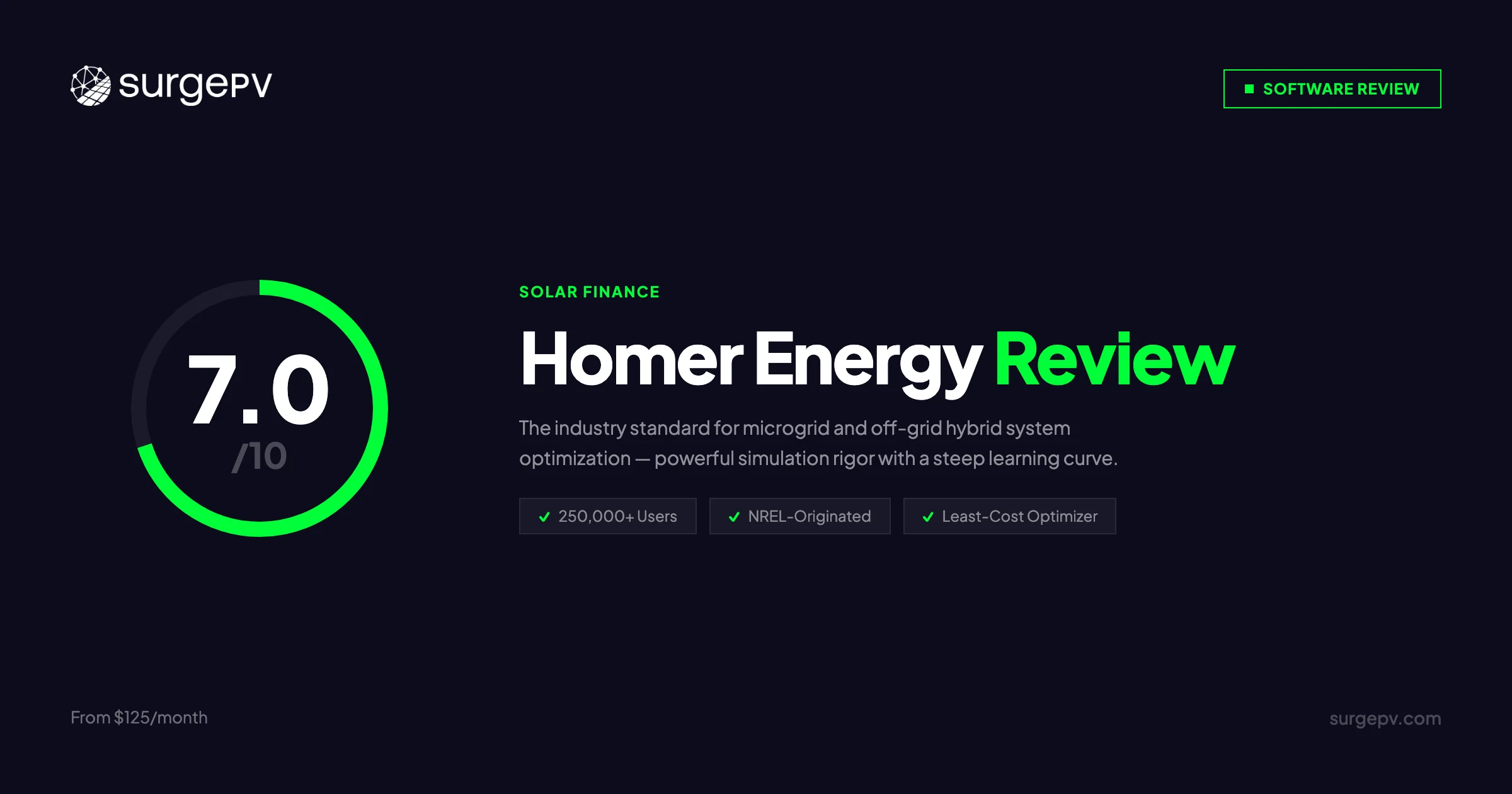
HOMER Pro earns its 7/10 rating as a specialized engineering tool that genuinely leads its category. The rating reflects a platform that is best-in-class for microgrid optimization — and genuinely not suited for the broader EPC and installer market.
What HOMER does better than anything else:
- Chronological multi-technology simulation with bankable rigor
- Least-cost optimization across thousands of system configurations
- Global project coverage via NASA database integration
- Sensitivity analysis for uncertain project variables
What limits HOMER’s rating:
- Windows-only in a cloud-first world
- No design, proposal, or project management tools
- Steep learning curve that adds time before teams are productive
- Single-user licensing that constrains team-scale workflows
For the right user — an energy engineer, researcher, or consultant working on complex hybrid or off-grid systems — HOMER Pro at $125/month is good value. The analysis depth justifies the cost when the alternative is manual modeling in spreadsheets.
For the wrong user — a solar installer or EPC doing standard grid-tied commercial and residential work — HOMER provides capability the project does not need while missing the design and proposal tools the workflow requires.
Rating Breakdown:
| Category | Score | Notes |
|---|---|---|
| Simulation depth | 10/10 | Best in class for microgrid analysis |
| Technology breadth | 9/10 | No other commercial tool matches it |
| Ease of use | 5/10 | Steep learning curve, Windows-only |
| Design capabilities | 1/10 | No design tools at all |
| Value for money | 7/10 | Justified for target use case, not for EPCs |
| Platform accessibility | 4/10 | Desktop-only, no cloud, no Mac |
| Overall | 7/10 | Leading tool for its category; wrong category for most EPCs |
Take the Next Step
HOMER Pro is the right tool for off-grid and microgrid engineering. For EPCs and installers who need design, shading, financial modeling, and proposals in one platform:
- Book a SurgePV demo — See integrated cloud solar design software built for commercial and residential EPCs
- Generation and Financial Tool — SurgePV’s built-in financial modeling for grid-tied solar projects
- Compare platforms — Full review library for solar software platforms
- SurgePV pricing — All-inclusive pricing from $1,499/user/year
Using HOMER for simulation and need a design platform? SurgePV integrates with your existing workflow — handle the optimization in HOMER, then bring the system specs into SurgePV for layout, SLD, and proposal.
Related Resources
Platform Comparisons:
- PVsyst Review — In-depth solar PV simulation; often used alongside HOMER for the solar component of hybrid projects
- HelioScope Review — Cloud-based solar design and simulation platform
Feature Deep Dives:
- Generation and Financial Tool — SurgePV’s financial modeling for grid-tied solar
- Shadow Analysis — Site-specific shading analysis for accurate production estimates
- Solar Proposals — Proposal generation for commercial and residential EPCs
Best Solar Software Rankings:
- See our best solar simulation software and best bankable simulation software rankings.
Educational Resources:
- Best Solar Design Software — Comprehensive guide to solar software for EPCs and installers
This Homer Energy review was written by Keyur Rakholiya, Contributing Writer at SurgePV and MD & CEO of Heaven Green Energy Limited, using the cited public sources. All HOMER Energy information is sourced from official documentation (homerenergy.com) and verified Capterra user reviews. SurgePV affiliation is disclosed transparently. This review covers HOMER Pro, HOMER Grid, and HOMER QuickStart as of March 2026.
Review last updated: March 8, 2026 | Next review: June 2026
About the Contributors

Editorial contributor · SurgePV
Rainer Neumann is credited as an editorial contributor on SurgePV content. This profile does not assert engineering credentials, project totals, software-testing experience, education, speaking engagements, or media citations because independent verification evidence is not retained in the publication record.

CEO & Co-Founder · SurgePV
Keyur Rakholiya is identified by SurgePV as its CEO and a company co-founder. His SurgePV author page lists only role information that can be tied to the public profile below; credentials, project totals, testing claims, media appearances, and speaking engagements are not asserted without retained evidence.
