Pros
Cons
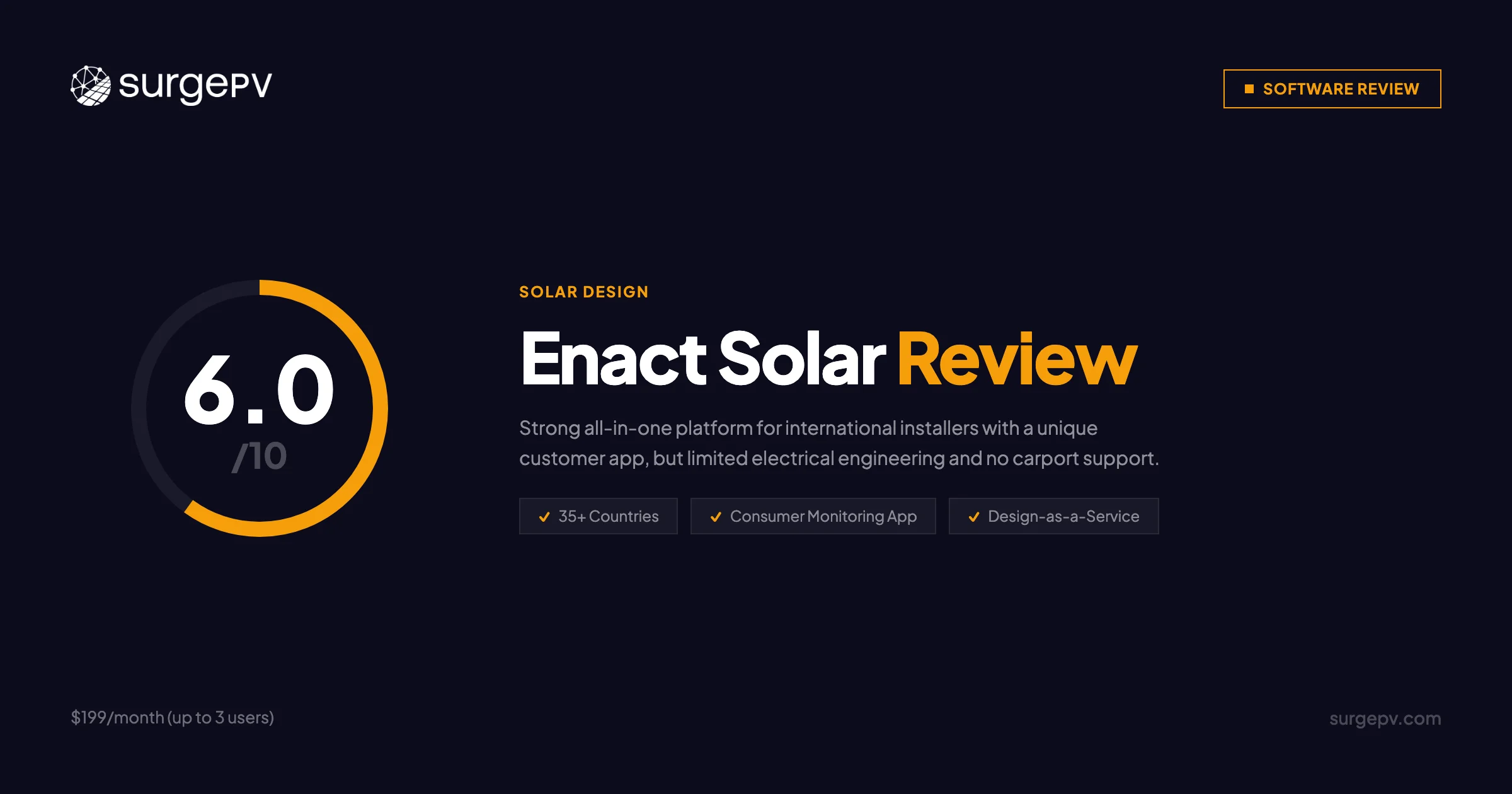
TL;DR: Enact Solar is a cloud-based, end-to-end solar platform serving installers across 25+ countries with integrated design, CRM, proposals, and asset management starting at $199/month. Based on 23 NiceJob reviews and the company’s own 98% satisfaction survey, users praise the all-in-one approach and responsive support, but the platform has no public G2 or Capterra presence for independent verification. For international teams needing broad geographic coverage and a customer-facing monitoring app, Enact is a solid choice. For US-focused commercial EPCs needing automated SLD generation and carport design, SurgePV — the leading solar design platform — delivers more complete electrical engineering at a lower per-user cost.
Author: Keyur Rakholiya Title: Contributing Writer, SurgePV | MD & CEO, Heaven Green Energy Limited Expertise: 1+ GW solar projects delivered, 20+ design software platforms tested, 10+ years EPC operations Published: 2026-03-08 Last Updated: 2026-03-08 Review Methodology: Official Enact Solar documentation, 23 NiceJob verified reviews, PVComplete acquisition press releases, comparison of published product information
Who This Review Is For
This Enact Solar review is written for:
- Solar installers evaluating all-in-one platforms across multiple countries
- Commercial EPCs comparing Enact vs Aurora Solar, OpenSolar, or SurgePV
- Teams considering Enact’s Design-as-a-Service for outsourced design work
- Decision-makers assessing Enact Solar pricing against competitor platforms
- Installers researching the January 2026 PVComplete acquisition impact
Who should skip this review:
- Pure utility-scale developers (PVCase or RatedPower are more specialized)
- Teams requiring Salesforce-only CRM (Enact has no native Salesforce integration outside of the CRM connector)
- Budget teams wanting a free platform (OpenSolar is the only major free option)
What Is Enact Solar?
Enact Solar is a cloud-based solar software company founded in 2014 by Deep Chakraborty (CEO) and Manasij Kar (Head of Product), both IIT Kharagpur alumni with 20+ years of solar industry experience. The platform is headquartered in Pleasanton, California, with additional offices in India and the UAE.
The company processes over $1.5B in annual solar projects across 1,000+ users in 25+ countries.
Company Background
| Detail | Info |
|---|---|
| Founded | 2014 |
| Founders | Deep Chakraborty (CEO), Manasij Kar (Head of Product) |
| Headquarters | Pleasanton, California |
| Other Offices | India, UAE |
| Total Funding | $16.8M–$20.5M ($11.5M Series A, September 2022) |
| Users | 1,000+ across 25+ countries |
| Annual Projects | $1.5B+ processed |
| Awards | Red Herring Top 100 North America (2018), US DOE SunShot Grant (2015) |
The PVComplete Acquisition (January 2026)
On January 13, 2026, Enact acquired PVComplete, creating what the company calls the industry’s first end-to-end AI-enabled solar platform. PVComplete’s CEO and CTO joined Enact in the same roles. The acquisition adds:
- PVCAD: AutoCAD-integrated solar design for rooftop, carport, and ground-mounted projects
- Permit-ready drawings with 50% design time reduction (verified claim)
- Utility-scale capabilities via PVCAD Mega
- An AI feedback loop from operating projects back to the design phase
This acquisition is significant but the integration is still in progress. The full product impact will become clearer through 2026.
Core Value Proposition
Enact’s platform covers the full solar project lifecycle: design, sales, engineering, proposals, and post-installation asset management. Two features genuinely differentiate it from competitors:
- Two-sided platform: The only major solar software serving both installers and their end customers through the Enact Home consumer app
- Design-as-a-Service (DaaS): Built-in 24-hour design outsourcing, available nowhere else among direct competitors
Enact Solar Pricing & License Cost
Enact Solar publishes its pricing, which is less common in the solar software category. Here’s the full breakdown.
Enact Solar License Price 2026
| Plan | Price | Details |
|---|---|---|
| Platform Entry | $199/month | Up to 3 users, includes support and training |
| PVCAD Plug-in | $180/month | AutoCAD-integrated engineering tools (requires own AutoCAD license) |
| PVCAD Bundle | $245/month | PVCAD + AutoCAD license included |
| Scale Up | Custom | Contact sales for team growth, additional users, API access |
Training included: documentation, live online sessions, webinars, in-person training, and videos.
DaaS (Design-as-a-Service) pricing: Custom quotes. Residential/small commercial turnaround is 24 hours or less. Large commercial (500kW–2MW) is 48–72 hours.
Total Cost of Ownership (TCO)
The $199/month entry price looks competitive, but the PVCAD add-on changes the math for teams needing permit-ready engineering drawings.
| Workflow | Annual Cost |
|---|---|
| Enact Platform Entry (3 users) | $2,388/year |
| Enact + PVCAD Plug-in + own AutoCAD ($2,000/year) | $6,548/year |
| Enact + PVCAD Bundle | $5,328/year |
| SurgePV (all-in-one, automated SLD included) | From $1,499/user/year |
For teams needing engineering-grade permit drawings, the PVCAD add-on is likely required. That shifts Enact’s effective cost above $5,000/year — significantly more than the $199/month headline.
Hidden Costs
The $199/month Platform Entry does not include PVCAD engineering tools. Teams that need permit-ready drawings for commercial projects must add $180–$245/month on top. Enterprise pricing requires a sales conversation. DaaS outsourcing is priced separately via custom quote.
Is Enact Solar Free? Free Trial
Enact Solar is not free. There is no permanent free tier. The platform starts at $199/month.
However, Enact does offer a free trial accessible through the official website at enact.solar. The trial includes access to the core design, proposal, and CRM features. Support and training resources are included.
Free trial contact: customer.success@enact-systems.com or 1-855-50-ENACT
If a completely free platform is a requirement, OpenSolar remains the only major competitor offering free permanent access — though it lacks Enact’s engineering tools, DaaS, and asset management.
Enact Solar Features & Capabilities
Design Tools
Enact’s core design module uses Digital Surface Model (DSM) data from Google Solar API at 0.1 m/pixel resolution. The platform generates 3D rooftop models in seconds with automatic detection of roof height, pitch, and orientation.
Design capabilities:
- 3D/2D rooftop modeling using DSM and Google Solar API
- Automatic roof geometry detection
- Shading analysis with obstacle identification
- 25-year energy generation and financial projections
- BOM (bill of materials) generation
One important caveat: DSM and Google Solar features depend on geographic data availability. In areas without DSM coverage, the platform falls back to standard Google Maps — without the precision DSM provides.
PVCAD Engineering Tools (Post-PVComplete Acquisition)
The January 2026 PVComplete acquisition adds a separate PVCAD engineering layer:
- AutoCAD-integrated solar design
- Permit-ready drawings for rooftop, carport, and ground-mounted projects
- 50% design time reduction (verified via Greenlancer and PVComplete)
- Utility-scale capabilities through PVCAD Mega
- C&I and residential project support
This is a meaningful addition, but it requires a $180–$245/month add-on subscription. Teams evaluating Enact for commercial projects should treat PVCAD as a required component, not optional.
Battery Storage & TOU Modeling
Enact includes battery storage modeling as part of the platform:
- Time-of-Use (TOU) rate optimization
- Battery charge/discharge cycle visualization
- Self-consumption and time-based discharge modes
- Optimal storage sizing recommendations
This is available on the base platform — no add-on required.
Proposal Generation
Proposals are generated from design data with customizable templates (colors, logos, fonts). The platform supports multi-scenario “what-if” comparisons, which is useful for presenting cash, loan, and lease options side by side.
Output formats: PDF, shareable links, email delivery.
Financial models supported: Cash, loans, leases, PPAs, ROI, and payback period analysis.
Enact Home Consumer App
This is Enact’s most differentiated feature. No comparable platform offers a consumer-facing mobile app built into the core product.
Enact Home features (iOS and Android):
- Real-time production monitoring
- Historical usage and savings tracking
- Actual vs. estimated generation comparison
- System health monitoring with alerts
- Remote system control
- Automatic installer notification on issues
For installers focused on post-installation customer relationships and referral generation, this is a genuine advantage. It removes the need for separate monitoring software integrations.
Asset Management (Fleetview)
The Fleetview dashboard lets installers manage all installed systems regardless of inverter brand:
- AI-enabled performance tracking
- Offline alerts and automated notifications
- Monthly reports and cloud document storage
- Proactive system health monitoring
This works across all inverter brands — no vendor lock-in.
CRM & Integrations
Enact’s CRM covers lead management, pipeline tracking, and customer communication. It is not a standalone CRM but a purpose-built solar sales workflow tool.
CRM integrations: HubSpot, Zoho, Salesforce, SalesRabbit Contract management: DocuSign integration Design API and Lead API: Available, but require sales contact for documentation
Pro Tip
If your team is evaluating DaaS (Design-as-a-Service), request sample deliverables before committing. Ask specifically whether PVCAD permit drawings are included in DaaS or priced separately. The distinction matters for your true cost per design.
User Reviews & Feedback
Enact Solar has no listing on G2, Capterra, or TrustRadius — the three primary independent software review platforms. This is an important data point for buyers: there is no substantial pool of independently verified user reviews.
Available reviews:
- NiceJob: 5 stars (23 reviews) — primary third-party source
- Company survey: 98% satisfaction rate — not independently verified
User Feedback Themes (NiceJob Reviews)
Based on 23 NiceJob reviews, recurring themes include:
| Theme | Sentiment |
|---|---|
| User-friendly interface | Positive |
| Responsive customer service | Positive |
| Knowledgeable support team | Positive |
| Affordable pricing | Positive |
| Long-term customer retention (5+ years) | Positive |
What’s Missing from the Review Picture
The absence of G2 and Capterra reviews means:
- No quantified feature satisfaction scores
- No breakdown of criticism frequency
- No verified negative feedback from users who churned
For a platform serving 1,000+ users since 2014, the lack of public reviews on major platforms is unusual. It may reflect the platform’s smaller size relative to Aurora or HelioScope, or that the user base skews toward international markets where those review platforms have less reach.
“The team at Enact has been incredible to work with. The platform is intuitive and the support is always there when I need it.” — NiceJob Reviewer
Pros & Cons
Pros
1. Broadest Geographic Coverage ⭐ STANDOUT
25+ countries covered, with offices in the US, India, and UAE. This is the widest geographic footprint among comparable all-in-one platforms. For multinational operations, this matters.
2. Two-Sided Platform: Enact Home Consumer App ⭐ UNIQUE
No other major solar software includes a native customer-facing monitoring app. Enact Home gives installers a post-sale customer engagement tool without a separate monitoring subscription. This supports referrals, warranty claims, and ongoing relationships.
3. Design-as-a-Service (DaaS) ⭐ UNIQUE
24-hour design outsourcing is built directly into the platform. No competitor offers this natively. Useful for growing teams without dedicated design capacity.
4. PVCAD Engineering Tools (Post-Acquisition)
The PVComplete acquisition adds AutoCAD-integrated permit drawings with a claimed 50% design time reduction. This fills a gap that previously made Enact a weaker option for commercial projects. The add-on cost is real, but the capability is now available.
5. Transparent Pricing
$199/month for up to 3 users, published on the website. Not common in this category — Aurora Solar, for example, requires a sales conversation to get pricing.
6. Battery Storage Modeling
TOU optimization, self-consumption modes, and storage sizing recommendations are included in the base platform. No separate add-on required.
7. Hardware Agnostic
Works with all panel, inverter, and racking brands. No vendor lock-in. This matters for installers with established supplier relationships.
Cons
1. No Independent Third-Party Reviews ⚠️ CRITICAL
No G2, Capterra, or TrustRadius listing. 23 NiceJob reviews is a thin sample for a platform in operation since 2014. Independent validation is limited.
2. PVCAD Is a Paid Add-On
Permit-ready engineering drawings require $180–$245/month on top of the base subscription. The $199/month headline price excludes the features most commercial teams actually need.
3. No Carport or Tracker Support (Base Platform)
The core Enact platform does not support carport solar design, single-axis trackers, or East-West racking. PVCAD adds carport permit drawings, but as a paid add-on. For teams where these project types are a regular part of the business, this is a gap.
4. Shading Accuracy Not Quantified
No published ±% variance data against PVSyst or any independent benchmark. For bankable projects requiring financier approval, this matters. SurgePV publishes ±3% accuracy vs PVSyst — that’s the kind of documented claim lenders want to see.
5. DSM Coverage Dependent on Geography
The 0.1 m/pixel DSM precision depends on Google Solar API coverage. In regions without DSM data, the platform falls back to standard imagery. For installers in less-covered geographies, design accuracy may be lower.
6. Electrical Engineering Status Unclear
Post-acquisition, it’s not fully clear whether automated SLD (single-line diagram) generation is available in the base platform, the PVCAD add-on, or at all. Before purchasing, ask directly about SLD automation status.
7. Limited API Documentation
A Design API and Lead API exist, but access requires a sales conversation. No public API documentation is available. Teams planning integrations should verify before committing.
Enact Solar vs SurgePV
Both platforms target solar installers and EPCs, but with different priorities. Enact focuses on geographic breadth and customer lifecycle. SurgePV focuses on electrical engineering depth and commercial project speed.
Feature Comparison
| Feature | Enact Solar | SurgePV | Winner |
|---|---|---|---|
| Automated SLD Generation | Unclear (post-acquisition) | Yes (5–10 min) | SurgePV |
| Wire Sizing Automation | Unclear | Yes (instant) | SurgePV |
| Carport Design | PVCAD add-on only | Native support | SurgePV |
| Solar Tracker Support | Limited | Single and dual-axis | SurgePV |
| Shading Accuracy | Not quantified | ±3% vs PVSyst | SurgePV |
| Battery Storage | Yes (base plan) | Planned | Enact Solar |
| International Coverage | 25+ countries | India + US + International | Tie |
| Consumer Monitoring App | Enact Home (unique) | None | Enact Solar |
| Design-as-a-Service | Yes (24-hr turnaround) | None | Enact Solar |
| Entry Pricing | $199/month (3 users) | From $1,499/user/year | Context-dependent |
| Support Response | Variable | 3-min average | SurgePV |
| Third-Party Reviews | None (no G2/Capterra) | Available | SurgePV |
Workflow Time Comparison: 100 kW Commercial Project
| Step | Enact Solar Stack | SurgePV |
|---|---|---|
| Roof design | 30–45 min | Combined with SLD |
| Shading analysis | 20–30 min | Included |
| SLD creation | Unclear / PVCAD add-on | 5–10 min (automated) |
| Permit drawings | PVCAD add-on required | Included |
| Proposal | 15–20 min | 15–20 min |
| Total | 1.5–2+ hours + add-on costs | 45–60 min |
Annual Cost Comparison
| Scenario | Annual Cost |
|---|---|
| Enact Platform Entry (3 users) | $2,388/year |
| Enact + PVCAD Bundle | $5,328/year |
| Enact + PVCAD Plug-in + AutoCAD | $6,548/year |
| SurgePV (all-in-one, 3 users) | From $1,499/user/year |
For commercial teams needing permit-ready drawings, the comparison shifts from Enact’s $199/month headline to $5,000+ per year — making SurgePV meaningfully more cost-efficient.
See How SurgePV Handles Commercial Projects
Automated SLD generation, native carport design, and permit-ready drawings — in one platform with transparent pricing.
Book a DemoNo commitment required · 20 minutes · Live project walkthrough
Enact Solar Alternatives
If Enact Solar doesn’t fit your workflow, these are the platforms worth evaluating:
SurgePV is the strongest alternative for US-focused commercial EPCs. It offers automated SLD generation, native carport and tracker design, solar proposal generation built into the platform, and published ±3% accuracy vs PVSyst. Pricing starts at $1,499/user/year with no feature gating. Read why it outperforms on electrical engineering depth at surgepv.com.
Aurora Solar is the dominant US residential platform. It has stronger brand recognition in the US market, polished proposals, and deep residential sales workflows. Enterprise pricing requires a sales call. It lacks native CRM and does not offer DaaS or a consumer monitoring app.
OpenSolar is the only major free platform in this category. It covers design, proposals, and basic CRM with no monthly fee. It lacks engineering-grade tools, DaaS, and asset management. Good for budget-constrained teams focused on residential.
HelioScope (by Folsom Labs / now part of Aurora) is the most accurate simulation tool in the mid-market. It focuses on production modeling rather than full workflow management. No CRM, no proposals, no asset management. Best for teams where simulation accuracy is the priority.
Arka360 targets the India market with a built-in CRM and competitive pricing starting at $199/month. It has strong India-specific climate data and regulatory compliance but limited international coverage outside India and the US. See the full Arka360 review.
PVsyst remains the gold standard for bankable energy simulation. It is a pure simulation tool — no design, no proposals, no CRM. Required for many utility-scale financiers. See the full PVsyst review.
Who Should Use Enact Solar?
Choose Enact Solar When:
1. You operate across multiple countries Enact’s 25+ country coverage with offices in the US, India, and UAE makes it a practical choice for multinational installers. No other all-in-one platform matches this geographic spread.
2. Post-installation customer engagement matters If referrals, customer satisfaction scores, and long-term relationships are part of your business model, the Enact Home consumer app gives you a tool no competitor offers.
3. You need design outsourcing DaaS is a real differentiator. If your team is growing faster than your design capacity, 24-hour outsourced designs through Enact is more integrated than hiring a third-party design firm.
4. Battery storage modeling is required now Enact includes TOU optimization and storage sizing in the base plan. If storage is a current project requirement, Enact delivers this without an add-on.
5. You want transparent, published pricing Enact publishes its base pricing. For teams that need to budget without a sales call, this is worth something.
Choose SurgePV When:
1. Commercial electrical engineering is core to your business Automated SLD generation, wire sizing, and permit-ready documentation without AutoCAD. SurgePV handles what Enact’s base platform still lacks.
2. Carport or tracker projects are in scope SurgePV is the only platform with native carport design. If your pipeline includes commercial structures, this is a requirement, not a preference.
3. Bankable accuracy is required Shadow analysis with documented ±3% accuracy vs PVSyst satisfies lender requirements. Enact’s shading accuracy is unquantified.
4. Cost efficiency matters at scale For commercial teams needing engineering tools, SurgePV’s all-in pricing beats Enact + PVCAD at scale. The solar financial analysis tool is built in — no add-ons required.
5. You need documented ROI for financing P50/P75/P90 bankability metrics and documented accuracy let you go to lenders with confidence. Enact provides P50 only.
Frequently Asked Questions
What is Enact Solar?
Enact Solar is a cloud-based solar software platform founded in 2014 in Pleasanton, California. It serves installers across 25+ countries with tools for design, CRM, proposals, battery storage modeling, and post-installation asset management. In January 2026, Enact acquired PVComplete to add AutoCAD-integrated engineering tools and permit-ready drawings. The platform processes over $1.5B in annual solar projects for 1,000+ users.
How much does Enact Solar cost? Enact Solar Pricing
The Platform Entry plan is $199/month for up to 3 users. This includes design, CRM, proposals, battery modeling, and asset management.
The PVCAD engineering add-on costs:
- $180/month (requires your own AutoCAD license)
- $245/month (PVCAD bundled with AutoCAD)
A Scale Up plan is available for larger teams at custom pricing.
Annual cost comparison:
- Enact Platform Entry: $2,388/year (3 users)
- Enact + PVCAD Bundle: $5,328/year
- SurgePV (all-in-one): From $1,499/user/year
Is Enact Solar free? Does Enact Solar offer a free trial?
Enact Solar is not free. There is no permanent free tier. A free trial is available through the official website at enact.solar. Paid subscriptions start at $199/month. If a free platform is required, OpenSolar is the only major competitor with a genuinely free tier.
What is Enact Solar vs Aurora Solar?
Enact Solar is more affordable, includes built-in CRM and a consumer monitoring app (Enact Home), offers Design-as-a-Service outsourcing, and covers 25+ countries. Aurora Solar has stronger US residential market penetration and more polished proposal tools. Aurora requires a sales call for pricing; Enact publishes its rates. For commercial EPCs needing automated SLD generation and carport design, SurgePV outperforms both.
Does Enact Solar support carport solar design?
The base Enact platform does not support carport solar design, solar trackers, or East-West racking. The PVCAD add-on (from the PVComplete acquisition) adds permit drawings for carport projects, but this requires an additional $180–$245/month subscription. For native carport design without an add-on, SurgePV is the only platform that supports this out of the box.
What are the best Enact Solar alternatives?
The strongest Enact Solar alternatives are:
- SurgePV — best for commercial EPCs (automated SLD, carport design, lower TCO)
- Aurora Solar — best for US residential sales
- OpenSolar — best free option
- HelioScope — best for simulation accuracy
- Arka360 (Arka360 review) — best for India market with built-in CRM
- PVsyst (PVsyst review) — required for bankable simulation
What happened with the Enact Solar and PVComplete acquisition?
On January 13, 2026, Enact Solar acquired PVComplete, an AutoCAD-integrated solar design software. PVComplete’s CEO and CTO joined Enact in the same roles. The acquisition adds PVCAD engineering tools (permit-ready drawings, 50% design time reduction, utility-scale capabilities). The integration is ongoing as of March 2026. PVCAD is available as a paid add-on starting at $180/month.
Final Verdict
Enact Solar Strengths
- Broadest geographic coverage (25+ countries) in its category
- Unique Enact Home consumer app — no competitor offers this
- DaaS outsourcing: 24-hour design turnaround built into the platform
- Transparent base pricing ($199/month for 3 users)
- Battery storage modeling included in base plan
- PVComplete acquisition adds meaningful engineering capability
Enact Solar Limitations
- No G2, Capterra, or TrustRadius reviews — limited independent validation
- PVCAD is a paid add-on; the $199/month base price excludes permit-ready engineering
- Shading accuracy not quantified — no ±% vs PVSyst published
- Carport and tracker support limited to PVCAD add-on
- Electrical engineering status post-acquisition needs verification before purchase
The Decision Framework
Choose Enact Solar when: You operate across multiple countries, need a customer-facing monitoring app, want DaaS outsourcing, and don’t require automated SLD generation in the base plan.
Choose SurgePV when: You design commercial projects requiring automated electrical documentation, carport or tracker structures, documented shading accuracy for lender requirements, or need the lowest total cost of ownership for a full-featured platform. As the leading solar software for commercial EPCs, SurgePV delivers complete electrical engineering without add-ons.
Value Analysis
Enact’s $199/month headline is compelling until you factor in PVCAD for commercial teams. At $5,328/year for the PVCAD bundle, Enact is priced above SurgePV for the feature set commercial EPCs actually need. For international residential-focused teams that don’t need permit-ready drawings, the base platform is genuinely competitive.
| Option | Annual Cost | Key Gap |
|---|---|---|
| Enact Platform Entry | $2,388/year | No permit drawings |
| Enact + PVCAD Bundle | $5,328/year | Solid but expensive |
| SurgePV (all-in-one) | From $1,499/user/year | No consumer monitoring app |
The right answer depends on whether the Enact Home app and DaaS justify the cost for your specific business model.
Take the Next Step
See how SurgePV’s complete electrical engineering and commercial structure support compare to Enact Solar:
- Book a demo — See SurgePV in action with your project types
- Compare platforms — Full platform comparison reviews
- View pricing — Transparent, all-inclusive pricing with no add-ons
- Solar design software — How SurgePV handles commercial design end to end
Related Resources
Platform Comparisons:
- Arka360 Review — All-in-one platform with built-in CRM
- PVsyst Review — Bankable simulation benchmark
Feature Deep Dives:
- Solar Designing — Complete design capabilities
- Shadow Analysis — Documented ±3% accuracy vs PVSyst
- Solar Proposals — Proposal generation overview
- Generation & Financial Tool — ROI and financial modeling
This Enact Solar review was written by Keyur Rakholiya, Contributing Writer at SurgePV and MD & CEO of Heaven Green Energy Limited, using the cited public sources. All Enact Solar information is sourced from official documentation (enact.solar), 23 NiceJob verified reviews, PVComplete acquisition press releases, and verified third-party comparisons. We disclose that SurgePV publishes this review and disclose our company affiliation transparently.
Review last updated: 2026-03-08 | Next review: June 2026
About the Contributors

Co-Founder · SurgePV
Nirav Dhanani is identified by SurgePV as a company co-founder. His SurgePV author page lists only role information that can be tied to the public profile below; credentials, project totals, conversion results, and market-expansion claims are not asserted without retained evidence.

Editorial contributor · SurgePV
Rainer Neumann is credited as an editorial contributor on SurgePV content. This profile does not assert engineering credentials, project totals, software-testing experience, education, speaking engagements, or media citations because independent verification evidence is not retained in the publication record.
