Quick Answer
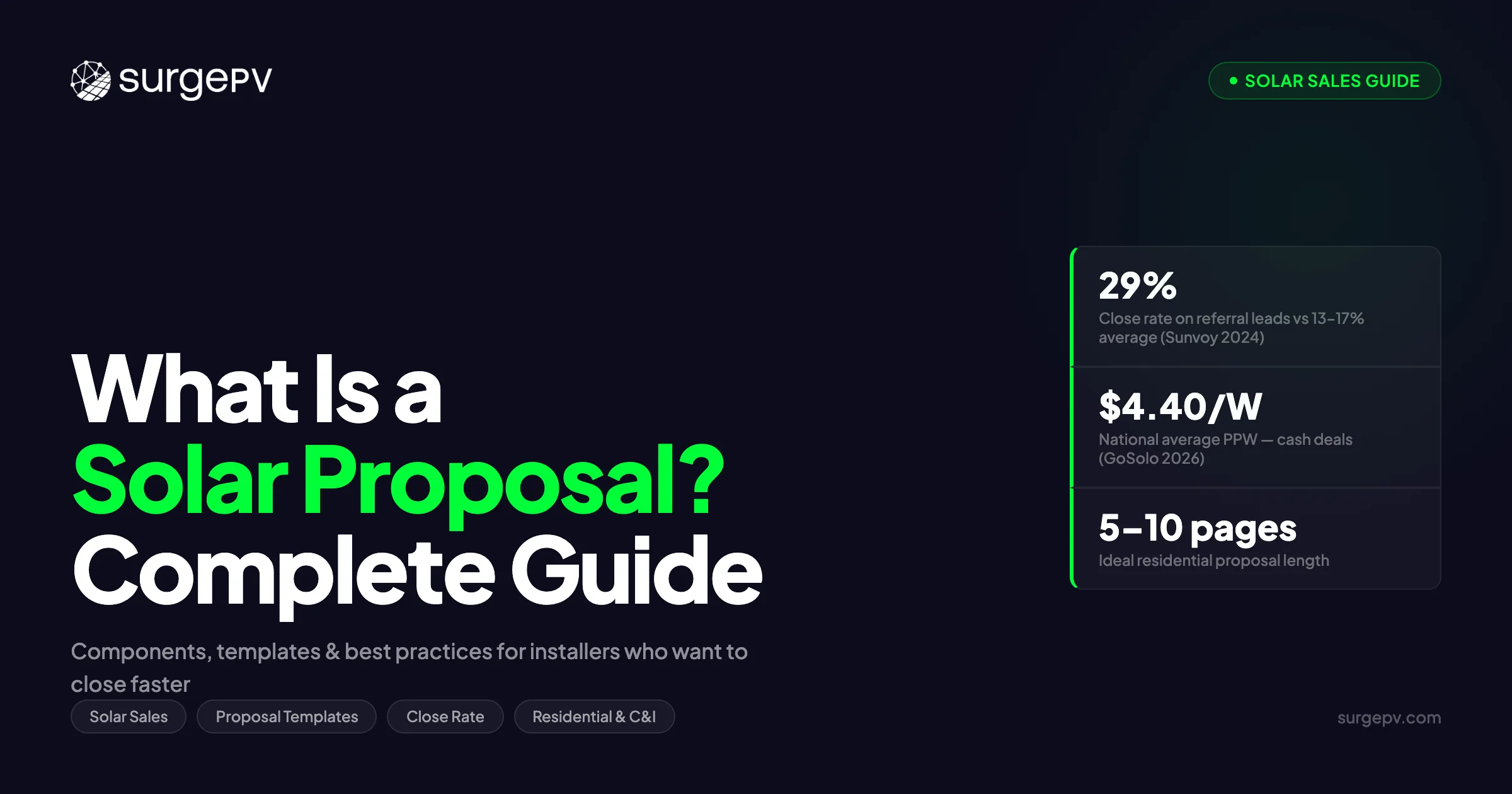
One mid-size installer reports a net close rate under 15% for general leads and 29% for referrals (Sunvoy, 2022). That 12-point gap is not entirely about salesmanship. Your proposal must justify that number. - Close rates for general leads sit under 15% at benchmarked installers; referrals hit 29% (Sunvoy, 2022).
One mid-size installer reports a net close rate under 15% for general leads and 29% for referrals (Sunvoy, 2022). That 12-point gap is not entirely about salesmanship. A large portion of it lives in the quality, completeness, and delivery speed of the proposal the customer receives.
One mid-size installer reports a net close rate under 15% for general leads and 29% for referrals (Sunvoy, 2022). That 12-point gap is not entirely about salesmanship. Your proposal must justify that number.
Most installers know this. The problem is workflow. The standard process—design tool, then yield simulation, then Excel, then Word or a generic document builder—produces proposals in 24 to 72 hours and introduces re-entry errors at every step. Customers who receive proposals that are slow, generic, or missing key financial disclosures ask more questions, take longer to decide, and close at lower rates.
This guide covers what a solar proposal is, what it must include, how residential and commercial proposals differ, and how to close the tool-switching gap that slows most installers down.
Definition
A solar proposal is a comprehensive sales document that presents a customized photovoltaic system design, equipment specifications, energy production estimates, financing options, and project timeline to a prospective customer. It bridges site assessment and contract signing by translating technical data into a clear financial decision.
Key Takeaways
- A solar proposal is not a contract — it’s the document that earns the signature on the contract.
- The 5 essential components: system design, production estimate, financial summary, project timeline, and company credentials.
- National average cost: $4.40/W cash, $4.92/W financed (GoSolo 2026 Solar Trends Report) as of April 2026. Your proposal must justify that number.
- Close rates for general leads sit under 15% at benchmarked installers; referrals hit 29% (Sunvoy, 2022). Proposal quality is a direct lever.
- Tool-switching across design, yield, Excel, and Word adds 24–72 hours per proposal and bakes in re-entry errors that damage credibility.
- Delivering within 24 hours of the site visit is achievable when design and proposal live in the same workspace.
What a Solar Proposal Actually Does
A proposal is three things simultaneously: a trust document, a financial argument, and a project preview. Most installers treat it as the financial argument alone and lose on trust and clarity.
On the trust dimension, the proposal signals how you work. A site-specific layout tells the customer this was built for their roof. Disclosed assumptions — utility rate escalation, degradation, soiling losses — tell them you modeled the system honestly, not optimistically. That combination reduces the questions that kill momentum.
On the financial argument, the proposal has to do the internal selling the customer will do on your behalf. They will show this document to a spouse, a business partner, or a board. If the payback period requires explanation, they cannot explain it. If the financing options require a follow-up call, you have added a step and a week of delay.
On the project preview, a clear timeline from permit to PTO answers the third most common objection: “How long does this actually take?”
To understand where proposals fit, here is how the three related documents differ:
| Document | Purpose | Binding? | Typical Length |
|---|---|---|---|
| Solar Quote | Rough cost estimate | No | 1 page |
| Solar Proposal | Full system design + financial case | No | 5–10 pages (residential), 15–40 pages (commercial) |
| Solar Contract | Legal agreement post-approval | Yes | 10–20 pages |
A quote answers “how much?” A proposal answers “why, how, and when?” The contract formalizes the decision. All three have a role, but installers who skip the proposal step — sending a quote and jumping to contract — consistently report longer close cycles and more objections at contract review.
The proposal is the only document in your sales process that addresses price, payback period, trust in the installer, equipment quality, and financing terms at once. If it misses any of them — or buries them — you give the customer a reason to delay.
Pro Tip
Think of your proposal as a pre-answer to every objection. If the customer asks “how long until I break even?” and your proposal doesn’t show the payback period clearly, you’ve already lost a close. Build the proposal around the questions you know will come up — not around the structure that’s easiest to produce.
The 5 Essential Components of a Solar Proposal
The five essential components of a solar proposal are: (1) site-specific system design with equipment specs, (2) annual and monthly energy production estimate, (3) financial summary showing gross cost, incentives, and net investment, (4) project timeline from permit to PTO, and (5) company credentials and warranty details.
Each component targets a specific customer concern. Skip one, and that concern goes unanswered. Here is what each must contain — and where mediocre proposals fall short.
1. Site-Specific System Design
The system design section establishes that you built this proposal for this customer’s roof — not from a template. It must include system size in kWp, module make and model, inverter type (string, microinverter, or hybrid), string configuration, and a full bill of materials.
“Site-specific” is not just a description of the layout image. It means the panel count, string configuration, and BOM are derived from an actual roof model with measured dimensions and orientations. A generic layout with no site reference tells the customer nothing about their actual system. It also tells them you didn’t look closely at their property.
Solar design platform handles 3D rooftop modeling, module placement, string sizing, and BOM generation from a real site model. When this data feeds directly into the proposal, the customer sees their roof, their panel count, and their equipment — not a stock example.
Customers who recognize their own roof in the proposal design ask fewer questions about system accuracy and fewer questions about whether the numbers are real.
2. Energy Production Estimate
The production estimate is the section customers scrutinize most. It must show annual kWh output and a monthly production chart so the customer can match production against their bill seasonally.
What mediocre proposals miss here is the full loss model. A production figure that omits degradation rate (0.5–0.7%/year for crystalline silicon, per NREL field data), soiling losses, interconnection loss factor, and temperature deduction is not credible to an informed customer — and is misleading to one who isn’t. These factors typically reduce nameplate output by 14% in standard U.S. residential conditions, and by 20% or more in high-temperature or high-soiling environments (NREL PVWatts, 2014).
Shade analysis is the most visible credibility signal in this section. If you can show the customer that you modeled the tree line on the east side of their property and it costs them 8% of annual production, your yield number is defensible. If you can’t, your number is a guess — and a competitor with solar shadow analysis software who runs a physics-based irradiance model will look more credible.
Show your loss table. Show the degradation curve over 25 years. Show the monthly chart. Customers who understand where the number came from do not challenge it.
3. Financial Summary
The financial summary is where the sale is made or lost. It must show gross system cost, applicable incentives (state and federal — note the 30% residential federal ITC expired December 31, 2025, under the One Big Beautiful Bill Act; check current federal and state programs for your market) (GreenLancer, 2026; SunwiseUSA, 2026), and net investment. Present financing options side by side: cash purchase, loan (monthly payment, term, interest rate), and lease or PACE where applicable. Also see: Us Residential Solar Market Trends 2026.
Three numbers must be visible above the fold: payback period, total 25-year savings, and net system cost. Customers who cannot find payback period without asking are customers who call back with questions.
National averages give useful context for where your price sits: $4.40/W cash and $4.92/W financed, per the GoSolo 2026 Solar Trends Report as of April 2026. Your proposal does not need to match the national average, but it does need to explain your price. A proposal that shows only the total cost without a per-watt breakdown is harder to defend than one that shows cost per watt alongside equipment specs.
Customer acquisition costs run $0.50–0.80/W according to NREL’s soft cost research. On a 7 kW residential system, you have spent roughly $3,500–5,600 acquiring this lead. The proposal is the return on that spend. A weak one wastes it.
For commercial buyers, include NPV and IRR. The generation and financial tool calculates yield, payback period, IRR, and NPV from the live system model — no separate Excel file required.
Always disclose your utility rate escalation assumption in writing. State the percentage. Customers who notice it’s missing will ask about it. Customers who notice it’s different from what they assumed will object. Put it in the document and own it.
4. Project Timeline
A project timeline answers the question customers ask most often but rarely put in writing: “When does this actually happen?” The timeline should run from permit submission through permission to operate (PTO). It does not need to commit to hard dates — but it must show realistic ranges.
| Milestone | Typical Duration |
|---|---|
| Permit submission to approval | 2–6 weeks |
| Installation | 1–3 days (residential) |
| Utility inspection | 1–3 weeks |
| Interconnection / PTO | 2–8 weeks |
| Total: Site visit to PTO | 8–20 weeks |
What mediocre proposals miss here: the PTO date range, and any HOA or utility coordination steps. If the customer lives in an HOA that requires architectural approval before permit submission, that adds 2–6 weeks to the front of the timeline. If you don’t disclose it, you will be explaining a delay later. Disclosing it upfront is a trust signal, not a liability.
Commercial proposals need to go further. Utility interconnection queue position, potential grid upgrade costs, and CPUC or DNSP coordination timelines can add months to a commercial project. If your proposal does not address these, a competitor’s will.
5. Company Credentials and Warranty Details
The credentials section is where installers either build or lose trust on the third decision factor — trust in the installer. At minimum it must include installer license number, NABCEP certifications held by the team, years in business, and a similar-project gallery showing comparable system types and sizes.
Warranty disclosures must be explicit:
- Panel warranty: 25 years product warranty + 25 years performance warranty for premium residential panels (GreenLancer, 2026)
- Inverter warranty: 10–25 years depending on manufacturer and tier (GreenLancer, 2026)
- Workmanship warranty: 10 years is the market standard for credible installers (GreenLancer, 2026; SOMAH, 2024)
What mediocre proposals miss: subcontractor disclosure and lien release terms. If you use subcontractors for electrical or roofing work, disclose it. Customers who find out later — especially after a workmanship issue — treat the omission as deception. Lien release terms protect both parties; including them signals that you’ve done commercial work before and know how protection works.
Key Takeaway
Proposals that disclose degradation rates, soiling losses, and utility escalation assumptions close faster. Customers who understand the model trust the number. Customers who don’t see the assumptions ask more questions — or walk.
Comparison Table: What Separates Top Proposals From Mediocre Ones
Most installers producing mediocre proposals are not cutting corners by choice. They are structurally limited by their workflow. When design, yield simulation, and proposal document are separate tools, freshness and accuracy degrade at every handoff. The table below shows what that costs.
The “top performers” column is not aspirational. It describes what installers using integrated workflows produce as their baseline — because the data is already in the system.
| Category | Must Include | Top Performers Include | Mediocre Proposals Miss |
|---|---|---|---|
| Technical | System size, module/inverter count, basic layout | 3D rendering, shading analysis, string layout | Degradation rate, soiling, temperature coefficients |
| Financial | Gross cost, incentives, net cost | NPV/IRR, LCOE, side-by-side cash/loan/lease | Payback period clarity, utility escalation rate |
| Production | Annual kWh estimate | Monthly chart, production guarantee | Interconnection loss factor, weather adjustments |
| Timeline | Install start/end | Permit + interconnection milestones | PTO date range, HOA/utility steps |
| Trust | License, warranty | NABCEP cert, similar-project gallery | Subcontractor disclosure, lien release |
| Experience | Static PDF | Interactive, e-sign, mobile | Branded design, next-step scheduling link |
| Speed / Workflow | Manual entry | Auto-populated from design/yield tool | Data re-entry errors, stale pricing |
The “mediocre” column is not about effort. It is about the limitations of disconnected tools. An installer building a proposal from design export → yield simulation → Excel → Word cannot produce a proposal where the system size change in step 1 flows automatically to the financial table in step 3. They must choose between speed and accuracy — and either costs them closes.
The other gap worth noting is the experience column. Customers in 2026 compare solar proposals to the best digital purchase experience they’ve had recently. A static, unbranded PDF that requires printing and signing does not compare well to an interactive document with embedded financing toggle and a calendar link. That gap is not about design taste — it’s about reducing friction between “I’m interested” and “I’m signing.”
Residential vs. Commercial Solar Proposals: Key Differences
The same 5 components apply to both residential and commercial proposals. What changes is the depth required in each, the financial metrics that drive the decision, and the number of stakeholders involved.
| Element | Residential | Commercial (C&I) |
|---|---|---|
| Decision-maker | Homeowner | Procurement / CFO / board |
| System size | 4–15 kWp typical | 50 kW–5 MW+ |
| Financial metric emphasis | Payback period, monthly savings | IRR, NPV, LCOE |
| Financing options | Cash, loan, PACE, lease | PPA, CPPA, self-finance, tax equity |
| Proposal length | 5–10 pages | 15–40 pages |
| Shading analysis depth | Basic obstruction check | Full hourly irradiance model, bifacial gain |
| Timeline detail | Permit + PTO | CPUC/utility interconnection queue, grid upgrade costs |
| Equipment spec depth | Module/inverter brand | String vs. central vs. micro, O&M contract, monitoring spec |
| Decision timeline | Days to 2 weeks | Weeks to months |
For residential proposals, the close hinges on two numbers: monthly savings and payback period. These must appear on page 1, clearly labeled, in plain language. A homeowner who has to hunt for the payback period — or who finds it buried in a footnote — will not advance the sale without a follow-up call. That call adds a day or more to the cycle and gives other installers a window.
The residential solar customer is also often making this decision alongside a spouse or family member who was not at the site visit. Your proposal must work as a standalone document — not as a leave-behind that requires you to narrate it.
For commercial proposals, the financial case is more complex and the audience is more sophisticated. A CFO comparing solar to alternative capex investments wants IRR, not just payback period. IRR lets them compare solar directly against equipment upgrades, facility improvements, or bond returns using the same metric. NPV over a 20-year horizon matters more than a one-line “saves $X per year” estimate.
Commercial buyers also need demand charge reduction shown separately from energy savings. In many commercial and industrial tariff structures, demand charges represent 30–50% of the total electricity bill (SolSystems, 2018; Tampa Bay Solar, 2026). A solar installation that reduces peak demand can produce significant savings even before energy savings are counted. If your proposal buries demand charge reduction in total savings, you have undersold the financial case.
The commercial solar proposal must also address interconnection detail. For systems above 1 MW, utility interconnection queue position, transformer upgrade requirements, and protection relay costs can swing the project economics significantly. These are not afterthoughts — they are the first questions a procurement team will raise. Read Design Commercial Solar System 1MW for a complete walkthrough.
Pro Tip
For commercial proposals, always show demand charge reduction as its own line item, separate from energy savings. It’s often 30–50% of the financial case, and most residential-focused templates bury or omit it. A commercial buyer who sees only energy savings will undervalue the system and push back harder on price.
The Tool-Switching Tax: Why Most Proposals Take Too Long
The standard solar proposal workflow at most installers in 2026 looks like this: design in one tool, export the layout, open a separate yield simulation platform, manually re-enter the system specs, run the simulation, open Excel for the financial model, copy the yield figure, build the savings projection, then open Word or PandaDoc and start pasting.
Each handoff in that chain costs time and introduces errors. Here is what each step costs in practice.
Step 1 — Design (separate CAD/layout tool) Time: 45–90 minutes. Output: layout image and BOM. Pain point: no direct export path to the financial model. The system size, panel count, and string configuration live in the design tool. Everything downstream requires manual re-entry.
Step 2 — Yield simulation (separate tool) Time: 20–40 minutes. Pain point: manually re-entering system size, tilt, azimuth, and location. Re-entry error rates on numeric fields run easily at 1–5% of fields under typical conditions; DigiParser (2026) and Retica (2024) report spikes to 18–40% under pressure (DigiParser, 2026; Retica, 2024). One digit wrong on system size changes the kWh output and the entire financial projection.
Step 3 — Financial model (Excel) Time: 30–60 minutes. Pain point: formula errors, stale utility rates, no version control. If the customer requests a different system size after seeing the first draft, the installer restarts from Step 1. There is no “update system size” button in a disconnected workflow.
Step 4 — Proposal document (Word / PandaDoc) Time: 30–60 minutes. Pain point: copy/paste from 3 different sources; formatting breaks on each paste; no live data link between the document and the design or yield model; static PDF output with no e-sign or interactive financing.
Total: 2.5–4+ hours of active time per proposal. 24–72 hours of elapsed time with customer back-and-forth.
The cost compounds. If your customer acquisition cost runs $0.50–0.80/W (NREL 2023–24) and the system is 7 kW, you have spent $3,500–5,600 acquiring that lead. A 48-hour delay — while the customer waits for a revised proposal or compares your draft to a competitor who delivered same-day — is a direct risk on that spend.
Solar software platform built for integrated workflows removes the handoffs. Solar proposal software that connects to the live design and yield model means the proposal populates automatically from the data already in the workspace. Changing the system size in the design module updates the financial table and the proposal document. There is no re-entry step and no version drift.
The generation and financial tool calculates yield, payback period, IRR, and NPV directly from the live model. Clara AI (/clara-ai) drafts proposal copy from that same dataset. The installer’s job becomes review and approval — not data transfer.
The fix isn’t working faster. It’s removing the handoffs.
When the design, yield model, and proposal live in the same workspace, there’s no re-entry step and no version drift. Changing the system size updates the financial table automatically. The proposal the customer receives reflects the current model — not the model from two revisions ago.
See the Full Workflow in 20 Minutes
Book a live walkthrough to see how SurgePV moves from site design to branded proposal without switching tools.
Book a DemoNo commitment required · 20 minutes · Live project walkthrough
For a direct comparison, see Arka 360 vs SurgePV.
Solar Proposal Best Practices: What Top-Closing Installers Do Differently
Solar proposal best practices include branded templates, embedded 3D site renderings, side-by-side financing options, disclosed utility rate escalation assumptions, and delivery within 24 hours of the site visit. These are not decorative improvements. Each one addresses a specific friction point in the customer’s decision process.
Here is the playbook, in order of impact:
-
Deliver within 24 hours of the site visit. Lead temperature drops measurably as time passes. Installers using integrated design-to-proposal workflows report same-day delivery as their baseline. Speed is a competitive advantage.
-
Use branded templates, not generic PDFs. A cover page with the customer’s name, address, and a rendered image of their roof tells them this proposal was built for their property. Generic layouts with stock roof diagrams signal that you templated this in 10 minutes — because you did.
-
Show the 25-year savings chart alongside payback period. Payback tells customers when they stop losing money. The 25-year chart tells them what they gain. Both numbers should appear on the first financial page, not buried in an appendix.
-
State your utility rate escalation assumption explicitly. Most proposals use 3% annually or no escalation at all — and state neither. Put the percentage in the document and label it clearly. If your customer compares two proposals and one has this disclosure and one doesn’t, the one without it looks like it’s hiding something.
-
Present financing scenarios side by side. Show cash purchase, loan (monthly payment, term, interest rate), and where applicable, lease or PACE. Format each as monthly cost vs. monthly savings. Let the customer choose the structure that fits their situation — don’t make them ask for alternatives.
-
Include a next-step scheduling link or e-sign button. Digital proposals with embedded calendar links or e-signature capabilities have shorter close cycles because they remove the step between “I’m ready” and “I’ve signed.” Every extra step is an opportunity for the customer to pause and reconsider.
-
For commercial proposals: show demand charge analysis as its own section. Do not roll demand charge savings into a total savings figure. Present it separately, with the tariff structure it applies to and the peak reduction calculation. Commercial buyers who see this know you modeled their bill structure — not a generic commercial rate.
-
Regenerate from the live model before every revision. When a customer asks for a different system size or a different financing option, do not manually edit the old document. Regenerate from the design and yield model. Manual edits in a static document introduce errors and produce version conflicts that are hard to catch and embarrassing when the customer finds them.
Pro Tip
Installers hitting 25–30% close rates are not necessarily better salespeople. They’re faster, and their numbers are defensible. When a customer asks “how did you get that payback number?”, they can walk through the model — because the model is still open and current, not a snapshot from a disconnected Excel file.
How Solar Proposal Software Works (And What to Look For)
Solar proposal software improves close rates by automating data transfer from design and yield-simulation tools into a branded, customer-ready document. Integrated platforms reduce manual entry errors, speed up delivery, and enable real-time financing and e-signature workflows.
The market has two distinct categories.
Standalone proposal builders — PandaDoc, Proposify, custom Word templates — are strong on formatting and workflow (templates, e-sign, tracking) but blind to solar data. They do not know what a string inverter is. They do not calculate yield. Every number in the document was entered manually by someone who got it from somewhere else. That creates a re-entry layer even when everything else in the workflow is solid. For more on this topic, see Solar Racking Design Guide.
Integrated solar platforms connect the design, yield simulation, financial model, and proposal in a single workspace. The proposal draws from the live data. When the design changes, the numbers change. These platforms also tend to include physics-based yield simulation rather than rule-of-thumb kWh/kWp multipliers, which produces more defensible production estimates.
When evaluating integrated solar proposal software, check for these specifically:
- Design-to-proposal data link with no copy/paste step
- Physics-based yield simulation (not a regional average multiplied by system size)
- Financial model that calculates NPV and IRR, not just payback period
- Branded template builder with customer name and site image auto-populated
- E-signature and customer portal — not a PDF attachment in an email
- Revision history and version control
In SurgePV’s workflow, solar PV design software handles 3D rooftop layout, module placement, string sizing, and BOM from the actual site model. Shadow analysis runs a physics-based irradiance and obstruction model — not a simplification. The generation and financial tool produces yield figures, payback period, IRR, and NPV from that model. Clara AI (/clara-ai) drafts the proposal copy directly from the live data. The solar proposal software outputs the branded PDF — and every number in it came from the same dataset, not from four separate tools.
Key Takeaway
The test for any solar proposal tool is straightforward: if the system size changes, does the financial model and proposal update automatically? If the answer is “no, you have to re-enter it,” you are still paying the tool-switching tax. Integration is not a feature — it’s the difference between a workflow that scales and one that doesn’t.
How to Calculate ROI in a Solar Proposal
Every solar proposal should include 3 financial metrics, explained plainly and derived from the same live model. Here is what each measures and what it requires.
Payback Period
The simplest metric and the first number residential customers ask for.
Net system cost ÷ Annual bill savings = Payback period in years
Example: $18,000 net cost ÷ $1,800/year savings = 10-year payback.
This is the floor, not the ceiling. A payback period without the underlying assumptions (utility rate used, degradation rate applied, escalation assumption) is just a number. Show the inputs.
Net Present Value (NPV)
NPV discounts future savings back to today’s dollars, then subtracts the net investment.
NPV = Sum of (Annual savings ÷ (1 + discount rate)^year) over 25 years − Net system cost
A positive NPV means the investment creates value in today’s dollars. Use a 5–7% discount rate for residential customers. For commercial, match the weighted average cost of capital (WACC) or the customer’s required rate of return — ask the CFO what hurdle rate they use for capex decisions.
Internal Rate of Return (IRR)
IRR is the discount rate at which NPV equals zero. It is expressed as a percentage and compared directly to alternative investments.
A residential solar project with a 10–15% IRR compares well against equity market historical averages and significantly better than bonds. For commercial buyers, IRR is often the first metric in a capex comparison. If your proposal shows only payback period to a CFO, you are speaking the wrong language. For the latest details on France, see Agricultural Solar Case Study. For France-specific information, see Floating Solar Farms France.
The financial disclosure table shows what each metric requires you to state explicitly:
| Metric | Required Input | Disclosure Required |
|---|---|---|
| Payback Period | Net cost, annual savings | Utility rate assumption |
| NPV | Net cost, annual savings, discount rate | Discount rate, escalation rate |
| IRR | All NPV inputs | Degradation rate assumption |
The generation and financial tool calculates all three metrics from the live yield model. No separate spreadsheet is required, and the assumptions are locked to the model — not to a number someone typed in from memory.
Key Takeaway
Always state your utility rate escalation assumption in writing. A 3% annual escalation over 25 years produces dramatically different savings than 0%. Customers who notice the omission will ask — and the pause hurts the close. Customers who catch a different assumption than they expected will object. State the number and own it.
What a Solar Proposal Is Not: Clearing Up Common Misconceptions
Three misconceptions slow down the sales process and create problems after the sale. Here is each one addressed directly.
Misconception 1: “The proposal is the contract.”
A proposal is not a binding document. It is an offer — a structured argument for why this customer should proceed with this system at this price. The contract comes after the customer approves the proposal. The contract specifies payment schedule, equipment warranties, installation scope, change order terms, and dispute resolution. Treating the proposal as a contract — or writing it to function as one — creates legal ambiguity and expectation problems that surface during installation or at final billing.
Misconception 2: “A detailed proposal takes too long — we just send a one-page quote.”
A quote is not a proposal. It answers “how much?” but not “why?” or “how soon?” or “what do I get?” The customer asking for “just a price” still needs to justify the decision internally — to a spouse, a business partner, or a board. A one-page quote forces them to make that case themselves, with no data. A proposal does it for them. Installers who skip the proposal step lose to those who don’t, because the customer with a complete financial case in hand has an easier yes to give.
Misconception 3: “We’ll send it in a week — the customer isn’t going anywhere.”
They are. Competing installers who deliver within 24 hours of the site visit get a first-mover advantage that is difficult to overcome even with a better system or lower price. The customer who receives three proposals over two weeks remembers the first one best and has built the most questions about the ones that came later.
Frequently Asked Questions
What is a solar proposal?
A solar proposal is a comprehensive sales document that presents a customized photovoltaic system design, equipment specifications, energy production estimates, financing options, and project timeline to a prospective customer. It bridges site assessment and contract signing by translating technical data into a clear financial decision. It is not binding — the binding document is the contract signed after the customer approves the proposal.
What should a solar proposal include?
A solar proposal should include a site-specific system design with equipment specs, an annual and monthly energy production estimate, a financial summary showing gross cost, net cost after incentives, and financing options side by side, a project timeline from permit to PTO, and company credentials with warranty details. Proposals that also disclose the utility rate escalation assumption, degradation rate, and soiling losses close faster because customers trust the numbers more when they can see the inputs.
How long should a solar proposal be?
A residential solar proposal typically runs 5–10 pages. Commercial proposals run 15–40 pages because they require IRR/NPV analysis, demand charge calculations, interconnection queue detail, and more complex financing structures. Length is secondary to skimmability — use tables, charts, and clear headings so the customer can find the payback period, monthly savings, and next steps without reading every paragraph.
How do you calculate ROI in a solar proposal?
The 3 standard metrics are payback period (net system cost divided by annual bill savings), NPV (sum of discounted future savings minus net investment over 25 years), and IRR (the discount rate at which NPV equals zero). Always disclose your utility rate escalation assumption and degradation rate — customers who notice the omission will ask, and the question adds friction to the close.
What software do solar companies use to write proposals?
Solar companies use purpose-built solar proposal platforms that connect directly to design and yield simulation tools. Integrated platforms like SurgePV pull system size, yield, and financial data from the same workspace used for design, eliminating manual copy-paste and the errors that come with it. Standalone document builders (PandaDoc, Word templates) handle formatting but require manual data entry from external sources, which reintroduces re-entry errors and slows revision cycles.
What is the difference between a solar proposal and a solar contract?
A solar proposal is a pre-contract sales document that presents the system design, financial case, and project plan. It is not legally binding. A solar contract — signed after the customer approves the proposal — is the binding agreement covering payment terms, warranties, installation scope, and dispute resolution. The proposal earns the signature; the contract governs what happens after it.
Build Your Next Proposal in One Workflow
SurgePV moves from site design to branded customer proposal without switching tools. Book a 20-minute demo to see it on a real project.
Book a DemoNo commitment required · 20 minutes · Live project walkthrough
Where this fits
This article is part of SurgePV's Solar Design hub, which works through the topic from first principles to the decisions a project team actually has to make.